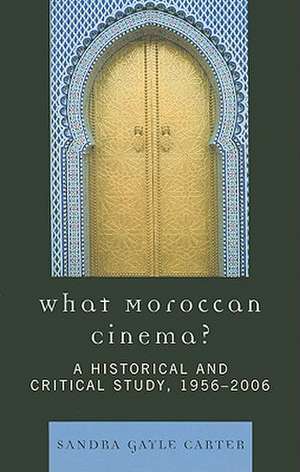
What Moroccan Cinema?: A Historical and Critical Study, 1956D2006: After the Empire: The Francophone World and Postcolonial France
Autor Sandra Gayle Carteren Limba Engleză Hardback – 13 aug 2009
Focusing on Moroccan history and institutions relative to the cinema industry such as television, newspaper criticism, and Berber videomaking, What Moroccan Cinema? is an intriguing study of the ways in which three historical periods shaped the Moroccan cinema industry. Carter provides an insightful and thorough treatment of the cinema institution, discussing exhibition and distribution, censorship, and cinema clubs and caravans. Carter grounds her analysis by exploring representative films of each respective era. The groundbreaking analysis offered in What Moroccan Cinema? will prove especially valuable to those in film and Middle Eastern studies.
Din seria After the Empire: The Francophone World and Postcolonial France
- 22%
 Preț: 375.48 lei
 - 29%
 Preț: 342.63 lei
 - 29%
 Preț: 343.67 lei
 - 35%
 Preț: 594.01 lei
 - 35%
 Preț: 594.73 lei
 - 29%
 Preț: 343.67 lei
 - 31%
 Preț: 529.40 lei
 - 25%
 Preț: 306.46 lei
 - 23%
 Preț: 335.60 lei
 - 35%
 Preț: 594.56 lei
 - 29%
 Preț: 561.12 lei
 - 26%
 Preț: 592.68 lei
 - 23%
 Preț: 320.82 lei
 - 24%
 Preț: 318.74 lei
 - 23%
 Preț: 321.63 lei
 - 30%
 Preț: 505.39 lei
 - 36%
 Preț: 565.57 lei
 - 29%
 Preț: 345.51 lei
 - 30%
 Preț: 564.34 lei
 - 29%
 Preț: 346.12 lei
 - 35%
 Preț: 594.73 lei
 - 29%
 Preț: 341.92 lei
 - 34%
 Preț: 568.23 lei
 - 33%
 Preț: 594.98 lei
 - 29%
 Preț: 342.93 lei
 - 23%
 Preț: 322.99 lei
 - 34%
 Preț: 552.85 lei
 - 22%
 Preț: 326.24 lei
 - 14%
 Preț: 633.75 lei
 - 35%
 Preț: 593.23 lei
 - 23%
 Preț: 319.28 lei
 - 23%
 Preț: 321.15 lei
 - 22%
 Preț: 327.05 lei
 - 34%
 Preț: 568.84 lei
 - 25%
 Preț: 306.14 lei
 - 34%
 Preț: 608.79 lei
 - 36%
 Preț: 679.02 lei
 - 29%
 Preț: 344.06 lei
 - 23%
 Preț: 335.38 lei
Preț: 807.77 lei
Preț vechi: 1244.96 lei
-35%
Puncte Express: 1212
Carte tipărită la comandă
Livrare economică 28 noiembrie-12 decembrie
Livrare prin curier în România Termenul estimat este afișat lângă disponibilitate.
Transport gratuit pentru acest produs Plată online sau ramburs, în funcție de opțiunile comenzii.
Retur gratuit în 14 zile Comandă securizată și suport în română.
Specificații
ISBN-13: 9780739131855
ISBN-10: 0739131850
Pagini: 379
Dimensiuni: 163 x 240 x 29 mm
Greutate: 0.7 kg
Editura: Bloomsbury Publishing
Colecția Lexington Books
Seria After the Empire: The Francophone World and Postcolonial France
Locul publicării:New York, United States
ISBN-10: 0739131850
Pagini: 379
Dimensiuni: 163 x 240 x 29 mm
Greutate: 0.7 kg
Editura: Bloomsbury Publishing
Colecția Lexington Books
Seria After the Empire: The Francophone World and Postcolonial France
Locul publicării:New York, United States
Cuprins
Chapter 1 Introduction
Chapter 2 Chapter 1: Laying the Industry Foundations, 1956-1970
Chapter 3 Chapter 2: Looking to Define a Moroccan Aesthetic, 1971-1985
Chapter 4 Chapter 3: New Developments, New Audiences, 1986-2006
Chapter 5 Chapter 4: Recent Developments, Themes and Conclusions
Chapter 2 Chapter 1: Laying the Industry Foundations, 1956-1970
Chapter 3 Chapter 2: Looking to Define a Moroccan Aesthetic, 1971-1985
Chapter 4 Chapter 3: New Developments, New Audiences, 1986-2006
Chapter 5 Chapter 4: Recent Developments, Themes and Conclusions
Recenzii
It is a relief that at last Sandra Gayle Carter's magisterial and multi-dimensional work on Moroccan cinema is now available to film scholars, to media and cultural studies specialists, and to experts on Morocco and the contemporary 'Middle East'. History, political economy, textual analyses of numerous movies, global cinema influences from France, Egypt, Hollywood, Bollywood, Hong Kong: all are woven into this study. As are Morocco's shifting cultural geographies, from the marginalized forty-five percent of its Berber citizens, to the fifty percent of its population under twenty, to the thirty percent who live in one city, Casablanca. This book definitively raises the bar for studies of national cinemas.
This is a finely-wrought study of Moroccan cinema - one of the most important in the Arab world, arguably second only to Egypt's. Situating her work within the field of cultural studies, Sandra Gayle Carter's historical perspective is based on a close analysis of written and visual material in the Moroccan film archives. She brings this to bear on the origins of filmmaking during French colonial rule and then, in the body of her book, on the first five decades of Moroccan independence(1956-2006). As she engages in a detailed and comprehensive assessment of the institutional structure of Moroccan cinema and provides clear-headed interpretations of a number of key Moroccan films, Carter ends with some suggestive remarks about the future of Moroccan cinema, both thematically and with regard to the role of cinema in Moroccan society.
Highly recommended.
[Sandra Gayle Carter 's] magnificent book What Moroccan Cinema?: A Historical and Critical Study, 1956-2006 draws on a huge amount of research to give readers a rich context for understanding Moroccan cinema in its first 50 years since independence. Carter provides a model for just what it would take to comprehend films from this nation without reducing out questions of funding, audience, changing social history, and the media worlds within which cinema always operates. And she does so without neglecting to provide readings of a substantial number of individual films along the way, regularly juxtaposing discussion of the film text with its reception and financial fate. Her comprehensive study is an invaluable resource for those who want to understand both individual Moroccan films in their historical context, and for those interested in the larger question of the place of Moroccan cultural production (including film, videos, media and ? by extension ? literature) in Moroccan society....Carter is anexcellent guide for helping us to understand the multiple registers within which the dynamic and ever changing Moroccan cinema has operated and continues to operate as Moroccan art and society continue to change. She has done Middle East and North Africa
This is a substantial work that brings new light to the topic of Moroccan cinema. Carter has done an incredible amount of research into its history-covering a 50 year span-while also defining the major relevant issues and arguments.
The author's attention to detail is particularly successful. This attention to background information and the accompanying extensive footnotes ensures the readers realize the complexity of the study and understand how challenging it is to analyze Moroccan cinema as so many factors have to be taken into consideration.. Overall, a successful and fascinating text about the current state and even more so the history of Moroccan cinema.
Sandra Gayle Carter's book fills a void in the publication market dedicated to Moroccan's film history. She opens a door to one of the thus far mostly overlooked film industries. Carter's cultural studies' approach to her work is very important for reader positioning because it explains the content as well as the representation of said subject matter throughout the book..Throughout the introduction as well as the chapters, the author's attention to detail is particularly successful. This attention to background information and the accompanying extensive footnotes ensures the readers realize the complexity of the study and understand how challenging it is to analyze the Moroccan cinema..Overall, a successful and fascinating text about the current state and even more so the history of Moroccan cinema.
This is a finely-wrought study of Moroccan cinema - one of the most important in the Arab world, arguably second only to Egypt's. Situating her work within the field of cultural studies, Sandra Gayle Carter's historical perspective is based on a close analysis of written and visual material in the Moroccan film archives. She brings this to bear on the origins of filmmaking during French colonial rule and then, in the body of her book, on the first five decades of Moroccan independence(1956-2006). As she engages in a detailed and comprehensive assessment of the institutional structure of Moroccan cinema and provides clear-headed interpretations of a number of key Moroccan films, Carter ends with some suggestive remarks about the future of Moroccan cinema, both thematically and with regard to the role of cinema in Moroccan society.
Highly recommended.
[Sandra Gayle Carter 's] magnificent book What Moroccan Cinema?: A Historical and Critical Study, 1956-2006 draws on a huge amount of research to give readers a rich context for understanding Moroccan cinema in its first 50 years since independence. Carter provides a model for just what it would take to comprehend films from this nation without reducing out questions of funding, audience, changing social history, and the media worlds within which cinema always operates. And she does so without neglecting to provide readings of a substantial number of individual films along the way, regularly juxtaposing discussion of the film text with its reception and financial fate. Her comprehensive study is an invaluable resource for those who want to understand both individual Moroccan films in their historical context, and for those interested in the larger question of the place of Moroccan cultural production (including film, videos, media and ? by extension ? literature) in Moroccan society....Carter is anexcellent guide for helping us to understand the multiple registers within which the dynamic and ever changing Moroccan cinema has operated and continues to operate as Moroccan art and society continue to change. She has done Middle East and North Africa
This is a substantial work that brings new light to the topic of Moroccan cinema. Carter has done an incredible amount of research into its history-covering a 50 year span-while also defining the major relevant issues and arguments.
The author's attention to detail is particularly successful. This attention to background information and the accompanying extensive footnotes ensures the readers realize the complexity of the study and understand how challenging it is to analyze Moroccan cinema as so many factors have to be taken into consideration.. Overall, a successful and fascinating text about the current state and even more so the history of Moroccan cinema.
Sandra Gayle Carter's book fills a void in the publication market dedicated to Moroccan's film history. She opens a door to one of the thus far mostly overlooked film industries. Carter's cultural studies' approach to her work is very important for reader positioning because it explains the content as well as the representation of said subject matter throughout the book..Throughout the introduction as well as the chapters, the author's attention to detail is particularly successful. This attention to background information and the accompanying extensive footnotes ensures the readers realize the complexity of the study and understand how challenging it is to analyze the Moroccan cinema..Overall, a successful and fascinating text about the current state and even more so the history of Moroccan cinema.