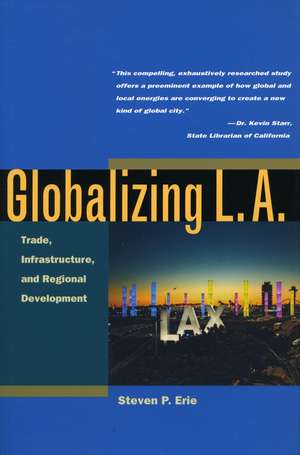
Globalizing L.A.: Trade, Infrastructure, and Regional Development
Autor Steven Erieen Limba Engleză Paperback – 24 feb 2004
Subliniem de la început că Globalizing L.A. se distanțează radical de teoriile economice convenționale care pun accent exclusiv pe fluxurile de informații sau capitalul social. În timp ce majoritatea analizelor moderne se concentrează pe active imateriale, Steven Erie demonstrează autoritar că succesul global al Los Angeles-ului a fost clădit pe beton, oțel și viziune politică strategică. Dacă The Rise and Fall of Urban Economies v-a oferit cadrul teoretic al disparităților economice regionale, această lucrare oferă instrumentele practice și studiile de caz istorice care explică transformarea unei metropole situate la 20 de mile de coastă, fără port natural, în cel mai mare centru comercial al Statelor Unite.
Notăm cu interes modul în care autorul analizează evoluția regiunii prin prisma infrastructurii ca motor catalitic. De la disputele feroviare de la sfârșitul secolului al XIX-lea până la implementarea coridorului Alameda și a proiectelor transfrontaliere NAFTA, textul dezvăluie o istorie a antreprenoriatului public. Credem că valoarea adăugată a acestei cărți rezidă în demitizarea ideii de creștere organică, arătând cum instituțiile politice locale au funcționat ca un „oraș-stat” pentru a asigura supremația în Pacific Rim. Această abordare continuă temele explorate de Steven Erie în Beyond Chinatown, unde analiza resursele de apă ca fundament al puterii economice, însă aici perspectiva se extinde asupra întregului aparat de transport și logistică.
Structura narativă este una riguroasă, alternând analiza istorică cu politicile publice contemporane. Cititorul va înțelege nu doar cum s-a construit trecutul, ci și de ce actualele bariere de mediu și cerințele de securitate post-9/11 reprezintă provocări existențiale pentru modelul de dezvoltare al Californiei de Sud. Este o lectură esențială pentru cei care doresc să înțeleagă mecanismele reale, adesea invizibile, din spatele globalizării urbane.
Preț: 211.04 lei
Carte disponibilă
Livrare economică 02-16 noiembrie
Specificații
ISBN-10: 0804746818
Pagini: 336
Dimensiuni: 152 x 229 x 23 mm
Greutate: 0.45 kg
Ediția:1
Editura: Stanford University Press
Colecția Stanford University Press
V-ar putea interesa
-
 The Third PillarRaghuram RajanPreț: 106.35 lei
 -
 The New Geography of InnovationMehran GulPreț: 123.61 lei
 -
 Preț: 224.52 lei
 -
 Preț: 370.66 lei
 -
 Triumph of the CityEdward Glaeser-43%Preț: 53.27 lei93.51 lei
 -
 City at the Edge of ForeverPeter LunenfeldPreț: 116.86 lei
 -
 The New Geography of JobsEnrico MorettiPreț: 111.58 lei
 -
 Shared Prosperity in a Fractured WorldDani RodrikPreț: 165.98 lei
 -
 Preț: 414.84 lei
 -
 Regional Policy in the Southern African Development CommunityJ. Ernst DrewesPreț: 406.76 lei
 -
 The Travels of a T-Shirt in the Global EconomyPietra RivoliPreț: 130.70 lei
 -
 -26%Preț: 99.39 lei135.09 lei
 -
 Violent Saviours: The West, the Rest, and Capitalism Without ConsentWilliam Easterly-25%Preț: 101.94 lei136.36 lei
 -
 -26%Preț: 91.09 lei123.01 lei
 -
 -8%Preț: 489.83 lei532.42 lei
 -
 Preț: 84.26 lei
 -
 City of QuartzMike DavisPreț: 102.15 lei
 -
 -18%Preț: 142.14 lei173.27 lei
 -
 Doom LoopEswar S. PrasadPreț: 185.03 lei
 -
 Los Angeles. Portrait of a CityDavid L. Ulin-8%Preț: 470.77 lei511.71 lei
De ce să citești această carte
Recomandăm această carte profesioniștilor din administrație publică și studenților la economie care vor să înțeleagă cum se construiește competitivitatea regională. Veți câștiga o perspectivă clară asupra importanței infrastructurii fizice și a instituțiilor locale în succesul economic. Este un studiu de caz magistral despre cum deciziile politice și investițiile masive în porturi și aeroporturi pot transforma geografia și pot propulsa un oraș pe scena mondială.
Despre autor
Steven Erie este un reputat specialist în politici publice și studii urbane, cunoscut pentru analizele sale profunde asupra dezvoltării Californiei. În opera sa, care include titluri precum Paradise Plundered și Beyond Chinatown, el explorează intersecția dintre guvernare, infrastructură și economie. Lucrările sale sunt recunoscute pentru modul în care documentează rolul agențiilor publice și al liderilor antreprenoriali în modelarea marilor metropole. Prin Globalizing L.A., Erie își consolidează poziția de expert în înțelegerea mecanismelor care transformă regiunile în noduri logistice globale.
Descriere scurtă
Beginning with the fierce battles over railroad and harbor development in the late nineteenth century, Erie chronicles L.A.'s emergence as the nation's leading trade center and gateway to the Pacific Rim in the twentieth century. The book explores recent epic battles over port development, the expansion of LAX, the landmark Alameda Corridor rail link, and implementing NAFTA border-infrastructure projects.
Until the 1990s, the book argues, L.A. behaved much like a city-state where powerful, semi-autonomous development bureaucracies and entrepreneurial leaders provided the farsighted strategic planning that made these infrastructure projects possible. Today, Southern California faces daunting challenges, from community and environmental resistance to new post-9/11 security concerns, which will affect its future development and global competitiveness.
More Praise for Globalizing L.A.
"A significant new contribution to the study of urban development. . . . This book will change the way we think about Los Angeles and Southern California. . . . It is the next great book on the region."—David Perry, Director and Professor, Great Cities Institute University of Illinois at Chicago
Recenzii
"This is the first major study of L.A.'s trade infrastructure and goes far beyond earlier books on L.A. It will add significantly to the existing literature on urbanization, the impact of globalization on local communities, the emergence of economic regions or city-states, and the history of the Los Angeles region itself."—Earl Fry, Brigham Young University
"[A] fascinating history of the Los Angeles region's great assets and the forces that that drove their development. . . . One hundred years ago, it was improbable that the Los Angeles region would become the 10th largest economy in the world. In Globalizing L.A., Erie explains how that happened and then, fingers crossed, offers lessons on how California's largest and most diverse city and region can keep playing a leading role."—Los Angeles Times
"Erie has built a potent political-economy of urban development that recognizes the crucial role of the public sector in mediating globalizing processed . . . . and this is a valuable lesson for academics, dockworkers, community developers, and environmental activists alike."—Economic Geography
"This book adds invaluably to knowledge of the regional governance and development, foretelling which places will become smart cities and which will be ghost towns."—San Diego Daily Transcript
"Referencing an impressive body of recent academic research, Erie argues that world-class seaport and airport facilities confer substantial economic advantages and more facilitating links between local businesses and the global economy."—The Sacramento Bee
Notă biografică
Textul de pe ultima copertă
“Steven Erie provides a distinctive and persuasive analysis of political strategies that have been central to shaping the growth of the complex Los Angeles region. The book should be of much interest to scholars who are concerned with the development of the L.A. region and the role of semi-autonomous governments in the United States and beyond.”—Jameson Doig, Princeton University