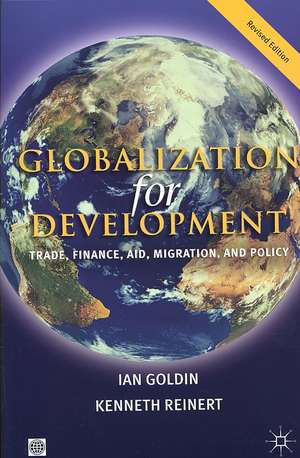
Globalization for Development
Autor Ian Goldin, Kenneth Reinerten Limba Engleză Paperback – 23 mai 2007
Preț: 316.44 lei
Puncte Express: 475
Carte tipărită la comandă
Livrare economică 27 noiembrie-11 decembrie
Livrare prin curier în România Termenul estimat este afișat lângă disponibilitate.
Transport gratuit de la 400.00 lei Plată online sau ramburs, în funcție de opțiunile comenzii.
Retur gratuit în 14 zile Comandă securizată și suport în română.
Specificații
ISBN-13: 9780821369296
ISBN-10: 0821369296
Pagini: 330
Ilustrații: 1
Dimensiuni: 165 x 229 x 20 mm
Greutate: 0.52 kg
Ediția:Revised
Editura: World Bank Publications
Locul publicării:London, United Kingdom
ISBN-10: 0821369296
Pagini: 330
Ilustrații: 1
Dimensiuni: 165 x 229 x 20 mm
Greutate: 0.52 kg
Ediția:Revised
Editura: World Bank Publications
Locul publicării:London, United Kingdom
V-ar putea interesa
-
 Governing Globalization: Issues and InstitutionsDeepak Nayyar-28%Preț: 454.43 lei632.78 lei
 -
 The Economics of Sustainable DevelopmentAaron HalpernPreț: 364.72 lei
 -
 Preț: 407.09 lei
 -
 The Globalization of InequalityFrancois BourguignonPreț: 212.93 lei
 -
 Minor TransnationalismFrançoise LionnetPreț: 286.51 lei
 -
 Preț: 570.55 lei
 -
 Global Civilization in the 21st CenturyAndrew Targowski-27%Preț: 945.76 lei1287.53 lei
 -
 Bibliodiversity: A Manifesto for Independent PublishingSusan Hawthorne-12%Preț: 86.48 lei97.88 lei
 -
 Preț: 429.16 lei
 -
 Preț: 163.39 lei
 -
 The World Is Not for SaleJose BovePreț: 97.58 lei
 -
 -23%Preț: 228.32 lei297.21 lei
Cuprins
Foreword Preface Background and Context Globalization and Poverty Trade Capital Flows Foreign Aid Migration Ideas Towards a Policy Agenda
Notă biografică
IAN GOLDIN, PhD (Oxford University), is Director of the University of Oxford James Martin 21st Century School and a Professorial Fellow at Balliol College, University of Oxford. From 2003 to August 2006 he was Vice President at the World Bank. Previously, he was Director of Development Policy at the World Bank. Prior to rejoining the Bank in February 2001, Dr. Goldin spent five years as the Chief Executive and Managing Director of the Development Bank of Southern Africa (DBSA). Before this, he worked as a Principal Economist at the European Bank for Reconstruction and Development (EBRD) in London and as Head of the Trade Program at the OECD Development Center in Paris. Dr. Goldin has published 11 books and numerous articles. His research and publications have focused on economic policy, development, and trade. His better known books include: The Economics of Sustainable Development, Open Economies, and Trade Liberalization: Global Economic Implications. KENNETH A. REINERT is currently Associate Professor of Public Policy at George Mason University, where he received a Distinguished Teaching Award in 2003. He has held the positions of Senior International Economist at the U.S. International Trade Commission and Associate Professor of Economics at Kalamazoo College. Professor Reinert has published widely in the areas of international trade, economic development, and environmental policy. He co-edited Applied Methods for Trade Policy Analysis: A Handbook (Cambridge University Press, 1997), authored Windows on the World Economy: An Introduction to International Economics (South-Western Thomson, 2005), and is currently co-editing the Princeton Encyclopedia of the World Economy.
Descriere
Descriere de la o altă ediție sau format:
Globalization and its relation to poverty reduction and development are not well understood. This book explores the ways in which globalization can overcome poverty or make it worse. The book defines the big historical trends, identifies the main globalization processes - trade, finance, aid, migration, and ideas - and examines how each can contribute to economic development. By considering what helps and what does not, the book presents policy recommendations to make globalization more effective as a vehicle for shared growth and poverty reduction. It will be of interest to students, researchers, and anyone concerned with the effects of globalization on international development.
Globalization and its relation to poverty reduction and development are not well understood. This book explores the ways in which globalization can overcome poverty or make it worse. The book defines the big historical trends, identifies the main globalization processes - trade, finance, aid, migration, and ideas - and examines how each can contribute to economic development. By considering what helps and what does not, the book presents policy recommendations to make globalization more effective as a vehicle for shared growth and poverty reduction. It will be of interest to students, researchers, and anyone concerned with the effects of globalization on international development.
Recenzii
This book is essential reading for anyone interested in globalization and development. It provides important new insights and perspectives into how global flows of finance, trade, migrants, and ideas shape development and advances the debate by identifying urgently needed policy changes for a more inclusive globalization.
Globalization may need defense, but it also needs reform. The authors tell us the story so far and go on to propose ways and means of getting to a happier ending. The ways identified, based on fine empirical assessment, certainly deserve our serious attention.
This book cuts through the confusion of many discussions of globalization. In particular, it gives a clear definition in terms of the basic flows that embody interaction among countries, including trade, migration, and so on. This provides a clear analytical framework for analyzing the impact of globalization on development and thus on reducing poverty. It is a first-class piece of work and a 'must-read' for those seeking clarity on one of the great issues of our time.
This book draws on a wealth of cross-country experience and knowledge to demonstrate that globalization has the ability to contribute to poverty alleviation, but only under certain circumstances. As such, it provides invaluable insight to development practitioners and policy makers alike. It contains not only a lucid analytical framework in which to analyze these tradeoffs, but also some invigorating ideas on how globalization can be made to work for the poor. In this, it is a vital area for anyone concerned about a fairer sharing of our communal prosperity.
Ian Goldin has been at the centre of action in the debate on globalization and development for a long time. His collaboration with Ken Reinert on this subject is a must for those who are looking for both courageous conceptual design and practical solutions." "Much has happened since the first edition of this skilful overview of issues in globalization and development. The recent turmoil in the Euro-zone and the world economy make this edition all the more timely.
This analysis goes beyond theory and suggests national and global policies to be adopted in order to address the dire matter of poverty. This well written book convinces readers that globalization can be made to work for the poor and is an essential guide for practitioners in this field.
This is a clearly written and well-planned book focusing on how globalisation can help alleviate povery in the developing world. ... This is therefore a timely book addressing the concerns of those who might have been influenced by some of the more vocal critics in the globalisation movement.
Globalization may need defense, but it also needs reform. The authors tell us the story so far and go on to propose ways and means of getting to a happier ending. The ways identified, based on fine empirical assessment, certainly deserve our serious attention.
This book cuts through the confusion of many discussions of globalization. In particular, it gives a clear definition in terms of the basic flows that embody interaction among countries, including trade, migration, and so on. This provides a clear analytical framework for analyzing the impact of globalization on development and thus on reducing poverty. It is a first-class piece of work and a 'must-read' for those seeking clarity on one of the great issues of our time.
This book draws on a wealth of cross-country experience and knowledge to demonstrate that globalization has the ability to contribute to poverty alleviation, but only under certain circumstances. As such, it provides invaluable insight to development practitioners and policy makers alike. It contains not only a lucid analytical framework in which to analyze these tradeoffs, but also some invigorating ideas on how globalization can be made to work for the poor. In this, it is a vital area for anyone concerned about a fairer sharing of our communal prosperity.
Ian Goldin has been at the centre of action in the debate on globalization and development for a long time. His collaboration with Ken Reinert on this subject is a must for those who are looking for both courageous conceptual design and practical solutions." "Much has happened since the first edition of this skilful overview of issues in globalization and development. The recent turmoil in the Euro-zone and the world economy make this edition all the more timely.
This analysis goes beyond theory and suggests national and global policies to be adopted in order to address the dire matter of poverty. This well written book convinces readers that globalization can be made to work for the poor and is an essential guide for practitioners in this field.
This is a clearly written and well-planned book focusing on how globalisation can help alleviate povery in the developing world. ... This is therefore a timely book addressing the concerns of those who might have been influenced by some of the more vocal critics in the globalisation movement.