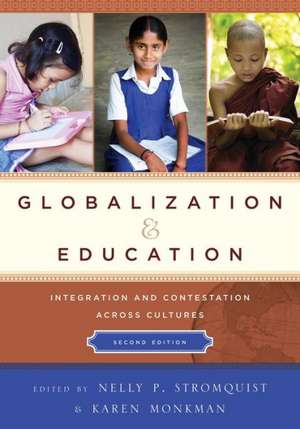
Globalization and Education: Integration and Contestation across Cultures
Editat de Nelly P. Stromquist, Karen Monkmanen Limba Engleză Paperback – 4 mar 2014
The second edition has been thoroughly updated throughout and contains seven new chapters. The expanding interest in the intersection of education and globalization has brought up several new topics, including: the salience of global education policies, notably EFA; the expansion and differentiation of higher education; the emphasis on work-related training; the increasing role of non-state actors such as the transnational corporations; and greater attention to human rights. Also in this new edition is a chapter on qualitative methodologies especially suitable to the understanding of the intersection of globalization and education.
Preț: 456.45 lei
Preț vechi: 645.99 lei
-29%
Puncte Express: 685
Carte tipărită la comandă
Livrare economică 30 noiembrie-14 decembrie
Livrare prin curier în România Termenul estimat este afișat lângă disponibilitate.
Transport gratuit pentru acest produs Plată online sau ramburs, în funcție de opțiunile comenzii.
Retur gratuit în 14 zile Comandă securizată și suport în română.
Specificații
ISBN-13: 9781475805284
ISBN-10: 1475805284
Pagini: 315
Ilustrații: black & white tables
Dimensiuni: 208 x 278 x 22 mm
Greutate: 0.68 kg
Ediția:2nd Edition.
Editura: Bloomsbury Publishing
Colecția R&L Education
Locul publicării:New York, United States
ISBN-10: 1475805284
Pagini: 315
Ilustrații: black & white tables
Dimensiuni: 208 x 278 x 22 mm
Greutate: 0.68 kg
Ediția:2nd Edition.
Editura: Bloomsbury Publishing
Colecția R&L Education
Locul publicării:New York, United States
V-ar putea interesa
-
 The Devil That Danced on the WaterAminatta FornaPreț: 92.49 lei
 -
 Country Of My SkullAntjie Krog-19%Preț: 76.61 lei94.05 lei
 -
 World On FireAmy ChuaPreț: 93.56 lei
 -
 -21%Preț: 282.06 lei355.70 lei
 -
 -28%Preț: 346.93 lei482.89 lei
 -
 -31%Preț: 710.53 lei1030.88 lei
 -
 Understanding Social ExclusionJohn Hills-28%Preț: 392.55 lei547.65 lei
 -
 Governing Globalization: Issues and InstitutionsDeepak Nayyar-28%Preț: 454.43 lei632.78 lei
 -
 Language Rights and Political TheoryWill Kymlicka-28%Preț: 415.04 lei577.10 lei
 -
 Horizontal Inequalities and ConflictF. Stewart-15%Preț: 646.52 lei760.61 lei
 -
 The Other Side of the RiverAlex KotlowitzPreț: 118.45 lei
 -
 Preț: 101.55 lei
 -
 Polite LiesKyoko MoriPreț: 111.85 lei
 -
 The Fire Next TimeJames BaldwinPreț: 83.83 lei
 -
 A New World OrderAnne-Marie SlaughterPreț: 298.12 lei
 -
 Globalisation In World HistoryA. G. Hopkins-31%Preț: 98.06 lei141.19 lei
 -
 -15%Preț: 98.24 lei115.12 lei
 -
 Preț: 256.80 lei
 -
 Minor TransnationalismFrançoise LionnetPreț: 286.51 lei
 -
 Preț: 570.55 lei
 -
 The SAGE Handbook of Intercultural CompetenceDarla K. Deardorff-27%Preț: 1095.68 lei1500.93 lei
 -
 Preț: 163.39 lei
 -
 -43%Preț: 263.89 lei465.59 lei
 -
 The World Is Not for SaleJose BovePreț: 97.58 lei
Cuprins
Preface
Abbreviations & Acronyms
Part I. Conceptual and Methodological Issues
Defining Globalization and Assessing Its Implications, Revisted
Nelly P. Stromquist and Karen MonkmanGlobalization, Educational Change, and the National State
Martin CarnoyGlobalization and Global Governance in Education
Karen Mundy and Caroline ManionThe Productive Plasticity of Rights: Globalization, Education and Human Rights
Monisha Bajaj"The Girl Effect": U.S. Transnational Corporate Investment in Girls' Education
Kathryn Moeller Globalization and Curriculum Inquiry: Performing Transnational Imaginaries
Noel GoughGlobalization and the Social Construction of Reality: Affirming or Unmasking the "Inevitable"?
Catherine A. Odora HoppersStudying Globalization: The Vertical Case Study Approach
Lesley Bartlett and Frances VavrusPart II. Globalization Impacts in Various Educational Sectors
Globalization Responses from European and Australian University Sectors
Jan Currie and Lesley VidovichGlobalization of the Community College Model: Paradox of the Local and the Global Revisited
Rosalind Latiner RabyGrowing Up in the Great Recession: Revisiting the Restructuring of Gender, Schooling, and Work
Peter Kelly and Jane KenwayGlobalization, Adult Education and Development
Shirley WaltersPart III. National Case Studies of Globalization Impacts
Globalization in Japan: Education Policy and Curriculum
Lynne ParmenterGlobal Encounters of the Universal and the Particular in Educational Policies in México 1988-2006
Rosa Nidia BuenfilThe Impacts of Globalization on Education in Malaysia
Molly N. N. LeeThe Consequences of Global Mass Education: Schooling, Work and Well-being in EFA-era Malawi
Nancy Kendall and Rachel SilverGlobalization and Education in Post-Apartheid South Africa: The Narrowing of Education's Purpose
Salim Vally and Carol Anne Spreen "Still Hanging off the Edge": An Australian Case Study of Gender, Universities and Globalization
Jill BlackmoreContributors
Index
Abbreviations & Acronyms
Part I. Conceptual and Methodological Issues
Defining Globalization and Assessing Its Implications, Revisted
Nelly P. Stromquist and Karen MonkmanGlobalization, Educational Change, and the National State
Martin CarnoyGlobalization and Global Governance in Education
Karen Mundy and Caroline ManionThe Productive Plasticity of Rights: Globalization, Education and Human Rights
Monisha Bajaj"The Girl Effect": U.S. Transnational Corporate Investment in Girls' Education
Kathryn Moeller Globalization and Curriculum Inquiry: Performing Transnational Imaginaries
Noel GoughGlobalization and the Social Construction of Reality: Affirming or Unmasking the "Inevitable"?
Catherine A. Odora HoppersStudying Globalization: The Vertical Case Study Approach
Lesley Bartlett and Frances VavrusPart II. Globalization Impacts in Various Educational Sectors
Globalization Responses from European and Australian University Sectors
Jan Currie and Lesley VidovichGlobalization of the Community College Model: Paradox of the Local and the Global Revisited
Rosalind Latiner RabyGrowing Up in the Great Recession: Revisiting the Restructuring of Gender, Schooling, and Work
Peter Kelly and Jane KenwayGlobalization, Adult Education and Development
Shirley WaltersPart III. National Case Studies of Globalization Impacts
Globalization in Japan: Education Policy and Curriculum
Lynne ParmenterGlobal Encounters of the Universal and the Particular in Educational Policies in México 1988-2006
Rosa Nidia BuenfilThe Impacts of Globalization on Education in Malaysia
Molly N. N. LeeThe Consequences of Global Mass Education: Schooling, Work and Well-being in EFA-era Malawi
Nancy Kendall and Rachel SilverGlobalization and Education in Post-Apartheid South Africa: The Narrowing of Education's Purpose
Salim Vally and Carol Anne Spreen "Still Hanging off the Edge": An Australian Case Study of Gender, Universities and Globalization
Jill BlackmoreContributors
Index
Recenzii
This reissue of Globalization and Education is more than just a second edition, since chapters from the first edition (published in 2000) have been substantially updated and several new chapters added. The editors and many of the contributors have been co-operating on this topic for many years; hence, the book reflects a prolonged extensive contemplation about the complexities of the topic, which undoubtedly contributes to the book's depth and scope. Consequently, we have an accurate large volume, primarily from the field of comparative education studies, which explains some of the most relevant attributes and characteristics of the subject of included studies, which also sheds light on actual developments on all levels of education. . . .This multifaceted book presents yet another case of a larger cooperative educational study, which proves that the end of the neoliberal epoch is highly desired and as much as possible projected in the area of education. Recalling the tradition of the Enlightenment, one may say that educators and philosophers are again emphatically encouraged to invent humanity anew.
Nelly P. Stromquist and Karen Monkman have revisited two decades of pedagogical and political debates about the dynamics of the global and the local in education to produce a thorough, lucid, and significant book. The editors assembled a diverse and highly qualified group of scholars that have contributed the most engaging, vivid, and in-depth discussions of key contemporary educational issues, ranging from models of understanding globalization to multiple forms of discrimination occurring in schools, and to ways of inquiring about global processes in different regions of the world. Globalization and Education is a treasure trove of the best research and wise thinking that should find its place in the toolbox of educators and scholars trying to understand how global and local dynamics are changing education in the 21st Century.
The book presents noted scholars who share an actor-driven and network-based understanding of globalization. Rather than seeing globalization as an external, coercive force that turns national and local actors into passive recipients and implementers of international "standards" and "best practices," the contributors disentangle the concept and analyze in fascinating ways what globalization means and does to educational development in different contexts and countries.
I welcome the second edition of Globalization and Education: Integration and Contestation Across Cultures. Stromquist and Monkman put together a brilliant constellation of stars of comparative and international education. This book, written by 21 women and four men is full of ideas, concepts, and solid arguments that help us to better understand the dialectic between local cultures and globalization in its relation with educational systems.
Nelly P. Stromquist and Karen Monkman have revisited two decades of pedagogical and political debates about the dynamics of the global and the local in education to produce a thorough, lucid, and significant book. The editors assembled a diverse and highly qualified group of scholars that have contributed the most engaging, vivid, and in-depth discussions of key contemporary educational issues, ranging from models of understanding globalization to multiple forms of discrimination occurring in schools, and to ways of inquiring about global processes in different regions of the world. Globalization and Education is a treasure trove of the best research and wise thinking that should find its place in the toolbox of educators and scholars trying to understand how global and local dynamics are changing education in the 21st Century.
The book presents noted scholars who share an actor-driven and network-based understanding of globalization. Rather than seeing globalization as an external, coercive force that turns national and local actors into passive recipients and implementers of international "standards" and "best practices," the contributors disentangle the concept and analyze in fascinating ways what globalization means and does to educational development in different contexts and countries.
I welcome the second edition of Globalization and Education: Integration and Contestation Across Cultures. Stromquist and Monkman put together a brilliant constellation of stars of comparative and international education. This book, written by 21 women and four men is full of ideas, concepts, and solid arguments that help us to better understand the dialectic between local cultures and globalization in its relation with educational systems.