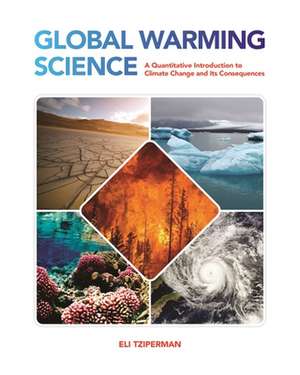
Global Warming Science
Autor Eli Tzipermanen Limba Engleză Paperback – 15 mar 2022
Observăm în volumul Global Warming Science o abordare riguroasă și extrem de pragmatică a unui subiect adesea tratat doar calitativ. Publicată de Princeton University Press, această lucrare se distinge prin transformarea conceptelor teoretice în exerciții de calcul aplicat. Remarcăm structura inovatoare a capitolelor: autorul nu se limitează la descrierea fenomenelor, ci ghidează cititorul prin mecanismele fizice și chimice din spatele încălzirii globale, folosind instrumente matematice accesibile studenților de la nivel de licență. Descoperim aici o integrare rară a tehnologiei în curriculumul de mediu. Fiecare secțiune, de la efectul de seră la dinamica incendiilor de pădure sau a criosferei, este însoțită de „ateliere” practice. Acestea utilizează Jupyter Python notebooks, permițând utilizatorului să interacționeze direct cu datele climatice și să modeleze predicții, o necesitate în știința contemporană. Notăm cu interes faptul că, deși tratează teme complexe precum acidificarea oceanelor sau instabilitatea precipitațiilor, textul rămâne ancorat în ecuații diferențiale simple și reacții chimice de bază. Cititorii familiarizați cu Global Warming de L. D. Danny Harvey vor aprecia trecerea de la prezentarea descriptivă a proceselor climatice la o metodologie „hands-on”, axată pe modelare și analiză de date. În timp ce Climate Change and Climate Modeling de J. David Neelin oferă o bază solidă în modelare, volumul lui Eli Tziperman se remarcă prin aplicabilitatea imediată a exercițiilor propuse și prin resursele digitale care facilitează învățarea activă. Este un instrument pedagogic complet, care elimină bariera dintre teorie și cercetarea climatică reală.
Preț: 402.26 lei
Preț vechi: 467.74 lei
-14%
Carte disponibilă
Livrare economică 07-21 noiembrie
Livrare express 24-30 octombrie pentru 48.44 lei
Specificații
ISBN-10: 0691228795
Pagini: 336
Dimensiuni: 205 x 252 x 15 mm
Greutate: 0.8 kg
Editura: Princeton University Press
V-ar putea interesa
-
 The Story of CO2 Is the Story of EverythingPeter BrannenPreț: 215.16 lei
 -
 Into the Clear Blue SkyRob JacksonPreț: 79.10 lei
 -
 Aquatic Geochemical OceanographyJames W. Murray-7%Preț: 379.29 lei409.32 lei
 -
 What's The Weather?: Clouds, Climate, and Global WarmingFraser Ralston-15%Preț: 76.88 lei90.49 lei
 -
 -18%Preț: 35.61 lei43.20 lei
 -
 Adventures in FermentationJohnny DrainPreț: 166.52 lei
 -
 Ecology for the 21st centuryOrianna Carter-32%Preț: 645.30 lei954.97 lei
 -
 -23%Preț: 674.31 lei875.73 lei
 -
 The Wake of HMS ChallengerGillen D'Arcy WoodPreț: 171.07 lei
 -
 See Inside: Planet Earth: KS 1Katie DaynesPreț: 89.45 lei
 -
 Earth System, TheLee Kump-11%Preț: 655.48 lei736.49 lei
 -
 Statistical Analysis with Python For DummiesJoseph SchmullerPreț: 197.44 lei
 -
 SnoSverker SörlinPreț: 124.75 lei
 -
 SunbirthAn YuPreț: 108.24 lei
 -
 What We Can KnowIan McEwanPreț: 115.91 leiRecomandat
 -
 Preț: 57.23 lei
 -
 Human NatureKate MarvelPreț: 136.91 lei
 -
 Life on a Little-Known PlanetElizabeth KolbertPreț: 193.02 lei
 -
 Heat WavesDalton RainsPreț: 194.99 lei
De ce să citești această carte
Recomandăm această carte studenților și autodidacților care doresc să înțeleagă încălzirea globală dincolo de titlurile știrilor. Câștigul principal este dobândirea capacității de a analiza date reale folosind Python și matematică elementară. Este o resursă esențială pentru cei care caută o bază științifică solidă, transformând cititorul dintr-un observator pasiv într-un analist capabil să evalueze incertitudinile modelelor climatice actuale.
Despre autor
Eli Tziperman este profesor de oceanografie și științe planetare, având o experiență vastă în modelarea sistemelor climatice. Activitatea sa academică se concentrează pe dinamica oceanelor și variabilitatea climatică pe termen lung. În Global Warming Science, autorul își valorifică experiența de la catedră, rafinând materialul în urma cursurilor susținute la nivel universitar. Abordarea sa pune accent pe claritatea matematică și pe utilizarea uneltelor computaționale moderne, reflectând standardele actuale din cercetarea de vârf în domeniul geofizicii.
Descriere scurtă
Notă biografică
Cuprins
- Preface
- 1 OVERVIEW
- 1.1 Workshop
- 2 GREENHOUSE
- 2.1 The greenhouse effect
- 2.1.1 Earth’s energy balance
- 2.1.2 The greenhouse effect: a two-layer model
- 2.1.3 The emission height and lapse rate
- 2.2 Greenhouse gases
- 2.2.1 Wavelength-dependent black-body radiation
- 2.2.2 Energy levels and absorption
- 2.2.3 Broadening
- 2.2.4 Radiative forcing, logarithmic dependence on CO2
- 2.2.5 Other greenhouse gases, global warming potential
- Box 2.1: The Clausius-Clapeyron relation
- 2.2.6 The water vapor feedback
- 2.3 Workshop
- 3 TEMPERATURE
- 3.1 Climate sensitivity and the role of the ocean
- 3.1.1 Equilibrium climate sensitivity
- 3.1.2 Transient climate sensitivity
- 3.2 Polar amplification
- 3.3 “Hiatus” periods
- 3.4 Stratospheric cooling
- 3.4.1 Detection and attribution
- 3.5 Workshop
- 4 SEA LEVEL
- 4.1 Global mean sea level changes
- 4.1.1 Thermal expansion
- Box 4.1: Past warm climates
- 4.1.2 Ice sheets and mountain glaciers
- 4.1.3 Land water storage
- 4.1.4 Detection of anthropogenic climate change in GMSL
- 4.2 Regional sea level changes
- 4.2.1 Atmosphere-ocean interaction
- 4.2.2 Land changes
- 4.2.3 Gravitational effects: sea level fingerprints of melting
- 4.3 Workshop
- 5 OCEAN ACIDIFICATION
- 5.1 Calcium carbonate (CaCO3) dissolution
- Box 5.1: The carbon cycle
- 5.2 The carbonate system
- 5.2.1 Carbonate system equations
- 5.2.2 Approximate solution of the carbonate system
- 5.3 Response to perturbations
- 5.3.1 Response to increased atmospheric CO2 concentration
- 5.3.2 Response to warming
- 5.3.3 Long-term decline of anthropogenic CO2
- 5.4 Workshop
- 6 OCEAN CIRCULATION
- Box 6.1: Ocean temperature, salinity, and water masses
- 6.1 Observations and projections
- 6.2 The Stommel model
- 6.3 Multiple equilibria, tipping points, hysteresis
- 6.4 Keeping it simple
- 6.5 Consequences of AMOC collapse
- 6.6 The oceans and global warming
- 6.7 Workshop
- 7 CLOUDS
- 7.1 Cloud fundamentals
- 7.2 Moist convection and cloud formation
- 7.3 Cloud microphysics
- 7.4 Cloud feedbacks and climate uncertainty
- 7.5 Workshop
- 8 HURRICANES
- 8.1 Factors affecting hurricane magnitude
- 8.2 Potential intensity
- Box 8.1: El Niño, La Niña
- 8.3 Observed changes to hurricane activity
- 8.4 Workshop
- 9 ARCTIC SEA ICE
- 9.1 Processes and feedbacks
- 9.2 Detection of climate change
- 9.3 Future projections
- 9.4 Workshop
- 10 GREENLAND AND ANTARCTICA
- 10.1 Terminology
- 10.2 Processes
- 10.2.1 Accumulation
- 10.2.2 Surface melting and PDD
- 10.2.3 Calving
- 10.2.4 Ice flow
- 10.2.5 Basal hydrology
- Box 10.1: Ice ages
- 10.3 Observed trends and projections
- 10.4 Workshop
- 11 MOUNTAIN GLACIERS
- 11.1 Observed retreat
- 11.2 Mountain glaciers as a climate indicator
- 11.2.1 Reconstructing temperature from glacier extent
- 11.2.2 Ice cores from mountain glaciers
- 11.3 Glacier dynamics
- 11.4 Mountain glacier retreat in perspective
- 11.5 Workshop
- 12 DROUGHTS AND PRECIPITATION
- 12.1 Relevant processes and terms
- 12.2 Why droughts happen, climate teleconnections
- Box 12.1: The Indian Ocean dipole
- 12.3 Detection of climate change
- 12.4 Observations, paleo proxy data
- 12.5 Example projections: Southwest United States and the Sahel
- 12.6 Understanding precipitation trends
- 12.6.1 Hadley cell expansion and weakening
- 12.6.2 “Wet getting wetter, dry getting drier” projections
- 12.6.3 Precipitation extremes in a warmer climate
- 12.7 A bucket model for soil moisture
- 12.8 Workshop
- 13 HEAT WAVES
- 13.1 Physical processes
- 13.2 Heat stress
- 13.3 Future projections
- 13.4 Workshop
- 14 FOREST FIRES
- 14.1 Tools
- 14.2 Detection of burnt area due to ACC
- 14.3 Fires and natural climate variability
- 14.4 Observed global trends and future projections
- 14.5 Workshop
- Notes
- Bibliography
- Index
- 4.1 Global mean sea level changes
- 3.1 Climate sensitivity and the role of the ocean
- 2.1 The greenhouse effect