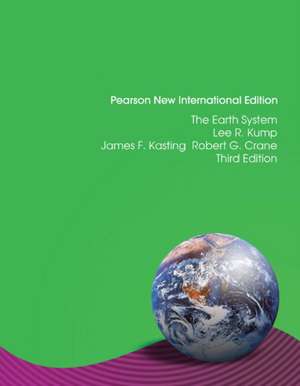
Earth System, The
Autor Lee Kump, Lee R. Kump, James F. Kasting, Robert G. Craneen Limba Engleză Paperback – 23 iul 2013
Reținem că The Earth System nu este doar un manual de geologie tradițională, ci o analiză interdisciplinară care tratează planeta ca un mecanism unitar. Încă din capitolul dedicat modelului Daisyworld, autorii Lee Kump, James F. Kasting și Robert G. Crane introduc cititorul în teoria sistemelor, explicând cum interacțiunile dintre biosferă și mediul fizic mențin condițiile necesare vieții. Această a treia ediție se distinge prin rigoarea datelor cantitative, oferind o bază științifică solidă pentru înțelegerea schimbărilor climatice contemporane. Structura volumului urmează o progresie logică, pornind de la mecanismele fizice fundamentale — cum ar fi efectul de seră, circulația atmosferică și oceanică — către procesele biologice și geologice pe termen lung, precum tectonica plăcilor și reciclarea elementelor. Ultimele capitole sunt dedicate în mod specific impactului uman, analizând dovezile științifice ale încălzirii globale și diminuarea stratului de ozon. Cititorii familiarizați cu Geosystems: An Introduction to Physical Geogra de Ginger Birkeland vor aprecia aici accentul pus pe evoluția istorică a sistemului terestru; în timp ce volumul lui Birkeland se concentrează pe geografia fizică actuală, The Earth System integrează lecțiile trecutului geologic pentru a proiecta scenarii viitoare. Credem că forța acestui text rezidă în capacitatea de a conecta discipline precum biologia, chimia și fizica sub umbrela științei sistemelor terestre. Spre deosebire de An Introduction to the Earth-Life System de Charles Cockell, care este conceput pentru un singur semestru, lucrarea de față oferă o profunzime sporită asupra mecanismelor de feedback care reglează stabilitatea climatică a Pământului în comparație cu alte planete similare.
Preț: 655.48 lei
Preț vechi: 736.49 lei
-11%
Carte disponibilă
Livrare economică 05-19 noiembrie
Livrare express 21-27 octombrie pentru 58.77 lei
Specificații
ISBN-10: 1292021632
Pagini: 466
Dimensiuni: 216 x 276 x 26 mm
Greutate: 1.15 kg
Ediția:3. Auflage
Editura: Pearson
V-ar putea interesa
-
 -20%Preț: 57.12 lei71.12 lei
 -
 Fundamental Processes in Ecology: An Earth Systems ApproachDavid M. Wilkinson-21%Preț: 293.37 lei370.30 lei
 -
 Climate: A Very Short IntroductionMark Maslin-21%Preț: 55.29 lei69.84 lei
 -
 How the Earth Works: Discover How Plate Tectonics Shapes Our PlanetLucia Dr Perez Diaz-16%Preț: 103.81 lei124.14 lei
 -
 -13%Preț: 131.16 lei151.45 lei
 -
 A Little History of the EarthJamie WoodwardPreț: 151.60 lei
 -
 The Earth SystemLee R. Kump-23%Preț: 1277.98 lei1659.71 lei
 -
 Physical Geography: The BasicsJoseph HoldenPreț: 164.05 lei
 -
 -23%Preț: 674.31 lei875.73 lei
 -
 OriginsRon RedfernPreț: 355.07 lei
 -
 Ends of the EarthNeil ShubinPreț: 158.97 lei
 -
 Birkeland, G: Geosystems: An Introduction to Physical GeograGinger Birkeland-11%Preț: 682.18 lei766.50 lei
 -
 Understanding Earth (International Edition)John Grotzinger-38%Preț: 505.96 lei811.07 lei
 -
 The Burning EarthSunil AmrithPreț: 103.36 lei
 -
 Remote Sensing and Global Environmental ChangeSam J. Purkis-19%Preț: 445.23 lei549.67 lei
 -
 Earth System HistorySteven M. Stanley-11%Preț: 387.92 lei435.86 lei
 -
 SnoSverker SörlinPreț: 124.75 lei
 -
 Earth Systems and EnvironmentAmrita Pandey-23%Preț: 1101.01 lei1429.88 lei
 -
 Human NatureKate MarvelPreț: 136.91 lei
 -
 Life on a Little-Known PlanetElizabeth KolbertPreț: 193.02 lei
De ce să citești această carte
Recomandăm această carte studenților și profesioniștilor din domeniul științelor mediului care caută o înțelegere sistemică a planetei. Cititorul câștigă o perspectivă clară asupra modului în care procesele naturale și activitatea umană interacționează, beneficiind de un aparat matematic și analitic modern. Este un instrument esențial pentru a înțelege fundamentul științific al provocărilor ecologice actuale.
Despre autor
Lee Kump este un cercetător proeminent în domeniul biogeochimiei, ocupând funcția de decan al College of Earth and Mineral Sciences la Pennsylvania State University. Expertiza sa în istoria oceanelor și a atmosferei este completată de colaborarea cu James F. Kasting, un specialist recunoscut în evoluția atmosferei terestre și habitabilitatea planetară, și Robert G. Crane, expert în climatologie și teledetecție. Împreună, autorii aduc o viziune integrată asupra modului în care Pământul a evoluat ca sistem biologic și geologic, fiind autorități citate frecvent în literatura de specialitate privind schimbările climatice globale.
Descriere scurtă
The first textbook of its kind that addresses the issues of global change from a true Earth systems perspective, The Earth System offers a solid emphasis on lessons from Earth's history that may guide decision-making in the future. It is more rigorous and quantitative than traditional Earth science books, while remaining appropriate for non-science majors.
Notă biografică
ACADEMIC HONORS AND AWARDS Summa Cum Laude - Harvard (1975) Atmospheric, Oceanic, and Space Sciences Department (University of Michigan) Distinguished Alumni Award (1992) American Geophysical Union (Fellow, 2004) American Association for the Advancement of Science (Fellow, 1995) International Society for the Study of the Origin of Life (Fellow, 2002) Geochemical Society (Fellow, 2008) Faculty Scholar Award, Penn State University (2005)Dr. Robert Crane received his bachelor's degree in physical geography from the University of Reading, England, in 1976. He did graduate work in polar climatology, microwave remote sensing, and sea ice-atmosphere interactions at the University of Colorado's Institute for Arctic and Alpine Research (INSTAAR) and the National Snow and Ice Data Center, receiving a Master's degree in 1978 and a Ph.D. in 1981. As a Research Associate in the Cooperative Institute for Research in Environmental Sciences (CIRES), he continued his work on the microwave remote sensing of sea ice. Subsequently, Dr. Crane spent a year as a visiting professor at the University of Saskatchewan. He joined the faculty of the Pennsylvania State University in 1985. Dr. Crane held a joint appointment in the Department of Geography and in the Earth System Science Center from 1985 to 1993, serving as Associate Director of the Center from 1990 to 1993. He was appointed Associate Dean for Education in the College of Earth and Mineral Sciences in 1993, and currently holds the position of Associate Dean and Professor of Geography. Hi
Cuprins
1. Global Change 2. Daisyworld: An Introduction to Systems 3. Global Energy Balance: The Greenhouse Effect 4. The Atmospheric Circulation System 5. The Circulation of the Oceans 6. The Cryosphere 7. Circulation of the Solid Earth: Plate Tectonics 8. Recycling of the Elements 9. Focus on the Biota: Metabolism, Ecosystems and Biodiversity 10. Origin of the Earth and of Life 11. Effect of Life on the Atmosphere: The Rise of Oxygen and Ozone 12. Long-Term Climate Regulation. 13. Biodiversity Through Earth History. 14. Pleistocene Glaciations. 15. Global Warming, Part 1: The Scientific Evidence. 16. Global Warming, Part 2: Impacts, Adaptation, and Mitigation 17. Ozone Depletion. 18. Human Threats to Biodiversity. 19. Climate Stability on Earth and Earth-Like Planets. Appendix A: Units and Unit Conversions. Appendix B: Temperature Conversions. Appendix C: Periodic Table. Index.