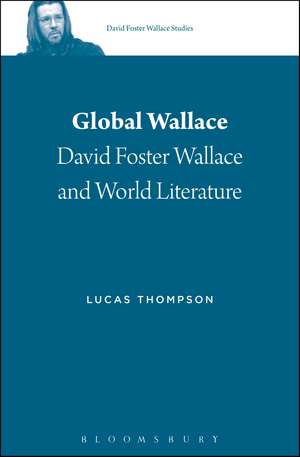
Global Wallace: David Foster Wallace and World Literature: David Foster Wallace Studies
Autor Dr. Lucas Thompsonen Limba Engleză Paperback – 28 iun 2018
Using a wide range of comparative case studies, and drawing on extensive archival research, Global Wallace reveals David Foster Wallace's substantial debts to such unexpected figures as Jamaica Kincaid, Julio Cortázar, Jean Rhys, Octavio Paz, Leo Tolstoy, Zbigniew Herbert, and Albert Camus, among many others. It also offers a more comprehensive account of the key influences that Wallace scholars have already perceived, such as Fyodor Dostoevsky, Franz Kafka, and Manuel Puig. By reassessing Wallace's body of work in relation to five broadly construed geographic territories -- Latin America, Russia, Eastern Europe, France, and Africa -- the book reveals the mechanisms with which Wallace played particular literary traditions off one another, showing how he appropriated vastly different global texts within his own fiction. By expanding the geographic coordinates of Wallace's work in this way, Global Wallace reconceptualizes contemporary American fiction, as being embedded within a global exchange of texts and ideas.

Preț: 256.78 lei
Preț vechi: 304.34 lei
-16%
Puncte Express: 385
Carte tipărită la comandă
Livrare economică 08-22 decembrie
Livrare prin curier în România Termenul estimat este afișat lângă disponibilitate.
Transport gratuit de la 400.00 lei Plată online sau ramburs, în funcție de opțiunile comenzii.
Retur gratuit în 14 zile Comandă securizată și suport în română.
Specificații
ISBN-13: 9781501342707
ISBN-10: 1501342703
Pagini: 286
Dimensiuni: 138 x 214 x 18 mm
Greutate: 0.36 kg
Ediția:NIPPOD
Editura: Bloomsbury Publishing
Colecția Bloomsbury Academic
Seria David Foster Wallace Studies
Locul publicării:New York, United States
ISBN-10: 1501342703
Pagini: 286
Dimensiuni: 138 x 214 x 18 mm
Greutate: 0.36 kg
Ediția:NIPPOD
Editura: Bloomsbury Publishing
Colecția Bloomsbury Academic
Seria David Foster Wallace Studies
Locul publicării:New York, United States
V-ar putea interesa
-
 That Awkward AgeRoger McgoughPreț: 91.49 lei
 -
 The Pre-RaphaelitesDinah Roe-18%Preț: 88.66 lei107.89 lei
 -
 Preț: 79.76 lei
 -
 Fran & LeniSadie Hasler-24%Preț: 86.04 lei112.92 lei
 -
 MainstreamRosaleen McDonagh-24%Preț: 85.60 lei112.67 lei
 -
 Dead FunnyTerry Johnson-24%Preț: 85.03 lei111.33 lei
 -
 In GratitudeJenny Diski-37%Preț: 58.15 lei92.86 lei
 -
 -24%Preț: 93.44 lei123.62 lei
 -
 Rain of Grace: New & Selected PoemsM'Backe, Shaikh Ibrahim Al-JahizzPreț: 125.74 lei
 -
![From Unincorporated Territory [Saina]](https://i1.books-express.ro/bt/9781890650469/from-unincorporated-territory-saina.jpg) From Unincorporated Territory [Saina]Craig Santos PerezPreț: 89.22 lei
From Unincorporated Territory [Saina]Craig Santos PerezPreț: 89.22 lei
Cuprins
Series Editor's Introduction
Acknowledgments
Introduction. Wallace and the World
Chapter One. Wallace and World Literature
Chapter Two. Wallace and Latin America
Chapter Three. Wallace and Russia
Chapter Four. Wallace and Eastern Europe: Kafka and Others
Chapter Five. French Existentialism's Afterlives: Wallace and the Fiction of the U.S. South
Chapter Six. African-American Appropriations: Race, Hip-Hop, and Popular Anthropology
Conclusion. "It's a Small Continent After All"? Wallace and the World
Bibliography
Index
Acknowledgments
Introduction. Wallace and the World
Chapter One. Wallace and World Literature
Chapter Two. Wallace and Latin America
Chapter Three. Wallace and Russia
Chapter Four. Wallace and Eastern Europe: Kafka and Others
Chapter Five. French Existentialism's Afterlives: Wallace and the Fiction of the U.S. South
Chapter Six. African-American Appropriations: Race, Hip-Hop, and Popular Anthropology
Conclusion. "It's a Small Continent After All"? Wallace and the World
Bibliography
Index
Recenzii
When a piece of literary criticism makes you aware at every turn of the substantial limits not just of your knowledge of a subject-one you thought you knew something about-but also of the frameworks in which you think, its worth and importance are blindingly obvious. Such was my experience in reading Lucas Thompson's Global Wallace: David Foster Wallace and World Literature. Its well-researched and wide-ranging attention to Wallace's global influences and intertexts should also be a shot of adrenaline into a Wallace Studies. . Thompson's book is itself a model of diligent criticism-impeccably researched, clearly written and organized, and (increasingly rare in new work on Wallace) appropriately contextualized in the rich network of Wallace criticism that came before it. ... It will prompt critics to bring a variety of new lenses to bear on his fiction and nonfiction, likely generating an abundance of exciting new readings and pathways for readings in classrooms and on the page.
Global Wallace has great merit for turning the notion of Wallace's exceptionalism on its head.
Unique in the growing corpus of Wallace scholarship, Global Wallace convincingly identifies the author as a literary flâneur without disavowing his definite provincialism. Traveling with Wallace on his readerly journeys, Thompson argues for the ways in which this consequential writer, who is so keen on the rich particular, engaged with 'universal truths and themes' that resonate around the world and in otherworldly regions of the United States.
David Foster Wallace may have written books in and about the heart of his country, but his reading took him around the world. We know that he looked to Dostoevsky and Kafka as models, but what about Borges, Cortázar, and Puig? What about Jamaica Kincaid? Or the role of Tolstoy's The Death of Ivan Ilych in "Good Old Neon"? Lucas Thompson's illuminating Global Wallace attends to these and many other influences and intertexts as it mines little-examined parts of Wallace's publications, library, and archive. Thompson also helps us understand Wallace's tricky relationship to race, and he recalibrates our sense of what in Wallace counts as innovation and what as appropriation. This book is a rigorous and lucid argument for greatly expanding the map on which scholars have placed one of our most important writers.
A genuinely novel intervention into the critical landscape. It is a significant addition to the critical body of Wallace Studies.
"Thompson's argument opens up a new way of looking at Wallace both as an isolated author and as part of a vast global literary tradition...[His] rigorous and exhaustive archival work will undoubtedly make Global Wallace an invaluable resource for future Wallace scholars....Thompson's ability to read across a broad constellation of literary influence while also turning his focus inwards, to the very: mechanics of Wallace's writing, produces fascinating insights. In doing so, Thompson provides one of the most comprehensive close analyses of Wallace's style produced to date. No doubt Global Wallace will become a touchstone text for scholars of Wallace new and old."
Global Wallace has great merit for turning the notion of Wallace's exceptionalism on its head.
Unique in the growing corpus of Wallace scholarship, Global Wallace convincingly identifies the author as a literary flâneur without disavowing his definite provincialism. Traveling with Wallace on his readerly journeys, Thompson argues for the ways in which this consequential writer, who is so keen on the rich particular, engaged with 'universal truths and themes' that resonate around the world and in otherworldly regions of the United States.
David Foster Wallace may have written books in and about the heart of his country, but his reading took him around the world. We know that he looked to Dostoevsky and Kafka as models, but what about Borges, Cortázar, and Puig? What about Jamaica Kincaid? Or the role of Tolstoy's The Death of Ivan Ilych in "Good Old Neon"? Lucas Thompson's illuminating Global Wallace attends to these and many other influences and intertexts as it mines little-examined parts of Wallace's publications, library, and archive. Thompson also helps us understand Wallace's tricky relationship to race, and he recalibrates our sense of what in Wallace counts as innovation and what as appropriation. This book is a rigorous and lucid argument for greatly expanding the map on which scholars have placed one of our most important writers.
A genuinely novel intervention into the critical landscape. It is a significant addition to the critical body of Wallace Studies.
"Thompson's argument opens up a new way of looking at Wallace both as an isolated author and as part of a vast global literary tradition...[His] rigorous and exhaustive archival work will undoubtedly make Global Wallace an invaluable resource for future Wallace scholars....Thompson's ability to read across a broad constellation of literary influence while also turning his focus inwards, to the very: mechanics of Wallace's writing, produces fascinating insights. In doing so, Thompson provides one of the most comprehensive close analyses of Wallace's style produced to date. No doubt Global Wallace will become a touchstone text for scholars of Wallace new and old."