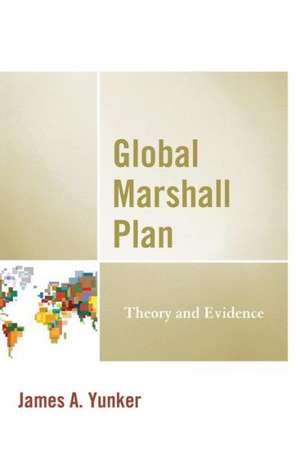
Global Marshall Plan: Theory and Evidence: Lexington Books
Autor James A. Yunkeren Limba Engleză Hardback – 14 aug 2014
Din seria Lexington Books
- 19%
 Preț: 426.72 lei
 - 32%
 Preț: 729.20 lei
 - 59%
 Preț: 427.24 lei
 - 28%
 Preț: 346.74 lei
 - 22%
 Preț: 338.89 lei
 - 23%
 Preț: 321.53 lei
 - 23%
 Preț: 319.79 lei
 - 37%
 Preț: 660.07 lei
 - 22%
 Preț: 341.76 lei
 - 29%
 Preț: 599.98 lei
 - 25%
 Preț: 884.44 lei
 - 26%
 Preț: 362.85 lei
 - 23%
 Preț: 322.75 lei
 - 23%
 Preț: 321.63 lei
 - 24%
 Preț: 308.07 lei
 - 29%
 Preț: 345.71 lei
 - 27%
 Preț: 263.04 lei
 - 33%
 Preț: 710.24 lei
 - 24%
 Preț: 369.89 lei
 - 34%
 Preț: 630.22 lei
 - 36%
 Preț: 730.77 lei
 - 34%
 Preț: 537.45 lei
 - 29%
 Preț: 345.71 lei
 - 33%
 Preț: 358.06 lei
 - 26%
 Preț: 363.28 lei
 - 34%
 Preț: 418.63 lei
 - 29%
 Preț: 342.12 lei
 - 28%
 Preț: 356.18 lei
 - 25%
 Preț: 362.03 lei
 - 22%
 Preț: 340.40 lei
 - 29%
 Preț: 344.18 lei
 - 28%
 Preț: 346.74 lei
 - 24%
 Preț: 309.62 lei
 - 35%
 Preț: 560.77 lei
 - 23%
 Preț: 318.96 lei
 - 23%
 Preț: 321.63 lei
 - 27%
 Preț: 355.41 lei
 - 23%
 Preț: 333.36 lei
 - 24%
 Preț: 313.51 lei
 - 33%
 Preț: 642.37 lei
 - 31%
 Preț: 437.25 lei
 - 34%
 Preț: 575.26 lei
 - 34%
 Preț: 616.07 lei
 - 34%
 Preț: 607.70 lei
 - 33%
 Preț: 639.19 lei
 - 35%
 Preț: 593.04 lei
 - 33%
 Preț: 640.95 lei
Preț: 594.18 lei
Preț vechi: 910.36 lei
-35%
Puncte Express: 891
Carte tipărită la comandă
Livrare economică 30 noiembrie-14 decembrie
Livrare prin curier în România Termenul estimat este afișat lângă disponibilitate.
Transport gratuit pentru acest produs Plată online sau ramburs, în funcție de opțiunile comenzii.
Retur gratuit în 14 zile Comandă securizată și suport în română.
Specificații
ISBN-13: 9780739192306
ISBN-10: 0739192302
Pagini: 198
Dimensiuni: 152 x 229 x 21 mm
Greutate: 0.44 kg
Editura: Bloomsbury Publishing
Colecția Lexington Books
Seria Lexington Books
Locul publicării:New York, United States
ISBN-10: 0739192302
Pagini: 198
Dimensiuni: 152 x 229 x 21 mm
Greutate: 0.44 kg
Editura: Bloomsbury Publishing
Colecția Lexington Books
Seria Lexington Books
Locul publicării:New York, United States
V-ar putea interesa
-
 Preț: 417.18 lei
 -
 Preț: 205.32 lei
 -
 Making Capitalism Fit for SocietyColin CrouchPreț: 187.80 lei
 -
 Fair EconomicsIrene Schoene-28%Preț: 190.32 lei264.82 lei
 -
 An Economic Theory of Greed, Love, Groups, and NetworksPaul FrijtersPreț: 346.70 lei
 -
 -8%Preț: 427.82 lei465.02 lei
 -
 The Theory of Political EconomyW. JevonsPreț: 476.36 lei
 -
 -28%Preț: 259.82 lei358.52 lei
 -
 Seventeen Contradictions and the End of CapitalismDavid Harvey-19%Preț: 75.86 lei93.37 lei
 -
 The Essential KeynesJohn Maynard Keynes-16%Preț: 80.11 lei95.93 lei
 -
 Modeling with Graphs and Finite State AutomataJean-Francois Aubry-9%Preț: 1015.29 lei1115.71 lei
 -
 Manifesto Of The Poor: Solutions Come From BelowFrancisco van der Hoff BoersmaPreț: 41.35 lei
Descriere
Today's foreign aid programs are small-scale because of the widespread belief that they are ineffective. This could be an example of a self-fulfilling prophecy: small scale virtually guarantees ineffectiveness. However, the pervasive contemporary pessimism regarding global economic inequality is most likely unfounded. The research described in this book suggests that a properly designed and sufficiently massive economic development assistance project-a Global Marshall Plan-could tremendously reduce the economic gap between the richest and poorest nations within a 50-year planning period. Enrichment of the poor nations would not entail impoverishment of the rich nations. The actual cost of the GMP program to the populations of the rich nations would be a very slight and virtually unnoticeable reduction in the rate of growth of their living standards.
The model incorporates features suggested by the skeptical literature on foreign aid, and it is shown that if certain key parameter values are sufficiently adverse, the GMP would indeed be ineffective. However, extensive sensitivity analysis demonstrates that the optimistic benchmark results are robust against wide variations in the numerical values of most model parameters. The fundamental policy implication of this research is that only an actual real-world experiment with a Global Marshall Plan could reliably determine whether or not it would be successful.
The model incorporates features suggested by the skeptical literature on foreign aid, and it is shown that if certain key parameter values are sufficiently adverse, the GMP would indeed be ineffective. However, extensive sensitivity analysis demonstrates that the optimistic benchmark results are robust against wide variations in the numerical values of most model parameters. The fundamental policy implication of this research is that only an actual real-world experiment with a Global Marshall Plan could reliably determine whether or not it would be successful.
Cuprins
Contents
1. Global Economic Inequality
, 1
,
Is It a Problem?
, 5
,
Outline of the Study
, 20
,
,
,
2. Foreign Aid: History and Evaluation
, 34
,
Six Decades of Foreign Aid
, 38
,
Research on Foreign Aid
, 51
,
Viewpoints on Foreign Aid
, 59
,
GMP Aspirations
, 66
,
,
,
3. A Global Marshall Plan Model
, 77
,
Theoretical Specification
, 80
,
Numerical Implementation
, 87
,
Validation of the Model
, 97
,
Appendix: Nations in the World Bank Dataset
, 105
,
,
,
4. Application of the GMP Model
, 110
,
Benchmark Policy Simulation
, 113
,
Burden of the GMP
, 125
,
Sensitivity Analysis
, 130
,
,
,
5. Summary and Conclusion
, 140
,
Evaluating the Research
, 145
,
The Implementation Issue
, 160
,
Why a GMP?
, 163
,
,
,
Notes
, 171
,
Index
, 186
,
1. Global Economic Inequality
, 1
,
Is It a Problem?
, 5
,
Outline of the Study
, 20
,
,
,
2. Foreign Aid: History and Evaluation
, 34
,
Six Decades of Foreign Aid
, 38
,
Research on Foreign Aid
, 51
,
Viewpoints on Foreign Aid
, 59
,
GMP Aspirations
, 66
,
,
,
3. A Global Marshall Plan Model
, 77
,
Theoretical Specification
, 80
,
Numerical Implementation
, 87
,
Validation of the Model
, 97
,
Appendix: Nations in the World Bank Dataset
, 105
,
,
,
4. Application of the GMP Model
, 110
,
Benchmark Policy Simulation
, 113
,
Burden of the GMP
, 125
,
Sensitivity Analysis
, 130
,
,
,
5. Summary and Conclusion
, 140
,
Evaluating the Research
, 145
,
The Implementation Issue
, 160
,
Why a GMP?
, 163
,
,
,
Notes
, 171
,
Index
, 186
,
Recenzii
James Yunker's Global Marshall Plan: Theory and Evidence is an important book because the world urgently needs new ideas. The original Marshall Plan worked wonders in Europe after World War II. Although the global situation is different in many respects from the situation back then, a Global Marshall Plan is perhaps our best option for coping with global economic inequality, a problem which the world community has thus far failed to address effectively. Based on a rigorous theoretical and empirical analysis, Yunker makes a convincing case for trying out that option.
The scale of world inequality-within, across, and between nations, genders, and other social groups-is staggering. Unchecked, its onward march harbors the kind of social and political instability few have yet to comprehend. Yet, in much the same way we have done when it comes to tackling the other great ills of our time-war, environmental catastrophe, human insecurity, health pandemics, among others-we have eschewed serious, imaginative, and innovative thinking about how to improve, in more than a marginal way, the lived experiences of much of the world's population. That we can no longer sit on our hands while Rome proverbially burns has been made clear by many. James Yunker is one of the very few brave enough to take world changing ideas seriously, explore their potential, examine their application, and show their capacity to make a dramatic difference to the world in which we live. Brave, passionate, compelling, Yunker's Global Marshall Plan: Theory and Evidence is essential reading for all.
The scale of world inequality-within, across, and between nations, genders, and other social groups-is staggering. Unchecked, its onward march harbors the kind of social and political instability few have yet to comprehend. Yet, in much the same way we have done when it comes to tackling the other great ills of our time-war, environmental catastrophe, human insecurity, health pandemics, among others-we have eschewed serious, imaginative, and innovative thinking about how to improve, in more than a marginal way, the lived experiences of much of the world's population. That we can no longer sit on our hands while Rome proverbially burns has been made clear by many. James Yunker is one of the very few brave enough to take world changing ideas seriously, explore their potential, examine their application, and show their capacity to make a dramatic difference to the world in which we live. Brave, passionate, compelling, Yunker's Global Marshall Plan: Theory and Evidence is essential reading for all.