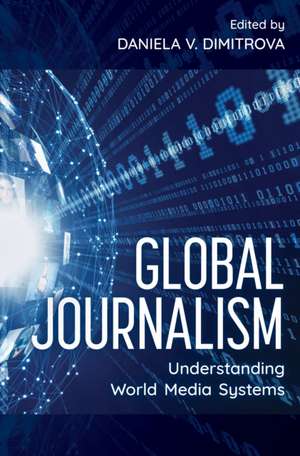
Global Journalism: Understanding World Media Systems
Editat de Daniela V. Dimitrovaen Limba Engleză Paperback – 10 aug 2021
Covering theoretical foundations of global journalism, from the classic Four Theories of the Press to more nuanced media models, this text proposes a framework for studying world media systems. Contributed chapters cover a wide range of topics, including media freedom, global news cultures, professional ethics and responsibilities, and education of global journalists, as well as the role of technology and issues such as fake news, soft power and public diplomacy, foreign news reporting and international news flow.
Visit Globaljournalism.org to access additional class materials, case studies, and multimedia.
| Toate formatele și edițiile | Preț | Express |
|---|---|---|
| Paperback (2) | 296.95 lei 6-8 săpt. | |
| Bloomsbury Publishing – 22 ian 2025 | 296.95 lei 6-8 săpt. | |
| Bloomsbury Publishing – 10 aug 2021 | 375.49 lei 3-5 săpt. | |
| Hardback (1) | 571.49 lei 6-8 săpt. | |
| Bloomsbury Publishing – 22 ian 2025 | 571.49 lei 6-8 săpt. |
Preț: 375.49 lei
Puncte Express: 563
Preț estimativ în valută:
66.39€ • 78.34$ • 58.14£
66.39€ • 78.34$ • 58.14£
Carte disponibilă
Livrare economică 24 martie-07 aprilie
Specificații
ISBN-13: 9781538146859
ISBN-10: 1538146851
Pagini: 232
Ilustrații: 16 b/w illustrations; 1 b/w photos
Dimensiuni: 178 x 256 x 14 mm
Greutate: 0.47 kg
Editura: Bloomsbury Publishing
Colecția Rowman & Littlefield Publishers
Locul publicării:New York, United States
ISBN-10: 1538146851
Pagini: 232
Ilustrații: 16 b/w illustrations; 1 b/w photos
Dimensiuni: 178 x 256 x 14 mm
Greutate: 0.47 kg
Editura: Bloomsbury Publishing
Colecția Rowman & Littlefield Publishers
Locul publicării:New York, United States
V-ar putea interesa
-
 RicochetMary Jo McconahayPreț: 39.59 lei
 -
 Preț: 450.54 lei
 -
 Politics and Web 2.0Gisela GonçalvesPreț: 402.63 lei
 -
 Don't Spoil My Beautiful FaceDavid RobiePreț: 179.71 lei
 -
 How To Successfully Publish Your BookDelroy Constantine-SimmsPreț: 273.34 lei
 -
 Preț: 69.60 lei
 -
 Journaux Et Journalistes. La Presse. La LibertéAlfred SirvenPreț: 182.01 lei
 -
 -12%Preț: 357.83 lei408.59 lei
 -
 Redaktionsmanagement: Ansätze aus Theorie und PraxisMiriam MeckelPreț: 306.08 lei
 -
 Medienjournalismus: Strukturen, Themen, SpannungsfelderUdo Michael KrügerPreț: 338.36 lei
 -
 Die Zeitung zwischen Print und DigitalisierungHans-Jürgen Bucher-15%Preț: 422.08 lei496.56 lei
 -
 Preț: 336.53 lei
 -
 Preț: 80.64 lei
 -
 Preț: 88.33 lei
 -
 Preț: 274.08 lei
 -
 Preț: 231.09 lei
 -
 Preț: 224.18 lei
 -
 Interkulturalität und kulturelle DiversitätAlois MoosmüllerPreț: 233.22 lei
 -
 Preț: 294.51 lei
 -
 Preț: 85.87 lei
Cuprins
List of Figures
Dedication
Acknowledgments
Preface
Contributors
Chapter 1
A Framework for the Study of Global Media Systems, Daniela V. Dimitrova
Part I: KEY CONCEPTS
Chapter 2
International News Flow in the Digital Age, Elad Segev
Chapter 3
Technology's Role in Global Journalism and Communication, H. Denis Wu
Chapter 4
Media Freedom Around the World, Jane Whyatt
Chapter 5
Exploring Journalistic Cultures, Patric Raemy and Lea Hellmueller
Chapter 6
Global Journalism and Mass Communication Education in the Digital Era, Tudor Vlad
Chapter 7
Navigating the Uncharted Waters of Journalism Ethics and Responsibilities in a 21st Century Information Age, Katerina Tsetsura and Dean Kruckeberg
Part II: WORLD REGIONS
Chapter 8
Media in Sub-Saharan Africa, Yusuf Kalyango, Jr.
Chapter 9
Media in the Middle East & North Africa (MENA), Claudia Kozman
Chapter 10
Media in Central & Eastern Europe, Ioana A. Coman and Christopher Karadjov
Chapter 11
Media in Western & Northern Europe, Elisabeth Fondren
Chapter 12
Media in Asia & the Pacific, Nakho Kim
Chapter 13
Media in Latin America, Manuel Alejandro Guerrero
Chapter 14
Media in North America, Zac Gershberg and D. Jasun Carr
Part III: CURRENT ISSUES
Chapter 15
The digital transformation of international and national news agencies: Challenges facing AFP, AP, and TASS, Terhi Rantanen and Anthony Kelly
Chapter 16
Covering International Conflicts and Crises, Raluca Cozma
Chapter 17
Public Diplomacy and International Communication, Suman Lee
Index
Dedication
Acknowledgments
Preface
Contributors
Chapter 1
A Framework for the Study of Global Media Systems, Daniela V. Dimitrova
Part I: KEY CONCEPTS
Chapter 2
International News Flow in the Digital Age, Elad Segev
Chapter 3
Technology's Role in Global Journalism and Communication, H. Denis Wu
Chapter 4
Media Freedom Around the World, Jane Whyatt
Chapter 5
Exploring Journalistic Cultures, Patric Raemy and Lea Hellmueller
Chapter 6
Global Journalism and Mass Communication Education in the Digital Era, Tudor Vlad
Chapter 7
Navigating the Uncharted Waters of Journalism Ethics and Responsibilities in a 21st Century Information Age, Katerina Tsetsura and Dean Kruckeberg
Part II: WORLD REGIONS
Chapter 8
Media in Sub-Saharan Africa, Yusuf Kalyango, Jr.
Chapter 9
Media in the Middle East & North Africa (MENA), Claudia Kozman
Chapter 10
Media in Central & Eastern Europe, Ioana A. Coman and Christopher Karadjov
Chapter 11
Media in Western & Northern Europe, Elisabeth Fondren
Chapter 12
Media in Asia & the Pacific, Nakho Kim
Chapter 13
Media in Latin America, Manuel Alejandro Guerrero
Chapter 14
Media in North America, Zac Gershberg and D. Jasun Carr
Part III: CURRENT ISSUES
Chapter 15
The digital transformation of international and national news agencies: Challenges facing AFP, AP, and TASS, Terhi Rantanen and Anthony Kelly
Chapter 16
Covering International Conflicts and Crises, Raluca Cozma
Chapter 17
Public Diplomacy and International Communication, Suman Lee
Index
Recenzii
The book provides an overview of selected discourses in international journalism research and offers insights into central characteristics of media systems worldwide, and thus complements the corpus of introductory literature quite usefully
The new and more nuanced media model that the book offers relies on synthetizing various media theories and empirical data, which can hopefully help researchers to understand more about the peculiarities of the world's media systems. At the end of each chapter the authors set questions based on their studies, which clearly indicates that this book is not only a textbook for scholars and researchers but it is also an object to trigger the critical thinking of students learning about global journalism and media systems.
At last, here is a global journalism textbook that accounts for the worldwide ascendance of digital platforms and the spread of populism and authoritarianism. What a fantastic collection!
One of the key challenges for journalism research is to identify, map and articulate issues that cut across national boundaries while keeping our eye on local particulars. This book provides an essential roadmap for navigating such a truly global journalism studies.
This excellent volume provides a comprehensive, state-of-the-world examination of global journalism's practices and characteristics. An explication of key concepts and topics is combined with more context-specific perspectives from all regions of the world to provide a multi-perspectival view.
There is no one work that provides the breadth and depth of understanding the technological changes and their impact on all aspects of global journalism as Dimitrova does here. Global Journalism generates a fresh and complex view of timely case studies and theoretical models featured by contributors from 12 different countries. This book will arouse interest and provide a scholarly foundation for understanding world media systems and key issues facing international communication today.
This inspiring book takes the reader on a world tour of journalism practices, touching on theories and current issues that describe, explain and predict the evolution of global journalism cultures from the local perspective. It is a must-read for journalism students in higher education.
A robust and breath-taking look at global journalism practices, this book showcases diverse views from more than 20 global media experts from 12 different countries unpacking pivotal issues snatched from today's headlines. Topics range from the refugee crisis, press freedom to journalism culture, and media ethics. Scholars and students alike benefit from this panorama rooted in the classical theories but fresh with new ideas and insights. Excellent as a textbook it belongs on every global news scholar's shelf.
While conceptions of "global journalism" may be relatively new, journalism has long been globalising in its ambitions to forge communicative networks across national borders. This excellent volume disrupts Western, ethnocentric assumptions in media research, its impressive range of chapters affording important insights into questions of power, influence and social change recurrently denied the attention they deserve. Highly recommended for scholars, students and journalists alike.
It's not easy to capture the rich diversity of contexts in which journalism exists. This book does so brilliantly, providing an accessible, up-to-date and truly global analysis of the key questions and issues that confront journalism at a time of fundamental transformations. It is a must-read for anyone who wants to gain a better understanding of journalistic cultures and practices.
Global Journalism is an exceptional volume, offering both a broad scope and nuanced detail. It takes digitalization seriously and fundamentally revisits how to think about global journalism in the digital age. It promises to set the agenda for the field by highlighting key themes while also exploring overlooked but important topics.
In this era beset by misinformation, quality journalism has never been more important. Dimitrova and colleagues convincingly show that there is more than one definition of quality and more than one way to achieve it. This cosmopolitan compendium will open some eyes!
It's widely acknowledged that finding journalism books that truly take an international focus has long been a remarkable challenge. Thanks to extensive and innovative dispatches masterfully put together by Daniela Dimitrova, this book is to become the go-to volume for anyone interested in theoretical, methodological and epistemological developments in international journalism or broadly, international communication. The editor has the world-leading, sought-after track-record to speak about these issues.
Global Journalism is the textbook global communication scholars have been waiting for.
Its truly global approach, clear-cut language, success placing complex processes into non-judgmental context, and seventeen well-chosen, comprehensive chapters makes it an ideal text for upper-level undergrads and grad students alike.
Admirably global in its reach and approach, Daniela Dimitrova has put together an excellent collection of essays which should be essential reading for students and researchers interested in journalism and its globalization.
The new and more nuanced media model that the book offers relies on synthetizing various media theories and empirical data, which can hopefully help researchers to understand more about the peculiarities of the world's media systems. At the end of each chapter the authors set questions based on their studies, which clearly indicates that this book is not only a textbook for scholars and researchers but it is also an object to trigger the critical thinking of students learning about global journalism and media systems.
At last, here is a global journalism textbook that accounts for the worldwide ascendance of digital platforms and the spread of populism and authoritarianism. What a fantastic collection!
One of the key challenges for journalism research is to identify, map and articulate issues that cut across national boundaries while keeping our eye on local particulars. This book provides an essential roadmap for navigating such a truly global journalism studies.
This excellent volume provides a comprehensive, state-of-the-world examination of global journalism's practices and characteristics. An explication of key concepts and topics is combined with more context-specific perspectives from all regions of the world to provide a multi-perspectival view.
There is no one work that provides the breadth and depth of understanding the technological changes and their impact on all aspects of global journalism as Dimitrova does here. Global Journalism generates a fresh and complex view of timely case studies and theoretical models featured by contributors from 12 different countries. This book will arouse interest and provide a scholarly foundation for understanding world media systems and key issues facing international communication today.
This inspiring book takes the reader on a world tour of journalism practices, touching on theories and current issues that describe, explain and predict the evolution of global journalism cultures from the local perspective. It is a must-read for journalism students in higher education.
A robust and breath-taking look at global journalism practices, this book showcases diverse views from more than 20 global media experts from 12 different countries unpacking pivotal issues snatched from today's headlines. Topics range from the refugee crisis, press freedom to journalism culture, and media ethics. Scholars and students alike benefit from this panorama rooted in the classical theories but fresh with new ideas and insights. Excellent as a textbook it belongs on every global news scholar's shelf.
While conceptions of "global journalism" may be relatively new, journalism has long been globalising in its ambitions to forge communicative networks across national borders. This excellent volume disrupts Western, ethnocentric assumptions in media research, its impressive range of chapters affording important insights into questions of power, influence and social change recurrently denied the attention they deserve. Highly recommended for scholars, students and journalists alike.
It's not easy to capture the rich diversity of contexts in which journalism exists. This book does so brilliantly, providing an accessible, up-to-date and truly global analysis of the key questions and issues that confront journalism at a time of fundamental transformations. It is a must-read for anyone who wants to gain a better understanding of journalistic cultures and practices.
Global Journalism is an exceptional volume, offering both a broad scope and nuanced detail. It takes digitalization seriously and fundamentally revisits how to think about global journalism in the digital age. It promises to set the agenda for the field by highlighting key themes while also exploring overlooked but important topics.
In this era beset by misinformation, quality journalism has never been more important. Dimitrova and colleagues convincingly show that there is more than one definition of quality and more than one way to achieve it. This cosmopolitan compendium will open some eyes!
It's widely acknowledged that finding journalism books that truly take an international focus has long been a remarkable challenge. Thanks to extensive and innovative dispatches masterfully put together by Daniela Dimitrova, this book is to become the go-to volume for anyone interested in theoretical, methodological and epistemological developments in international journalism or broadly, international communication. The editor has the world-leading, sought-after track-record to speak about these issues.
Global Journalism is the textbook global communication scholars have been waiting for.
Its truly global approach, clear-cut language, success placing complex processes into non-judgmental context, and seventeen well-chosen, comprehensive chapters makes it an ideal text for upper-level undergrads and grad students alike.
Admirably global in its reach and approach, Daniela Dimitrova has put together an excellent collection of essays which should be essential reading for students and researchers interested in journalism and its globalization.