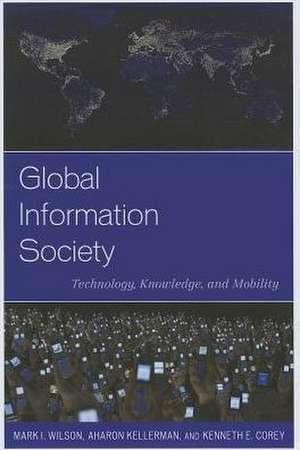
Global Information Society: Technology, Knowledge, and Mobility: Human Geography in the Twenty-First Century: Issues and Applications
Autor Mark I. Wilson, Aharon Kellerman, Kenneth E. Coreyen Limba Engleză Paperback – 11 apr 2013
| Toate formatele și edițiile | Preț | Express |
|---|---|---|
| Paperback (1) | 293.30 lei 6-8 săpt. | |
| Bloomsbury Publishing – 11 apr 2013 | 293.30 lei 6-8 săpt. | |
| Hardback (1) | 706.70 lei 6-8 săpt. | |
| Bloomsbury Publishing – 11 apr 2013 | 706.70 lei 6-8 săpt. |


Preț: 293.30 lei
Preț vechi: 359.84 lei
-18%
Puncte Express: 440
Preț estimativ în valută:
51.87€ • 60.87$ • 44.99£
51.87€ • 60.87$ • 44.99£
Carte tipărită la comandă
Livrare economică 09-23 martie
Specificații
ISBN-13: 9780742556942
ISBN-10: 0742556948
Pagini: 285
Ilustrații: 6 BW Illustrations, 1 Graphs, 2 Maps, 14 Tables
Dimensiuni: 153 x 228 x 16 mm
Greutate: 0.38 kg
Editura: Bloomsbury Publishing
Colecția Rowman & Littlefield Publishers
Seria Human Geography in the Twenty-First Century: Issues and Applications
Locul publicării:New York, United States
ISBN-10: 0742556948
Pagini: 285
Ilustrații: 6 BW Illustrations, 1 Graphs, 2 Maps, 14 Tables
Dimensiuni: 153 x 228 x 16 mm
Greutate: 0.38 kg
Editura: Bloomsbury Publishing
Colecția Rowman & Littlefield Publishers
Seria Human Geography in the Twenty-First Century: Issues and Applications
Locul publicării:New York, United States
Cuprins
Part I: Organization and Themes of the Global Information Society
Chapter 1: Introduction
Chapter 2: Foundations of the Information Society
Chapter 3: Technologies and Infrastructures
Chapter 4: Societal Dimensions of Mobility, Information, and Knowledge Production
Chapter 5: Individuals in the Information Society
Part II: Mapping the Global Information Society
Chapter 6: Spatial Organization of the Global Information Society
Chapter 7: The Americas
Chapter 8: Europe
Chapter 9: Asia-Pacific
Chapter 10: Africa and Middle East
Part III: Policy and Action for the Global Information Society
Chapter 11: Policy
Chapter 12: The Global Information Society: Moving from What Is to What Should Be
Part IV: Support Section
Chapter 13: Intelligent Development Planning Charrette
References
Chapter 1: Introduction
Chapter 2: Foundations of the Information Society
Chapter 3: Technologies and Infrastructures
Chapter 4: Societal Dimensions of Mobility, Information, and Knowledge Production
Chapter 5: Individuals in the Information Society
Part II: Mapping the Global Information Society
Chapter 6: Spatial Organization of the Global Information Society
Chapter 7: The Americas
Chapter 8: Europe
Chapter 9: Asia-Pacific
Chapter 10: Africa and Middle East
Part III: Policy and Action for the Global Information Society
Chapter 11: Policy
Chapter 12: The Global Information Society: Moving from What Is to What Should Be
Part IV: Support Section
Chapter 13: Intelligent Development Planning Charrette
References
Recenzii
This book, part of the 'Human Geography in the Twenty-First Century' series, is aptly titled. The underlying focus is the impact of society's new and vast ability to access information and communicate rapidly worldwide. The first part of the book primarily provides observational aspects of an information society and attempts to define those observations. The chapters in part 2, 'Mapping the Global Information Society,' discuss different geographic areas. This section is very important since the likely readership will be from the US, and getting an international perspective on the impact of information can be enlightening. The third section builds on the previous chapters to show the importance of good policy and planning. Readers may find the makeup of the authors unique. Wilson and Corey (both, Michigan State) and Kellerman (emer., Univ. of Haifa, Israel) have combined expertise in the fields of geography and urban/regional planning and design; their writing reflects their wide range of experience in these areas. The emphasis of the book is not necessarily on technology itself, but on analyzing the policy and planning behind the rollout of technological innovations and their impact on different regions of the world and different population subsets. Summing Up: Recommended. Lower-division undergraduates through researchers/faculty; general readers.
[T]he book has something for everyone. For those needing a succinct summary of the intellectual underpinnings of the information society, or a brief compendium of data on nearly all countries, the book has little competition. For those needing guidance on how to involve stakeholders in a serious attempt to grapple locally with global change, that is here, too.
Global Information Society . . . offers a helping hand at a particularly important time when changes in technology, the economy, and our society continue to gather pace. The book takes the readers on a historical journey, explaining how the concept of information society has come about; the opportunities and challenges involved from multiple perspectives and at different levels of analysis; how it has evolved to its current form; and to a lesser extent, where it might be going next. . . . Written by three distinguished digital immigrants who have witnessed, experienced, and researched the transition from the industrial to the information society over several decades . . . the book reminds the readers that the world did not become an information society overnight. The transition, however turbulent, radical, and revolutionary some of the changes have been, took decades to evolve and take hold. . . . The historical reviews and analytical frameworks presented in the book will not only help the readers make sense of the rapidly changing world in the global information society, but also gain the confidence and conviction to pursue new economic and social opportunities going forward.
Global Information Society: Technology, Knowledge, and Mobility authors Mark I.Wilson, Aharon Kellerman and Kenneth E.Corey are very clear in their intentions for this book: to 'empower its reader to understand the complexities of the networked global information society and to use that understanding to promote awareness and to positively effect change.' That this work is intended to facilitate the work of practitioners in the field of information and communication technology (ICT) development is a point the authors frequently return to throughout the text, but students of the field will also find this book highly useful. . . .Though this book is written with planners and ICT development professionals in mind, it is an excellent resource for those who want to learn more about the practicalities of ICT development planning or who are looking for a primer on the information society.The text combines dense theory with practical application in a straightforward, engaging, and highly readable manner.
This book offers a welcome call toward harnessing the power of the citizenry of the information society to help create better futures for locales around the world.
Global knowledge production, consumption, and exchange-whether print, visual, or social media-are challenges facing individuals, societies, governments, and also members of interdisciplinary scholarly communities. This volume provides a detailed, engaging, and thoughtful discussion on the regional impacts of information and communication technologies and recent and prospective technological innovations.
[T]he book has something for everyone. For those needing a succinct summary of the intellectual underpinnings of the information society, or a brief compendium of data on nearly all countries, the book has little competition. For those needing guidance on how to involve stakeholders in a serious attempt to grapple locally with global change, that is here, too.
Global Information Society . . . offers a helping hand at a particularly important time when changes in technology, the economy, and our society continue to gather pace. The book takes the readers on a historical journey, explaining how the concept of information society has come about; the opportunities and challenges involved from multiple perspectives and at different levels of analysis; how it has evolved to its current form; and to a lesser extent, where it might be going next. . . . Written by three distinguished digital immigrants who have witnessed, experienced, and researched the transition from the industrial to the information society over several decades . . . the book reminds the readers that the world did not become an information society overnight. The transition, however turbulent, radical, and revolutionary some of the changes have been, took decades to evolve and take hold. . . . The historical reviews and analytical frameworks presented in the book will not only help the readers make sense of the rapidly changing world in the global information society, but also gain the confidence and conviction to pursue new economic and social opportunities going forward.
Global Information Society: Technology, Knowledge, and Mobility authors Mark I.Wilson, Aharon Kellerman and Kenneth E.Corey are very clear in their intentions for this book: to 'empower its reader to understand the complexities of the networked global information society and to use that understanding to promote awareness and to positively effect change.' That this work is intended to facilitate the work of practitioners in the field of information and communication technology (ICT) development is a point the authors frequently return to throughout the text, but students of the field will also find this book highly useful. . . .Though this book is written with planners and ICT development professionals in mind, it is an excellent resource for those who want to learn more about the practicalities of ICT development planning or who are looking for a primer on the information society.The text combines dense theory with practical application in a straightforward, engaging, and highly readable manner.
This book offers a welcome call toward harnessing the power of the citizenry of the information society to help create better futures for locales around the world.
Global knowledge production, consumption, and exchange-whether print, visual, or social media-are challenges facing individuals, societies, governments, and also members of interdisciplinary scholarly communities. This volume provides a detailed, engaging, and thoughtful discussion on the regional impacts of information and communication technologies and recent and prospective technological innovations.