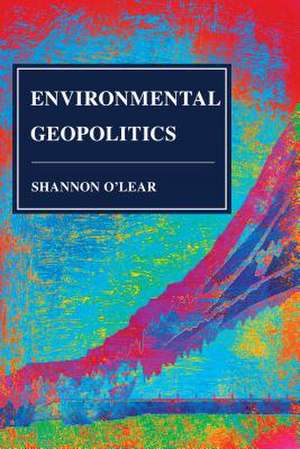
Environmental Geopolitics: Human Geography in the Twenty-First Century: Issues and Applications
Autor Shannon O'Learen Limba Engleză Paperback – 12 mar 2018







Preț: 278.25 lei
Preț vechi: 362.10 lei
-23%
Puncte Express: 417
Carte tipărită la comandă
Livrare economică 20 noiembrie-04 decembrie
Livrare prin curier în România Termenul estimat este afișat lângă disponibilitate.
Transport gratuit de la 400.00 lei Plată online sau ramburs, în funcție de opțiunile comenzii.
Retur gratuit în 14 zile Comandă securizată și suport în română.
Specificații
ISBN-13: 9781442265813
ISBN-10: 1442265817
Pagini: 216
Ilustrații: 25 b/w photos; 4 maps; 3 graphs
Dimensiuni: 148 x 226 x 4 mm
Greutate: 0.36 kg
Editura: Bloomsbury Publishing
Colecția Rowman & Littlefield
Seria Human Geography in the Twenty-First Century: Issues and Applications
Locul publicării:New York, United States
ISBN-10: 1442265817
Pagini: 216
Ilustrații: 25 b/w photos; 4 maps; 3 graphs
Dimensiuni: 148 x 226 x 4 mm
Greutate: 0.36 kg
Editura: Bloomsbury Publishing
Colecția Rowman & Littlefield
Seria Human Geography in the Twenty-First Century: Issues and Applications
Locul publicării:New York, United States
Descriere
This thought-provoking and clearly argued text provides a critical geopolitical lens for understanding global environment politics. A subfield of political geography, environmental geopolitics examines how environmental themes are used to support geopolitical arguments and physical realities of power and place. Shannon O'Lear considers common, problematic traits of such familiar but widely misunderstood narratives about human-environment relationships. Mainstream themes about human-environment relationships include narratives about presumed connections between human population trends and resource scarcity; ways in which conflict and violence are linked to resource use or environmental degradation; climate security; and the application of science to solve environmental problems. O'Lear questions these narratives, arguing that the role or meaning of the environment is rarely specified, humans' role in these situations tends to be considered selectively, and little attention is paid to spatial dimensions of human-environment relationships. She shows that how we tend to think about environmental concerns often obscure value judgments and constrain more dynamic approaches to human-environment relationships. Environmental geopolitics demonstrates how we can question familiar assumptions to generate more just and creative approaches to our many relationships with the environment.
Cuprins
List of Illustrations
Acknowledgments
Chapter 1: Introduction to Environmental Geopolitics
Chapter 2: Population and Environment
Chapter 3: Resource Conflict and Slow Violence
Chapter 4: Climate Change and Security
Chapter 5: Science, Imagery, and Understanding the Environment
Chapter 6: Building from Here
References
Inddex
About the Author
Acknowledgments
Chapter 1: Introduction to Environmental Geopolitics
Chapter 2: Population and Environment
Chapter 3: Resource Conflict and Slow Violence
Chapter 4: Climate Change and Security
Chapter 5: Science, Imagery, and Understanding the Environment
Chapter 6: Building from Here
References
Inddex
About the Author
Recenzii
O'Lear presents a cohesive, valuable analysis of the role geopolitics plays in discourse about the environment and environmental problems. She asserts that the Western world's dialogue about environmental problems fails to carefully define the environment, to understand the role of human power systems, and to understand the role of human geography. Through four in-depth case studies, O'Lear demonstrates the West's tendency to oversimplify risks, underplay political power struggles, and ignore the context of cultural and political geography. Her case studies focus on overpopulation, slow violence and resource scarcity, climate change security, and the role of science in policy making. Her cases provide a wealth of examples of the limitations in Western modes of environmental dialogue, drawing on a wide range of media coverage. Furthermore, though her four cases offer distinct pieces of supporting evidence for her research, O'Lear also integrates the cases well, connecting them for her overarching argument about linking geopolitics to environmental discourse. Ultimately, she presents a strong case for recognizing and challenging the West's existing framework for environmental discourse by bringing in a stronger role for science and a clearer understanding of security and risk.
Summing Up: Recommended. Upper-division undergraduates through faculty.
This well-written text powerfully links environmental matters and geopolitics in an accessible style. The theoretical lens of critical geopolitics is clearly articulated for students without daunting the uninitiated reader. Nicely done!
What will shape the planet's geopolitical future? How will observers make sense of profound changes in environment and politics in the Anthropocene? Shannon O'Lear's book makes a compelling case that humanity's relationship with the natural world-whether in the crops we grow, the resources we extract, the climate change we are responsible for and must adapt to, or the struggles over uneven access to food and water we must confront-is and will continue to be at the center of geopolitics. Building on long-standing critical geopolitical approaches, O'Lear richly illustrates environmental geopolitics as an emerging field of inquiry and engagement that can help us make sense of a rapidly changing world.
Building on more than a decade of work, Shannon O'Lear provides a deep reflection on the representations of key environmental issues and their impacts on geopolitics. The massive consequences of human activities on the planet are putting these issues at the core of a new 'geopolitics'-the politics of the earth itself. But how do we make sense of this shift and its effects on power relations? O'Lear will help students, activists, and policymakers to make better sense of the puzzle and open up new alternatives for relations with, and representations of, environmental issues.
Summing Up: Recommended. Upper-division undergraduates through faculty.
This well-written text powerfully links environmental matters and geopolitics in an accessible style. The theoretical lens of critical geopolitics is clearly articulated for students without daunting the uninitiated reader. Nicely done!
What will shape the planet's geopolitical future? How will observers make sense of profound changes in environment and politics in the Anthropocene? Shannon O'Lear's book makes a compelling case that humanity's relationship with the natural world-whether in the crops we grow, the resources we extract, the climate change we are responsible for and must adapt to, or the struggles over uneven access to food and water we must confront-is and will continue to be at the center of geopolitics. Building on long-standing critical geopolitical approaches, O'Lear richly illustrates environmental geopolitics as an emerging field of inquiry and engagement that can help us make sense of a rapidly changing world.
Building on more than a decade of work, Shannon O'Lear provides a deep reflection on the representations of key environmental issues and their impacts on geopolitics. The massive consequences of human activities on the planet are putting these issues at the core of a new 'geopolitics'-the politics of the earth itself. But how do we make sense of this shift and its effects on power relations? O'Lear will help students, activists, and policymakers to make better sense of the puzzle and open up new alternatives for relations with, and representations of, environmental issues.