Global Development and Colonial Power: German Development Policy at Home and Abroad: Kilombo: International Relations and Colonial Questions
Autor Daniel Bendixen Limba Engleză Hardback – 24 mar 2018
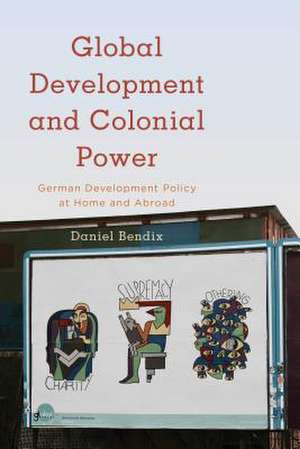
This book explores German development endeavours by state institutions as well as NGOs, and provides evidence of development policy's unacknowledged entanglement in colonial modes of thought and practice. It zooms in on concrete policies and practices in selected fields of intervention: development education and billboard advertising in Germany, and - taking Tanzania as a case in point - obstetric care and population control in the Global South. The analysis finds that disregarding colonial continuities means to perpetuate the inequalities and injustices that development policy claims to fight. This book argues that colonial power in global development needs to be understood as functioning through the transnational character of development policy at home and abroad.
| Toate formatele și edițiile | Preț | Express |
|---|---|---|
| Paperback (1) | 270.15 lei 6-8 săpt. | |
| Bloomsbury Publishing – 13 iun 2019 | 270.15 lei 6-8 săpt. | |
| Hardback (1) | 691.04 lei 6-8 săpt. | |
| Bloomsbury Publishing – 24 mar 2018 | 691.04 lei 6-8 săpt. |







Preț: 691.04 lei
Preț vechi: 1047.06 lei
-34%
Puncte Express: 1037
Preț estimativ în valută:
122.32€ • 142.70$ • 105.92£
122.32€ • 142.70$ • 105.92£
Carte tipărită la comandă
Livrare economică 26 februarie-12 martie
Preluare comenzi: 021 569.72.76
Specificații
ISBN-13: 9781786603494
ISBN-10: 1786603497
Pagini: 224
Ilustrații: 5 b/w photos;
Dimensiuni: 157 x 239 x 22 mm
Greutate: 0.47 kg
Editura: Bloomsbury Publishing
Colecția Rowman & Littlefield Publishers
Seria Kilombo: International Relations and Colonial Questions
Locul publicării:New York, United States
ISBN-10: 1786603497
Pagini: 224
Ilustrații: 5 b/w photos;
Dimensiuni: 157 x 239 x 22 mm
Greutate: 0.47 kg
Editura: Bloomsbury Publishing
Colecția Rowman & Littlefield Publishers
Seria Kilombo: International Relations and Colonial Questions
Locul publicării:New York, United States
Cuprins
1. Introduction / 2. German Colonialism, Development Policy and Colonial Power / 3. Development Education and the (De-)Stabilisation of Colonial Power / 4. Billboard Advertising and the Potential for Subverting Colonial Power / 5. Transforming Childbirth-Related Care in East Africa and Challenges to Colonial Power / 6. Controlling Population in East Africa / Conclusion: Colonial Power Transnationally, the German Case and Postcolonial Future
Recenzii
Daniel Bendix's rigorous, daring and original analysis challenges dominant understandings of history and development by engaging with the violences, paradoxes and present effects of Germany's colonial power. Bendix invites readers to open horizons for postcolonial futures by facing their complicity in systemic harm and the complexities of our planetary interdependence. This book offers a major contribution to international debates about the historical and systemic (re)production of global inequalities.
In this accessible and meticulously-researched book, Daniel Bendix offers a nuanced and compelling account of Germany's development interventions, challenging the Anglocentric focus of much postcolonial and critical race thinking on development with a reminder of the multiplicity of colonial projects and contemporary development interventions. What is equally refreshing is that Bendix consistently analyses the links between the discursive and the material, tracing across different historical periods the connections between shifting discourses around fertility and population growth and the changing interests of transnational German capital.
An original and comprehensive account of German development policy and one of a few studies to focus on development interventions concerning population control and reproductive health. Drawing on a range of archival materials, interviews with German development workers and observation, Daniel Bendix provides a convincing account of the discursive and non-discursive continuities from the colonial period into contemporary development interventions.
Based on painstaking research on a previously neglected development context, this book is an impressive and much needed contribution to post-colonial development studies. By challenging monolithic narratives of colonization, the book serves as a crucial reminder that we need to recognize the various and multifaceted ways in which colonial power is manifested in contemporary international development.
this is a well-researched (going by the literature,
resources and interviews) and well-analysed publication. This is a must for (advance level) students, researchers,
teachers and practitioners who wish to understand the connections between the colonial past (of Germany) and its
remains in the present, namely in its current the intra- and international developmental policies and practices.
In this accessible and meticulously-researched book, Daniel Bendix offers a nuanced and compelling account of Germany's development interventions, challenging the Anglocentric focus of much postcolonial and critical race thinking on development with a reminder of the multiplicity of colonial projects and contemporary development interventions. What is equally refreshing is that Bendix consistently analyses the links between the discursive and the material, tracing across different historical periods the connections between shifting discourses around fertility and population growth and the changing interests of transnational German capital.
An original and comprehensive account of German development policy and one of a few studies to focus on development interventions concerning population control and reproductive health. Drawing on a range of archival materials, interviews with German development workers and observation, Daniel Bendix provides a convincing account of the discursive and non-discursive continuities from the colonial period into contemporary development interventions.
Based on painstaking research on a previously neglected development context, this book is an impressive and much needed contribution to post-colonial development studies. By challenging monolithic narratives of colonization, the book serves as a crucial reminder that we need to recognize the various and multifaceted ways in which colonial power is manifested in contemporary international development.
this is a well-researched (going by the literature,
resources and interviews) and well-analysed publication. This is a must for (advance level) students, researchers,
teachers and practitioners who wish to understand the connections between the colonial past (of Germany) and its
remains in the present, namely in its current the intra- and international developmental policies and practices.