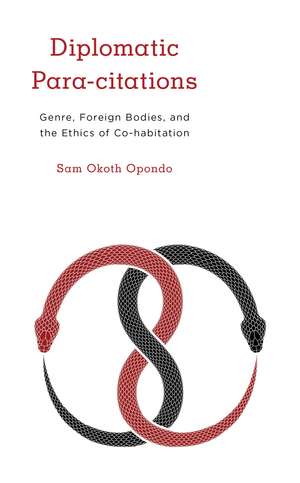
Diplomatic Para-citations: Genre, Foreign Bodies, and the Ethics of Co-habitation: Kilombo: International Relations and Colonial Questions
Autor Sam Okoth Opondoen Limba Engleză Hardback – 9 feb 2022
In an attempt to read 'the diplomatic' from the African postcolony, the book probes the injunction at the center of the law of genre that states that "genres are not to be mixed." This enables it to investigate the citational/recitational forms of knowledge and practices of recognition that reproduce the diplomatic and colonial order of things in the African context.
Through a reading of literature, philosophy, and a multiplicity of everyday practices in Africa and its diasporas, Sam Okoth Opondo explores amateur diplomatic practices that provide a counterforce to laws that prescribe faithfulness to a norm/form while proscribing the mixing of genres.




Preț: 974.99 lei
Preț vechi: 1486.01 lei
-34%
Puncte Express: 1462
Carte tipărită la comandă
Livrare economică 08-22 iunie
Specificații
ISBN-13: 9781786615848
ISBN-10: 1786615843
Pagini: 640
Ilustrații: 14 b/w photos;
Dimensiuni: 160 x 228 x 41 mm
Greutate: 1.07 kg
Editura: Bloomsbury Publishing
Colecția Rowman & Littlefield
Seria Kilombo: International Relations and Colonial Questions
Locul publicării:New York, United States
ISBN-10: 1786615843
Pagini: 640
Ilustrații: 14 b/w photos;
Dimensiuni: 160 x 228 x 41 mm
Greutate: 1.07 kg
Editura: Bloomsbury Publishing
Colecția Rowman & Littlefield
Seria Kilombo: International Relations and Colonial Questions
Locul publicării:New York, United States
Cuprins
Part One: Epiparasites/Introductory Fragments
The Ghosts of Eugene-Terre-Blanche
Introduction: Laws and Lore of Genre
Chapter 1. Apocalypsis: Para-citing and Becoming Malcolm X
Chapter 2. Counting with Sister Hypatia
Part Two: Bios/Entanglements
Chapter 3. Philopoesis and/as Resistance (Essay)
Chapter 4. Postscripts (Short Story)
Chapter 5. Biocolonial and Racial Entanglements (Essay)
Chapter 6. Becoming with' HIV/AIDS (Essay)
Part Three: Home/Abjection
Chapter 7. Inner-wares (Novella)
Chapter 8. Inter-city Half-lives (Essay)
Chapter 9. In Extremis: Diplomacies, Extremism, and Enmity
Chapter 10. Letters to Yvonne: Words and/as Worlds (Letters)
Chapter 11. Fishers-of-Men: A Lamentation (Poem)
Chapter 12. Counting Silently/Discretely: A Dirge
Part Four: Speculations/Hospitalities
Chapter 13. Childhood, Redemption, and the Prosaics of Waiting (Essay)
Chapter 14. Children of the Sand and Sea (Poem)
Chapter 15. Migricide, Hospitality, and Horror (Essay)
Chapter 16. Speculu
The Ghosts of Eugene-Terre-Blanche
Introduction: Laws and Lore of Genre
Chapter 1. Apocalypsis: Para-citing and Becoming Malcolm X
Chapter 2. Counting with Sister Hypatia
Part Two: Bios/Entanglements
Chapter 3. Philopoesis and/as Resistance (Essay)
Chapter 4. Postscripts (Short Story)
Chapter 5. Biocolonial and Racial Entanglements (Essay)
Chapter 6. Becoming with' HIV/AIDS (Essay)
Part Three: Home/Abjection
Chapter 7. Inner-wares (Novella)
Chapter 8. Inter-city Half-lives (Essay)
Chapter 9. In Extremis: Diplomacies, Extremism, and Enmity
Chapter 10. Letters to Yvonne: Words and/as Worlds (Letters)
Chapter 11. Fishers-of-Men: A Lamentation (Poem)
Chapter 12. Counting Silently/Discretely: A Dirge
Part Four: Speculations/Hospitalities
Chapter 13. Childhood, Redemption, and the Prosaics of Waiting (Essay)
Chapter 14. Children of the Sand and Sea (Poem)
Chapter 15. Migricide, Hospitality, and Horror (Essay)
Chapter 16. Speculu
Recenzii
The obsessions of Sam Okoth Opondo are love, family, violence, the sacred, the erotic, memory, and the power of stories. His mode is poetic assemblage. His voice is now a choir, and now ecstatic solo. Diplomatic Para-citations, a living manifesto, a new Poetics of Relation.
Transgressing the laws of genre, Diplomatic Para-citations unveils the forms of knowledge and practice that tie modern diplomacy to colonial cultures, and the painful moral and legal cartographies they entail. Against the reproduction of that order of things, Opondo places in the politics and poetics of amateur diplomacies an unpretentious but promising foundation for a more life-affirming ethics of everyday co-habitation all over the world.
A sweeping vision, matched in its seriousness of purpose by its delight in deeply explored details, Diplomatic Para-citations combines political science with literary, cinematic, and philosophical analyses. Opondo's originality and breadth of expertise make his bold theoretical interventions essential for challenging epistemic violence and for the transdisciplinary understanding, historicization, and problematization of contemporary issues on the continent and the Diaspora.
Diplomatic Para-citations is a feat of intellectual creativity and humanistic knowledge in a profane, genre-bending form. Opondo's 'amateur diplomacy', along with his ethical stance, centers what is at stake in the most basic of interactions. Moreover, he examines that which is at stake in interactions that are foreclosed or already coded within the epistemic violence of capitalist imperial modernity.
Transgressing the laws of genre, Diplomatic Para-citations unveils the forms of knowledge and practice that tie modern diplomacy to colonial cultures, and the painful moral and legal cartographies they entail. Against the reproduction of that order of things, Opondo places in the politics and poetics of amateur diplomacies an unpretentious but promising foundation for a more life-affirming ethics of everyday co-habitation all over the world.
A sweeping vision, matched in its seriousness of purpose by its delight in deeply explored details, Diplomatic Para-citations combines political science with literary, cinematic, and philosophical analyses. Opondo's originality and breadth of expertise make his bold theoretical interventions essential for challenging epistemic violence and for the transdisciplinary understanding, historicization, and problematization of contemporary issues on the continent and the Diaspora.
Diplomatic Para-citations is a feat of intellectual creativity and humanistic knowledge in a profane, genre-bending form. Opondo's 'amateur diplomacy', along with his ethical stance, centers what is at stake in the most basic of interactions. Moreover, he examines that which is at stake in interactions that are foreclosed or already coded within the epistemic violence of capitalist imperial modernity.