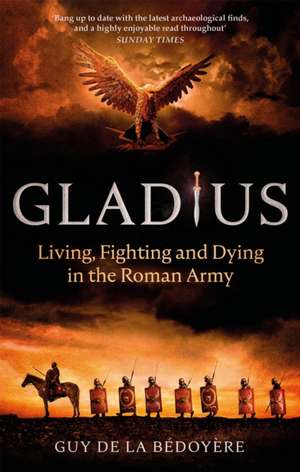
Gladius: Living, Fighting and Dying in the Roman Army
Autor Guy de la Bédoyèreen Limba Engleză Paperback – 4 noi 2021
Folosind ca fundament înregistrările epigrafice, corespondența privată și descoperirile arheologice recente, Gladius propune o perspectivă imersivă asupra celei mai eficiente mașinării de război a antichității. Considerăm că forța acestui volum rezidă în refuzul de a fi doar o cronică a bătăliilor; Guy de la Bédoyère alege în schimb să reconstruiască experiența umană brută a soldatului de rând, de la senatori la sclavi eliberați. Descoperim aici detalii intime despre viața în garnizoanele izolate din Britania sau Africa de Nord, despre pedepse, alimentație și relațiile complexe cu familiile rămase la granițele imperiului.
Cartea este organizată meticulos în 16 capitole tematice care urmăresc parcursul unui militar: de la jurământul de credință și sistemul de salarizare, până la activitățile de timp liber, cum ar fi vânătoarea de mistreți, și provocările retragerii la pensie. Putem afirma că autorul reușește să transforme datele tehnice despre „quinquereme” sau tactici de luptă într-o narațiune vie despre supraviețuire. Lucrarea acoperă aceeași arie tematică precum The Roman Army, 31 BC - AD 337 de Brian Campbell, dar cu o abordare mult mai axată pe istoria socială și pe „vocea” directă a soldaților, spre deosebire de formatul de tip sursă academică al lui Campbell.
În contextul operei sale, Gladius continuă explorarea societății antice începută în Populus și Domina, păstrând rigoarea științifică dublată de un stil accesibil. Dacă în Pharaohs of the Sun autorul se concentra pe dinastiile egiptene, aici revine la expertiza sa principală în lumea romană, oferind o analiză a armatei nu doar ca instrument de cucerire, ci ca motor social și economic care a susținut Imperiul timp de secole.
Preț: 82.60 lei
Preț vechi: 109.67 lei
-25%
Carte disponibilă
Livrare economică 11-25 noiembrie
Livrare express 27-31 octombrie pentru 57.43 lei
Specificații
ISBN-10: 0349143919
Pagini: 528
Dimensiuni: 126 x 196 x 40 mm
Greutate: 0.44 kg
Editura: Little Brown
Colecția Abacus
Locul publicării:London, United Kingdom
De ce să citești această carte
Recomandăm această carte oricărui pasionat de istorie care dorește să treacă dincolo de strategiile de pe hartă. Cititorul câștigă o înțelegere profundă a realității cotidiene romane, descoperind cum trăiau, ce mâncau și cum se revoltau soldații care au construit drumurile și orașele Europei. Este o lectură esențială pentru a înțelege armata ca o micro-societate complexă, nu doar ca o forță de luptă.
Despre autor
Guy de la Bédoyère este un istoric și arheolog britanic de renume, bine cunoscut publicului pentru prezența sa timp de cincisprezece ani în seria documentară „Time Team” de pe Channel 4. Absolvent al universităților Durham și London, el a publicat numeroase lucrări dedicate lumii antice, cu un accent deosebit pe Britania Romană și istoria socială a Imperiului. Expertiza sa vastă, ce îmbină cercetarea academică cu arheologia de teren, îi permite să aducă la viață detalii obscure din viața cotidiană a antichității, transformând inscripțiile și artefactele în narațiuni istorice captivante.
Descriere
Gladius takes the reader right into the heart of what it meant to be a part of the Roman army through the words of Roman historians, and those of the men themselves through their religious dedications, tombstones, and even private letters and graffiti. Guy de la Bédoyère throws open a window on how the men, their wives and their children lived, from bleak frontier garrisons to guarding the emperor in Rome, enjoying a ringside seat to history fighting the emperors' wars, mutinying over pay, marching in triumphs, throwing their weight around in city streets, and enjoying esteem in honorable retirement.
Recenzii
The Roman army was the greatest fighting machine the ancient world produced. The Roman Empire depended on soldiers not just to win its wars, defend its frontiers and control the seas but also to act as the engine of the state.
Gladius takes the reader right into the heart of what it meant to be a part of the Roman army, throwing open a window on how the men, their wives and their children lived, from bleak frontier garrisons to guarding the emperor in Rome, enjoying a ringside seat to history fighting the emperors' wars, mutinying over pay, marching in triumphs, throwing their weight around in city streets, and enjoying esteem in honorable retirement.
This is vital, exciting history, told by the men who lived it.
Gladius makes for a richly researched, detailed and plausible portrait, warts and all, bang up to date with the latest archaeological finds, and a highly enjoyable read throughout
A remarkably precise picture of life in the Roman army - how the men were armed and billeted, what they ate, drank, wore, how they were promoted or punished, how they built their great, straight roads, what they did for sexual relief
Notă biografică
Extras
There is no question that extreme brutality was engrained in Roman society and warfare. It is hard to see how that made the Romans particularly unusual by the standards of their time, but it would be true to say that they were exceptionally diligent in their use of violence to get what they wanted, and in acting on the state’s behalf to pursue its aims of conquest. It is also true that the people they fought were sometimes no less violent in their own way. The Romans were, however, usually better equipped and trained, and extremely persistent.
The world of the Romans was a place where life was cheap, though no one bothered to sit down and work out the price. Death could come quickly at the point of a spear or sword, slowly through starvation in a siege, or as a result of torture or devastating wounds. In the Republic, military power over Italy, Sicily, and then further afield had been won at enormous cost both to the Romans and their enemies. It set the pace for later Roman history. In 255 BC, in the First Punic War, the consul Marcus Atilius Regulus was defeated by the Carthaginians. He escaped with no more than about 500 of his troops. Of an original force of 15,000, just 2,000 survived the battle. The disaster was merely one of Rome’s expensive stepping stones to world domination. Some societies might have been so horrified by the losses they would have ended the war there and then. The Romans only became more determined.
The atrocities recorded during the days of the Roman army under the emperors had a long tradition. Polybius did not mince his words when he described Roman soldiers in action under the command of Scipio (later Africanus) in Spain during the Second Punic War in 209 BC. Scipio was only in his twenty-eighth year but was carving out a reputation for himself as a military leader of total ruthlessness. The target was Cartagena (Nova Carthago). Once the Romans were in, Scipio told his men ‘to exterminate every form of life they came across, sparing nobody’. Polybius explained that the purpose was to provoke terror, and described how in a city taken by the Romans ‘you can often see not only the bodies of human beings but also dogs sliced in two and the dismembered limbs of other animals’. As if that was not bad enough, Polybius mentioned that Cartagena’s destruction was even more brutal than usual because of its large population. Scipio was widely admired thanks to his later defeat of the Carthaginians at Zama, which brought the war to an end. No one considered him a war criminal, because the concept simply did not exist. He was a hero; someone to live up to.
Just a few years earlier, in 212 BC, the great Greek city of Syracuse in Sicily had fallen to a Roman force after a protracted siege. Syracuse had been defended with ingenious defensive mechanisms and machines invented by the brilliant engineer and mathematician Archimedes. The Roman commander Marcus Claudius Marcellus was so impressed that he wanted Archimedes’ life spared. As the city fell, Archimedes was so completely absorbed in drawing diagrams in the dust on the floor of his house that when a soldier burst in looking for loot and asked who he was, Archimedes said, ‘I beg, do not disturb this [work].’ The soldier ran him through having no idea who he was, though it probably would have made no difference if he had. This example of gratuitous violence destroyed one of the ancient world’s greatest geniuses, much to Marcellus’ sadness. But then, as Valerius Maximus said, the whole scenario had only come about because of the fall of Syracuse, which had led to Marcellus’ determination that Archimedes be saved; the same context resulted in his death.
Cuprins
Foreword
1. Introduction—The Army of the Emperors
2. Strength and Honour—Signing On in Caesar’s Army
3. Gloria Exercitus—Making Soldiers
4. Gold and Silver—Pay, Handouts and Bequests
5. A Soldier’s Life—Garrisoning the Empire
6. Living Off the Land—The Roman Army and the Environment
7. Ignominy and Defeat—The Roman Army’s Darkest Days
8. I Came, I Saw, I Conquered—The Roman War Machine Victorious
9. Living by the Sword—Violence and Atrocities
10. Quinqueremes and Triremes—The Roman Army at Sea
11. Mutineers and Rebels—King-Makers for Sale
12. Peacetime Duties—Jacks-of-All-Trades
13. Leisure and Leave—Hunting Wild Boar and Other Diversions
14. Wives and Lovers—Family Life on the Frontier
15. Veterans—The Emperor’s Die-Hards
16. Jupiter’s Men—Religion and Superstition
Epilogue
Rome’s Principal Wars
Emperors from Augustus to Valentinian I and Valens
Tacitus and Dio on the Size of the Army
Roman Names
Glossary of Terms
Notes
Abbreviations and Bibliography
List of Illustrations
Acknowledgements
Index