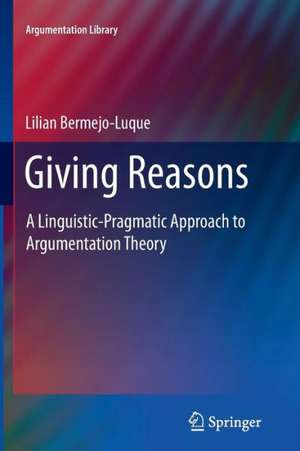
Giving Reasons: Argumentation Library, cartea 20
Autor Lilian Bermejo Luqueen Limba Engleză Paperback – 27 noi 2013
The book takes into consideration the major current comprehensive accounts of good argumentation (Perelman’s New Rhetoric, Pragma-dialectics, the ARG model, the Epistemic Approach) and shows that these accounts have fundamental weaknesses rooted in their instrumentalist conception of argumentation as an activity oriented to a goal external to itself. Furthermore, the author addresses some challenging meta-theoretical questions such as the justification problem for Argumentation Theory models and the relationship between reasoning and arguing.
Din seria Argumentation Library
- 24%
 Preț: 897.55 lei
 - 24%
 Preț: 831.70 lei
 - 18%
 Preț: 1437.34 lei
 - 15%
 Preț: 664.01 lei
 - 15%
 Preț: 632.00 lei
 - 15%
 Preț: 627.65 lei
 - 15%
 Preț: 628.68 lei
 - 15%
 Preț: 633.79 lei
 - 15%
 Preț: 615.62 lei
 - 15%
 Preț: 640.28 lei
 - 15%
 Preț: 615.02 lei
 - 15%
 Preț: 663.36 lei
 - 18%
 Preț: 981.36 lei
 - 15%
 Preț: 622.33 lei
 -
 Preț: 403.54 lei
 -
 Preț: 511.75 lei
 - 24%
 Preț: 592.33 lei
 -
 Preț: 378.24 lei
 - 15%
 Preț: 657.21 lei
 - 15%
 Preț: 672.19 lei
 - 24%
 Preț: 768.58 lei
 - 15%
 Preț: 631.39 lei
 - 15%
 Preț: 646.86 lei
 - 15%
 Preț: 679.46 lei
 - 19%
 Preț: 462.68 lei
 - 18%
 Preț: 738.76 lei
 - 15%
 Preț: 619.47 lei
 - 15%
 Preț: 621.32 lei
 - 15%
 Preț: 562.60 lei
 - 24%
 Preț: 688.74 lei
 - 18%
 Preț: 861.13 lei
Preț: 640.58 lei
Preț vechi: 753.62 lei
-15%
Puncte Express: 961
Carte tipărită la comandă
Livrare economică 21 noiembrie-05 decembrie
Livrare prin curier în România Termenul estimat este afișat lângă disponibilitate.
Transport gratuit pentru acest produs Plată online sau ramburs, în funcție de opțiunile comenzii.
Retur gratuit în 14 zile Comandă securizată și suport în română.
Specificații
ISBN-13: 9789400737846
ISBN-10: 940073784X
Pagini: 228
Ilustrații: XVI, 209 p.
Dimensiuni: 155 x 235 x 13 mm
Greutate: 0.35 kg
Ediția:2011
Editura: Springer
Colecția Argumentation Library
Seria Argumentation Library
Locul publicării:Dordrecht, Netherlands
ISBN-10: 940073784X
Pagini: 228
Ilustrații: XVI, 209 p.
Dimensiuni: 155 x 235 x 13 mm
Greutate: 0.35 kg
Ediția:2011
Editura: Springer
Colecția Argumentation Library
Seria Argumentation Library
Locul publicării:Dordrecht, Netherlands
V-ar putea interesa
-
 The English LanguageDavid Crystal-31%Preț: 64.25 lei93.11 lei
 -
 Port Out Starboard HomeMichael QuinionPreț: 109.15 lei
 -
 The Cat's Pyjamas: The Penguin Book of ClichésJulia CresswellPreț: 107.38 lei
 -
 Mother TongueBill Bryson-19%Preț: 64.10 lei78.99 lei
 -
 -21%Preț: 72.35 lei91.08 lei
 -
 The Language of PoetryJohn McRaePreț: 239.96 lei
 -
 Routledge Encyclopedia of Narrative TheoryDavid Herman-15%Preț: 553.05 lei650.64 lei
 -
 Preț: 264.09 lei
 -
 The Secret Life of WordsHenry Hitchings-7%Preț: 73.50 lei79.04 lei
 -
 The Last Word: Tales from the Tip of the Mother TongueBen Macintyre-28%Preț: 87.46 lei120.68 lei
 -
 For Wales, See EnglandMartyn FordPreț: 107.06 lei
 -
 Kick the Bucket and Swing the CatAlex GamesPreț: 130.89 lei
 -
 The Last Lingua FrancaNicholas Ostler-19%Preț: 63.74 lei78.29 lei
 -
 Where Words Come From: A Dictionary of Word OriginsFred Sedgwick-42%Preț: 114.84 lei196.48 lei
Public țintă
ResearchCuprins
Preface.- I Argumentation and Its Study.- II Why Do We Need a New Theory of Argumentation?.- III Acts of Arguing.- IV The Logical Dimension of Argumentation.- V The Dialectical Dimension of Argumentation.- VI The Rhetorical Dimension of Argumentation.- VII Argumentation Appraisal.- References.
Recenzii
From the reviews:
“Bermejo-Luque’s book Giving Reasons has the ambition of developing a new theoretical approach to argumentation that integrates logical, dialectical and rhetorical aspects. The author uses speech act theory to realize her ideal of ‘a linguistic-pragmatic approach’ to argumentation. … provide a coherent, systematic and comprehensive model for argument analysis and evaluation which overcomes the shortcomings of the current models and approaches to argumentation. … Giving Reasons will be of interest to argumentation theorists, as it raises some important issues.” (C. Andone, Argumentation, Vol. 26, 2012)
“Bermejo-Luque’s book Giving Reasons has the ambition of developing a new theoretical approach to argumentation that integrates logical, dialectical and rhetorical aspects. The author uses speech act theory to realize her ideal of ‘a linguistic-pragmatic approach’ to argumentation. … provide a coherent, systematic and comprehensive model for argument analysis and evaluation which overcomes the shortcomings of the current models and approaches to argumentation. … Giving Reasons will be of interest to argumentation theorists, as it raises some important issues.” (C. Andone, Argumentation, Vol. 26, 2012)
Textul de pe ultima copertă
This book provides a new, linguistic approach to Argumentation Theory. Its main goal is to integrate the logical, dialectical and rhetorical dimensions of argumentation in a model providing a unitary treatment of its justificatory and persuasive powers. This model takes as its basis Speech Acts Theory in order to characterize argumentation as a second-order speech act complex. The result is a systematic and comprehensive theory of the interpretation, analysis and evaluation of arguments. This theory sheds light on the many faces of argumentative communication: verbal and non-verbal, monological and dialogical, literal and non-literal, ordinary and specialized.
The book takes into consideration the major current comprehensive accounts of good argumentation (Perelman’s New Rhetoric, Pragma-dialectics, the ARG model, the Epistemic Approach) and shows that these accounts have fundamental weaknesses rooted in their instrumentalist conception of argumentation as an activity oriented to a goal external to itself. Furthermore, the author addresses some challenging meta-theoretical questions such as the justification problem for Argumentation Theory models and the relationship between reasoning and arguing.
The book takes into consideration the major current comprehensive accounts of good argumentation (Perelman’s New Rhetoric, Pragma-dialectics, the ARG model, the Epistemic Approach) and shows that these accounts have fundamental weaknesses rooted in their instrumentalist conception of argumentation as an activity oriented to a goal external to itself. Furthermore, the author addresses some challenging meta-theoretical questions such as the justification problem for Argumentation Theory models and the relationship between reasoning and arguing.
Caracteristici
Provides Argumentation Theory with a new, linguistic approach Integrates argumentation’s logical, dialectical and rhetorical dimensions Solves challenging meta-theoretical questions, e.g. the justification problem