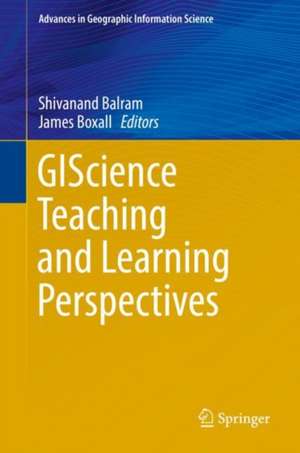
GIScience Teaching and Learning Perspectives: Advances in Geographic Information Science
Editat de Shivanand Balram, James Boxallen Limba Engleză Hardback – 4 mar 2019
Observăm că, în ciuda avansului tehnologic rapid, literatura academică a dus lipsă de o resursă care să ancoreze riguros utilizarea sistemelor informatice geografice în teorii de învățare solide, dedicate mediului universitar. Găsim în GIScience Teaching and Learning Perspectives volumul care acoperă această lacună, propunând o sinteză între pedagogiile moderne și implementările practice din sala de curs. Notăm cu interes modul în care editorii au structurat cele zece capitole pentru a ghida cititorul de la evoluția conceptului de alfabetizare geospațială până la provocările etice și tehnice ale erei geoweb.
Această lucrare completează perspectiva oferită de Geospatial Technologies in Geography Education, adăugând o dimensiune critică axată pe învățământul superior și pe pregătirea pentru piața muncii, în timp ce volumul lui Rafael de Miguel González se concentrează predilect pe educația secundară. În contextul operei editorului Shivanand Balram, această carte extinde preocupările din Collaborative Geographic Information Systems. Dacă lucrarea anterioară explora designul sistemelor și planificarea de grup, noul volum mută accentul pe modul în care aceste sisteme complexe sunt predate și asimilate de noua generație de specialiști.
Progresia conținutului este logică și aplicată: primele capitole definesc cadrul teoretic și abilitățile de cercetare, urmate de studii de caz despre programe de formare specifice (precum AMETHYST) și utilizarea formatelor online pentru teledetecție. Finalul volumului, marcat de o analiză a perspectivelor de angajare și a viitorului convergenței tehnologice, transformă textul dintr-un manual pedagogic într-un ghid strategic pentru facultățile de geomatică, cartografie și tehnologia informației.
Din seria Advances in Geographic Information Science
- 24%
 Preț: 724.18 lei
 - 24%
 Preț: 656.13 lei
 - 15%
 Preț: 616.24 lei
 - 18%
 Preț: 864.31 lei
 - 18%
 Preț: 1393.65 lei
 - 18%
 Preț: 917.91 lei
 - 15%
 Preț: 616.28 lei
 - 15%
 Preț: 621.21 lei
 - 18%
 Preț: 918.54 lei
 - 18%
 Preț: 959.88 lei
 - 15%
 Preț: 621.78 lei
 - 15%
 Preț: 648.78 lei
 - 18%
 Preț: 1084.76 lei
 - 15%
 Preț: 651.53 lei
 - 18%
 Preț: 1235.72 lei
 - 18%
 Preț: 915.54 lei
 - 18%
 Preț: 1084.91 lei
 - 18%
 Preț: 960.67 lei
 - 18%
 Preț: 905.27 lei
 - 15%
 Preț: 611.27 lei
 - 18%
 Preț: 818.67 lei
 - 18%
 Preț: 859.33 lei
 - 24%
 Preț: 1086.97 lei
 - 24%
 Preț: 1090.65 lei
 - 24%
 Preț: 1318.72 lei
 - 24%
 Preț: 1075.30 lei
 - 24%
 Preț: 1069.60 lei
Preț: 1067.54 lei
Preț vechi: 1301.87 lei
-18%
Carte disponibilă
Livrare economică 06-20 octombrie
Specificații
ISBN-10: 3030060578
Pagini: 211
Ilustrații: XV, 200 p. 34 illus., 12 illus. in color.
Dimensiuni: 155 x 235 mm
Greutate: 0.5 kg
Ediția:1st ed. 2019
Editura: Springer International Publishing
Colecția Springer
Seria Advances in Geographic Information Science
Locul publicării:Cham, Switzerland
De ce să citești această carte
Recomandăm această carte cadrelor didactice și cercetătorilor care doresc să depășească simpla instruire tehnică în utilizarea software-ului GIS. Cititorul câștigă acces la strategii de predare validate prin cercetare, menite să dezvolte gândirea spațială critică. Este o resursă esențială pentru a pregăti studenții pentru o piață a muncii tot mai dependentă de literația tehnologică și de capacitatea de a interpreta date geografice complexe într-un mod etic și riguros.
Despre autor
Shivanand Balram este un specialist recunoscut în sisteme informatice geografice, cu un interes marcat pentru sistemele colaborative și educația spațială. Munca sa se concentrează pe intersecția dintre designul sistemelor GIS și pedagogia universitară. Alături de James Boxall, expert în biblioteconomie geografică și administrarea datelor spațiale, acesta a coordonat numeroase proiecte menite să integreze resursele geospațiale în curriculumul academic. Ambii editori contribuie prin acest volum la consolidarea GIScience ca disciplină academică de sine stătătoare, fundamentată pe cercetare educațională.
Descriere scurtă
Cuprins
Notă biografică
James Boxall is first and foremost an educator. He teaches geography and GIS at Dalhousie University where holds appointments in Marine Affairs, Planning, Earth Sciences and Information management. His current position is as The Geographer in the GIS Centre at Dalhousie. He was on the National Science Foundation Review Panel of the Alexandria Digital Geolibrary project, a past-president of the Canadian Cartographic Association, the Association of Canadian Map Libraries and Archives, and the Geomatics Association of Nova Scotia. He is a Governor and Fellow of the Royal Canadian Geographical Society (RCGS) and a member of the Canadian Geographic Education Committee (CGE) and Chairs the Research Grants Committee for RCGS. He received the Society’s Education Medal in 2012 for helping to found the CGE of RCGS, and also received the Franklin Expedition Erebus Medal in 2015. He is also a Fellow of the Royal Geographical Society. He is also on Board of Governors of the Nova Scotia Museums. James co-chairs the International Network for Learning and Teaching Geography; is a regional representative on the IGU Commission for Geographical Education; member of the Canadian Committee for International Map Year; and past co-chair of the Canadian Round Table on Geomatics (NRCan) leading the development of GeoAlliance Canada. He was a lead proponent for the Declaration to Enhance Geographic Education in Canada. He sits on the Journal of Map and Geography Libraries review board. His professional passion is geospatial information and oceans.