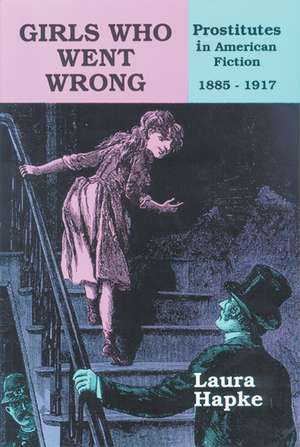
Girls Who Went Wrong: Prostitutes in American Fiction, 1885–1917
Autor Laura Hapkeen Limba Engleză Paperback – 1989
The period 1885 to 1917 saw thousands of American crusaders working hard to “save the fallen women,” but little on the part of American social protest writers. In this first work on the subject, Laura Hapke examines how writers attempted to turn an outcast into a heroine in a literature otherwise known for its puritanical attitude toward the fallen woman. She focuses on how these authors (all male) expressed late-Victorian conflicts about female sexuality. If, as they all maintained, women have an innate preference for chastity, how could they account for the prostitute? Was she a sinner, suggesting the potential waywardness of all women? Or, if she was a victim, what of her “depravity”?
Preț: 99.40 lei
Puncte Express: 149
Carte disponibilă
Livrare economică 16-30 noiembrie
Livrare prin curier în România Termenul estimat este afișat lângă disponibilitate.
Transport gratuit de la 400.00 lei Plată online sau ramburs, în funcție de opțiunile comenzii.
Retur gratuit în 14 zile Comandă securizată și suport în română.
Specificații
ISBN-13: 9780879724740
ISBN-10: 0879724749
Pagini: 224
Ilustrații: 7 b-w illus.
Dimensiuni: 152 x 229 x 13 mm
Greutate: 0.29 kg
Editura: University of Wisconsin Press
Colecția Popular Press 1
ISBN-10: 0879724749
Pagini: 224
Ilustrații: 7 b-w illus.
Dimensiuni: 152 x 229 x 13 mm
Greutate: 0.29 kg
Editura: University of Wisconsin Press
Colecția Popular Press 1
V-ar putea interesa
-
 Poetry: The Literary AgendaDavid Constantine-18%Preț: 153.16 lei187.56 lei
-
 My Little French KitchenRachel Khoo-21%Preț: 155.16 lei196.35 lei
-
 Popular CultureRaiford A Guins-27%Preț: 757.29 lei1037.37 lei
-
 Labor's Text: The Worker in American FictionLaura HapkePreț: 391.59 lei
-
 Sweatshop: The History of an American IdeaLaura HapkePreț: 326.80 lei
-
 Preț: 109.38 lei
-
 Preț: 123.60 lei
-
 Snapshot Versions of LifeRichard ChalfenPreț: 119.45 lei
-
 Probable Cause: Crime Fiction in AmericaLeRoy Lad PanekPreț: 99.40 lei
-
 A Legend for the Legendary: The Origin of the Baseball Hall of FameJames A. VlasichPreț: 109.66 lei
-
 -27%Preț: 57.58 lei78.62 lei
-
 The Year of Living DanishlyHelen RussellPreț: 87.05 lei
Descriere
Descriere de la o altă ediție sau format:
The period 1885 to 1917 saw thousands of American crusaders working hard to “save the fallen women,” but little on the part of American social protest writers. In this first work on the subject, Laura Hapke examines how writers attempted to turn an outcast into a heroine in a literature otherwise known for its puritanical attitude toward the fallen woman. She focuses on how these authors (all male) expressed late-Victorian conflicts about female sexuality. If, as they all maintained, women have an innate preference for chastity, how could they account for the prostitute? Was she a sinner, suggesting the potential waywardness of all women? Or, if she was a victim, what of her “depravity”?