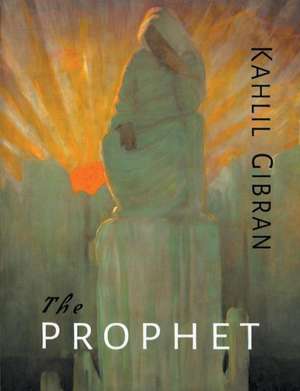
Gibran, K: Prophet
en Limba Engleză Paperback – 27 ian 2017
The Prophet is a collection of poetic essays that are philosophical, spiritual, and, above all, inspirational. Gibran's musings are divided into twenty-eight chapters covering such sprawling topics as love, marriage, children, giving, eating and drinking, work, joy and sorrow, housing, clothes, buying and selling, crime and punishment, laws, freedom, reason and passion, pain, self-knowledge, teaching, friendship, talking, time, good and evil, prayer, pleasure, beauty, religion, and death.
Each essay reveals deep insights into the impulses of the human heart and mind. The Chicago Post said of The Prophet "Cadenced and vibrant with feeling, the words of Kahlil Gibran bring to one's ears the majestic rhythm of Ecclesiastes . . . If there is a man or woman who can read this book without a quiet acceptance of a great man's philosophy and a singing in the heart as of music born within, that man or woman is indeed dead to life and truth."
Preț: 53.34 lei
Puncte Express: 80
Carte disponibilă
Livrare economică 03-17 decembrie
Livrare prin curier în România Termenul estimat este afișat lângă disponibilitate.
Transport gratuit de la 400.00 lei Plată online sau ramburs, în funcție de opțiunile comenzii.
Retur gratuit în 14 zile Comandă securizată și suport în română.
Specificații
ISBN-13: 9781684112722
ISBN-10: 1684112729
Pagini: 50
Dimensiuni: 189 x 246 x 3 mm
Greutate: 0.12 kg
Editura: Stanford Inversiones SpA
ISBN-10: 1684112729
Pagini: 50
Dimensiuni: 189 x 246 x 3 mm
Greutate: 0.12 kg
Editura: Stanford Inversiones SpA
V-ar putea interesa
-
 The ProphetKahlil Gibran-20%Preț: 50.86 lei63.66 lei
-
 Our Mathematical UniverseMax Tegmark-29%Preț: 67.37 lei94.27 lei
-
 MeditationsMarcus AureliusPreț: 34.20 lei
-
 The ProphetKahlil GibranPreț: 72.37 lei
-
 Preț: 78.41 lei
-
 -25%Preț: 70.62 lei93.94 lei
-
 Preț: 210.67 lei
-
 Preț: 127.95 lei
-
 And the Prophet SaidKahlil GibranPreț: 91.35 lei
-
 The Little Book of LoveKahlil GibranPreț: 56.29 lei
-
 -27%Preț: 145.23 lei198.83 lei
-
 The ProphetessChelan Harkin-20%Preț: 61.83 lei77.57 lei
-
 -15%Preț: 137.81 lei162.84 lei
-
 Kahlil GibranSuheil BushruiPreț: 110.33 lei
-
 The ProphetKahlil GibranPreț: 57.53 lei
-
 Essential GibranSuheil BushruiPreț: 65.89 lei
-
 Kahlil Gibran's the Prophet - an Oracle Card SetKahlil GibranPreț: 155.34 lei
-
 The Prophet (Deluxe Hardbound Edition)Kahlil GibranPreț: 64.94 lei
-
 The ProphetKahlil GibranPreț: 69.67 lei
-
 Preț: 146.02 lei
Notă biografică
Khalil Gibran was a Lebanese-American writer, poet and visual artist who lived in the United States. He was born on January 6, 1883, to a Maronite family in a hamlet in the Ottoman-controlled Mount Lebanon Mutasarrifate. Gibran's sketches were first shown in public in 1904 at Day's studio in Boston. At first, Gibran's father was an apothecary employee, but he was unable to make ends meet due to gambling debts. He started working for the local Ottoman administration. In Boston, at Day's studio, Gibran displayed his sketches for the first time in January 1904. Gibran met Mary Haskell, a city headmistress of a girls' school who is nine years his senior, at this show. They grew close, and Gibran kept that connection throughout the rest of his life. Gibran began a group of pencil portraits that he would later refer to as "The Temple of Art" in December 1909. The majority of Gibran's works released after 1918 were in English, despite the majority of his early writings being in Arabic. Jesus, the Son of Man was released in 1928, and Sand and Foam in 1926. Author Khalil Gibran passed away in 1931 from liver cirrhosis and an early stage of TB in one of his lungs. Gibran refused to be laid to rest, and he passed on the very next day.