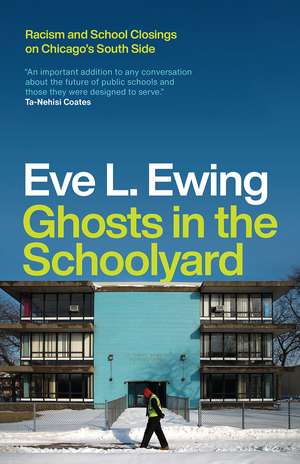
Ghosts in the Schoolyard: Racism and School Closings on Chicago's South Side
Autor Eve L. Ewingen Limba Engleză Paperback – 10 apr 2020
În literatura academică dedicată politicilor urbane, analiza închiderii școlilor a fost adesea limitată la perspective economice sau administrative, ignorând trauma colectivă a comunităților vizate. Ghosts in the Schoolyard completează această lacună, oferind o examinare profundă a modului în care rasismul sistemic și politicile educaționale se intersectează în South Side, Chicago. Subliniem modul în care Eve L. Ewing depășește discursul oficial despre „școli eșuate” pentru a dezvălui rolul acestor instituții ca depozitare ale memoriei istorice.
Descoperim aici o structură narativă riguroasă, organizată în patru capitole esențiale care ghidează cititorul de la înțelegerea valorii simbolice a școlii până la fenomenul de „doliu” colectiv cauzat de dispariția acestor spații. Cititorii familiarizați cu Shuttered Schools de Ebony M. Duncan-Shippy vor aprecia modul în care volumul de față aduce o dimensiune personală și etnografică, transformând datele statistice în istorii vii. Dacă lucrarea lui Duncan-Shippy oferă o perspectivă interdisciplinară largă asupra orașelor americane, Ewing se concentrează pe specificul cartierului Bronzeville, demonstrând că lupta pentru păstrarea școlilor este, de fapt, o luptă pentru autodeterminare.
Notăm cu interes cum această cercetare sociologică se raportează la opera diversă a autoarei. Deși Eve L. Ewing este cunoscută pentru explorările culturale din They Can't Kill Us Until They Kill Us sau pentru munca sa în universul benzilor desenate precum Exceptional X-Men by Eve L. Ewing Vol. 1: Duty Calls, acest volum reprezintă nucleul expertizei sale academice. Cartea integrează patru ilustrații și cinci tabele care ancorează observațiile calitative într-o realitate empirică incontestabilă, oferind o critică tăioasă la adresa deciziilor administrative care ignoră vocea cetățenilor.
Preț: 103.53 lei
Carte disponibilă
Livrare economică 27 octombrie-10 noiembrie
Specificații
ISBN-10: 022652616X
Pagini: 240
Ilustrații: 4 halftones, 1 line drawing, 5 tables
Dimensiuni: 140 x 216 x 15 mm
Greutate: 0.27 kg
Ediția:First Edition
Editura: University of Chicago Press
Colecția University of Chicago Press
V-ar putea interesa
-
 Preț: 316.75 lei
 -
 Preț: 280.02 lei
 -
 Mollie Is Three: Growing Up in SchoolVivian Gussin PaleyPreț: 141.10 lei
 -
 The Color of Strangers, the Color of FriendsAlan PeshkinPreț: 233.39 lei
 -
 Science, Curriculum, and Liberal Education: Selected EssaysJoseph J. SchwabPreț: 348.30 lei
 -
 Preț: 267.74 lei
 -
 Hyman's Comparative Vertebrate AnatomyMarvalee H. Wake-23%Preț: 467.30 lei606.88 lei
 -
 Preț: 37.80 lei
 -
 Buzzy and Thomas Move into the President's HouseVicki TashmanPreț: 39.77 lei
 -
 The Gnome and the MonkeyDonna MurilloPreț: 50.89 lei
 -
 -23%Preț: 675.97 lei877.88 lei
 -
 Preț: 304.85 lei
 -
 Preț: 86.89 lei
 -
 Preț: 87.04 lei
 -
 Einführung des Passivs (Deutsch 6. Klasse Gymnasium)Sina RamspergerPreț: 81.03 lei
 -
 Preț: 226.46 lei
 -
 Preț: 87.50 lei
 -
 Curriculum implementation and program managementAkampurira AbrahamPreț: 291.57 lei
 -
 Preț: 81.11 lei
 -
 Preț: 80.64 lei
 -
 Preț: 80.64 lei
 -
 Preț: 81.11 lei
 -
 Preț: 77.02 lei
De ce să citești această carte
Această carte este esențială pentru studenții la sociologie, politici publice și educație, oferind un studiu de caz magistral despre impactul rasismului instituțional. Cititorul câștigă o înțelegere clară a motivelor pentru care închiderea unei școli depășește calculele bugetare, devenind o problemă de justiție socială. Este o recomandare fermă pentru cei care vor să înțeleagă dinamica puterii în mediile urbane segregate.
Despre autor
Eve L. Ewing este o scriitoare, sociologă și profesoară universitară americană, recunoscută pentru analizele sale pătrunzătoare asupra rasei și educației în spațiul urban. Deținătoare a unui doctorat la Harvard, Ewing îmbină rigoarea academică cu o sensibilitate literară rară, fiind activă atât în cercetarea sociologică la University of Chicago, cât și în cultura mainstream. Opera sa vastă cuprinde de la eseuri critice și poezie până la scenarii pentru Marvel, toate fiind unite de un interes profund pentru istoria și reziliența comunităților afro-americane.
Descriere scurtă
That’s how Eve L. Ewing opens Ghosts in the Schoolyard: describing Chicago Public Schools from the outside. The way politicians and pundits and parents of kids who attend other schools talk about them, with a mix of pity and contempt.
But Ewing knows Chicago Public Schools from the inside: as a student, then a teacher, and now a scholar who studies them. And that perspective has shown her that public schools are not buildings full of failures—they’re an integral part of their neighborhoods, at the heart of their communities, storehouses of history and memory that bring people together.
Never was that role more apparent than in 2013 when Mayor Rahm Emanuel announced an unprecedented wave of school closings. Pitched simultaneously as a solution to a budget problem, a response to declining enrollments, and a chance to purge bad schools that were dragging down the whole system, the plan was met with a roar of protest from parents, students, and teachers. But if these schools were so bad, why did people care so much about keeping them open, to the point that some would even go on a hunger strike?
Ewing’s answer begins with a story of systemic racism, inequality, bad faith, and distrust that stretches deep into Chicago history. Rooting her exploration in the historic African American neighborhood of Bronzeville, Ewing reveals that this issue is about much more than just schools. Black communities see the closing of their schools—schools that are certainly less than perfect but that are theirs—as one more in a long line of racist policies. The fight to keep them open is yet another front in the ongoing struggle of black people in America to build successful lives and achieve true self-determination.
Notă biografică
Cuprins
Introduction
1 What a School Means
2 City of Losses
3 Dueling Realities
4 Mourning
Conclusion: An Open Door
Acknowledgments
Appendix: Methodological and Theoretical Notes
Notes
Bibliography
Index
Recenzii
Perhaps most importantly, Ewing gives direct voice to those served by those schools often dismissed as failing. What she finds is that these schools are often among the last working institutions in neighborhoods which have been systematically stripped of everything else. Mixing history, sociology, and even memoir, Ghosts in the Schoolyard is an important addition to any conversation about the future of public schools and those they were designed to serve."
public schools...Ewing explains school closures in a succinct manner, and her style of writing allows all to decipher the poignant points made in this book. Additionally, Ewing’s positionality as a Chicago native, and later a teacher in Chicago, is very important as it allows the reader to understand the landscape and history of Chicago from the standpoint of an insider...I highly recommend this book for all, especially for those interested in sociology, urban education, race, ethnicity, and qualitative research methods."