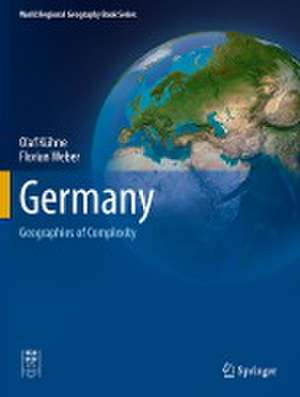
Germany: World Regional Geography Book Series
Autor Olaf Kühne, Florian Weberen Limba Engleză Paperback – 4 mar 2023
Apreciem rigoarea cu care Olaf Kühne și Florian Weber, ambii cercetători recunoscuți în domeniul geografiei sociale și regionale, fundamentează acest volum. Olaf Kühne își aduce expertiza vastă în teoria peisajului, dezvoltată anterior în lucrări precum Landschaftstheorie und Landschaftspraxis, în timp ce Florian Weber contribuie cu perspectiva sa asupra proceselor de transformare globală, vizibilă în Transformation Processes in Europe and Beyond. Împreună, aceștia propun o analiză a Germaniei care depășește simpla descriere geografică, ancorând-o într-un cadru teoretic neopragmatic. Germany acoperă o arie similară cu The Regions of Germany de Dieter K. Buse, dar cu o abordare mult mai teoretică și axată pe procese spațio-temporale complexe, spre deosebire de caracterul de referință enciclopedică al lucrării lui Buse. Structura este logică și progresivă: începe cu cadrul fizic și istoric (capitolele 3 și 4), trece prin analiza dezvoltării peisajului și ajunge la nucleul analitic reprezentat de eforturile de unificare și disparitățile regionale actuale (capitolul 6). Recomandăm această lucrare pentru modul în care reușește să explice cum ideile politice și idealurile culturale au modelat spațiul german. Spre deosebire de Guiding Principles for Spatial Development in Germany, care se concentrează pe politici publice, volumul de față oferă o sinteză interdisciplinară ce include adaptarea la schimbările climatice și gestionarea resurselor prime. Studiile de caz pe regiunea Ruhr și Berlin oferă exemple concrete despre modul în care teoria se traduce în realitate teritorială.
Din seria World Regional Geography Book Series
- 24%
 Preț: 1512.24 lei
 - 24%
 Preț: 1107.04 lei
 - 15%
 Preț: 595.65 lei
 - 24%
 Preț: 981.42 lei
 - 20%
 Preț: 1096.75 lei
 - 18%
 Preț: 1300.52 lei
 - 15%
 Preț: 672.73 lei
 - 20%
 Preț: 662.87 lei
 - 18%
 Preț: 811.82 lei
 - 24%
 Preț: 1097.26 lei
 - 24%
 Preț: 1109.31 lei
 - 24%
 Preț: 1171.07 lei
 - 24%
 Preț: 764.78 lei
 - 19%
 Preț: 562.39 lei
 - 18%
 Preț: 1442.63 lei
 - 20%
 Preț: 878.43 lei
Preț: 396.56 lei
Carte disponibilă
Livrare economică 16-30 noiembrie
Livrare express 30 octombrie-05 noiembrie pentru 57.63 lei
Specificații
ISBN-10: 3030929558
Pagini: 312
Ilustrații: X, 300 p. 1 illus.
Dimensiuni: 210 x 279 x 16 mm
Greutate: 0.86 kg
Ediția:1st ed. 2022
Editura: Springer
Colecția World Regional Geography Book Series
Seria World Regional Geography Book Series
Locul publicării:Cham, Switzerland
De ce să citești această carte
Recomandăm această carte studenților și cercetătorilor care doresc să înțeleagă Germania dincolo de datele statistice. Este o resursă esențială pentru a descifra cum istoria divizării și unificării a creat o structură spațială unică. Cititorul câștigă o perspectivă profundă asupra modului în care peisajul material și cel cultural se influențează reciproc, oferind instrumente teoretice pentru a analiza disparitățile regionale contemporane.
Despre autor
Olaf Kühne este profesor de geografie urbană și regională, cunoscut pentru abordările sale inovatoare în teoria peisajului și geografia socială. Opera sa, care include Landschaftstheorie und Landschaftspraxis, explorează modul în care convențiile sociale ne determină să evaluăm mediul înconjurător. Florian Weber este un cercetător axat pe procesele de transformare și geografie politică, fiind implicat în analize ample despre schimbările structurale în Europa și SUA. Împreună, cei doi autori reprezintă o autoritate în spațiul academic german, reușind să combine rigoarea metateoretică cu analize empirice de actualitate în cadrul seriei de geografie a editurii Springer.
Cuprins
Notă biografică
Florian Weber studied geography, business administration,sociology and journalism at the University of Mainz and gained his doctorate at the University of Erlangen-Nuremberg with a thesis comparing German and French area-based politics in light of discourse theory. After working from 2012-2013 as a project manager in Würzburg, he took up an appointment as researcher and project coordinator in the transregional university cooperation UniGR at Kaiserslautern University of Technology and after that Weihenstephan-Triesdorf University of Applied Sciences. Since October 2016 he has been Associate Professor (Akademischer Rat) at the University of Tübingen, where he completed his post-doctoral degree (Habilitation) in 2018. In April 2019 he was appointed Junior Professor of European Studies at Saarland University, with special reference to Western Europe and border regions. His research focuses on discourse and landscape, renewable energies, cross-border cooperations, and comparative international urban district politics and development.
Textul de pe ultima copertă
The historical development of Germany serves as a background in order to provide context for the development of spatially relevant ideas and ideals (whether in relation to politics, landscape, or culture). In this regard, questions of divergence and convergence become highly salient.
The book makes the complexity of spatial and social developments in Germany comprehensible. The neopragmatic approach adopted here allows bringing together different theoretical strands while providing a basis for independent regional geographic research at the same time. Beginning with an overview of the physical structures of Germany which provides the material point of departure for the societal development of Germany, key aspects of the German history are discussed. Particular attention is paid to the reciprocal influence between material substrate and notions of landscape. Here, specific ‘German’ trajectories of aesthetic and normative conceptions of landscape become clear.
A common theme throughout the book are questions of divergence and of efforts towards convergence, which become evident when considering past and present economic, political, and demographic developments. Efforts to tackle current challenges, such as adapting to climate change and mitigating it, or securing raw materials, also become apparent. The complexity of spatial processes in Germany is illustrated in case study regions dealing with the challenges of structural change in traditional industrial regions (such as the Ruhr area), or e.g. efforts of Berlin to position and find itself as the capital of a unified Germany.
Overall, the book shows how theory-driven regional geographic research can make spatiotemporal complexities tangible and comprehensible.