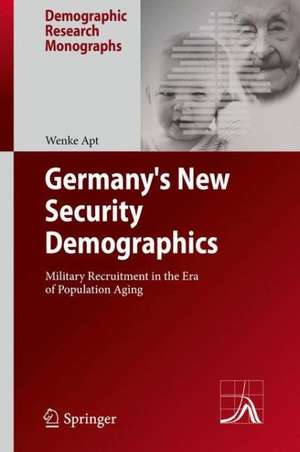
Germany's New Security Demographics
Autor Wenke Apten Limba Engleză Hardback – 18 dec 2013
An additional human capital projection until 2030 illustrates how the decline in the youth population will interact with trends in educational attainment and adolescent health to further complicate military recruitment in the future. A concluding review of recruiting practices in other NATO countries provides insight in best-practice policy options to reduce the military’s sensitivity to demographic change.
Following this approach, the book gives prominence to a topic that has thus far been under-represented in the greater discussion of demographic change today, namely the demographic impact on international affairs and strategic calculations.
Preț: 666.33 lei
Preț vechi: 783.92 lei
-15%
Puncte Express: 999
Carte tipărită la comandă
Livrare economică 08-22 decembrie
Livrare prin curier în România Termenul estimat este afișat lângă disponibilitate.
Transport gratuit pentru acest produs Plată online sau ramburs, în funcție de opțiunile comenzii.
Retur gratuit în 14 zile Comandă securizată și suport în română.
Specificații
ISBN-13: 9789400769632
ISBN-10: 9400769636
Pagini: 236
Ilustrații: XVIII, 217 p. 64 illus.
Dimensiuni: 160 x 241 x 19 mm
Greutate: 0.47 kg
Ediția:2014
Editura: Springer
Locul publicării:Dordrecht, Netherlands
ISBN-10: 9400769636
Pagini: 236
Ilustrații: XVIII, 217 p. 64 illus.
Dimensiuni: 160 x 241 x 19 mm
Greutate: 0.47 kg
Ediția:2014
Editura: Springer
Locul publicării:Dordrecht, Netherlands
V-ar putea interesa
-
 Go Ask AliceAnonymous-20%Preț: 62.44 lei77.99 lei
 -
 The Sexualization of Girls and Girlhood: Causes, Consequences, and ResistanceEileen L. Zurbriggen-31%Preț: 610.33 lei889.48 lei
 -
 Youth Studies: An IntroductionAndy Furlong-15%Preț: 505.69 lei594.94 lei
 -
 A Sociology of Japanese Youth: From Returnees to NEETsRoger GoodmanPreț: 475.34 lei
 -
 Japan's Emerging Youth Policy: Getting Young Adults Back to WorkTuukka Toivonen-18%Preț: 1255.87 lei1531.54 lei
 -
 Preț: 399.81 lei
 -
 -18%Preț: 1261.09 lei1537.92 lei
 -
 -13%Preț: 574.11 lei659.90 lei
 -
 Grow the Tree You GotTom SturgesPreț: 134.57 lei
 -
 Growing Up AbsurdPaul GoodmanPreț: 140.89 lei
 -
 -27%Preț: 1602.64 lei2185.18 lei
 -
 Key Concepts in Youth StudiesMark CieslikPreț: 374.92 lei
 -
 -15%Preț: 426.80 lei502.11 lei
 -
 Adolescent Neglect: Research, Policy and PracticeGwyther Rees-26%Preț: 197.37 lei267.74 lei
 -
 Quenton CohenMacPreț: 107.78 lei
Public țintă
ResearchCuprins
Acknowledgements.- 1. Introduction.- 2. The Military Environment.- 3. A Demographic View on Security.- 4. The Selectivity of Manpower Demand and Supply.- 5. Determinants of Military Manpower Supply.- 6. The Military Recruitment Target Population.- 7. Demographic Change as a Strategic Constraint: Issues and Options.- Bibliography.
Textul de pe ultima copertă
Military recruitment will become more difficult in times of demographic aging. The question arises whether demographic change will constrain the capacity of aging states like Germany to conduct foreign policy and pursue their national security interests. Since contemporary military operations still display a strong human element, particular scrutiny is given to the empirical analysis of the determinants of military propensity and military service among youth.
An additional human capital projection until 2030 illustrates how the decline in the youth population will interact with trends in educational attainment and adolescent health to further complicate military recruitment in the future. A concluding review of recruiting practices in other NATO countries provides insight in best-practice policy options to reduce the military’s sensitivity to demographic change.
Following this approach, the book gives prominence to a topic that has thus far been under-represented in the greater discussion of demographic change today, namely the demographic impact on international affairs and strategic calculations.
An additional human capital projection until 2030 illustrates how the decline in the youth population will interact with trends in educational attainment and adolescent health to further complicate military recruitment in the future. A concluding review of recruiting practices in other NATO countries provides insight in best-practice policy options to reduce the military’s sensitivity to demographic change.
Following this approach, the book gives prominence to a topic that has thus far been under-represented in the greater discussion of demographic change today, namely the demographic impact on international affairs and strategic calculations.
Caracteristici
Thorough overview and discussion of the interaction between demographic trends and international security New insights into the impact of demographic change on strategic calculations Systematic review of the demography-induced recruitment challenges of the German military