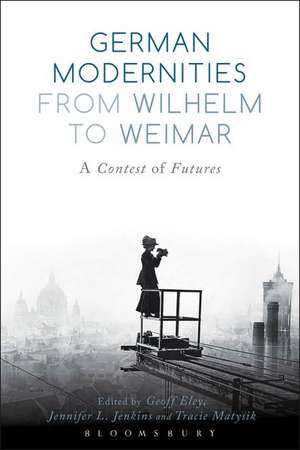
German Modernities From Wilhelm to Weimar: A Contest of Futures
Editat de Professor Geoff Eley, Professor Jennifer L. Jenkins, Professor Tracie Matysiken Limba Engleză Paperback – 25 aug 2016
German Modernities From Wilhelm to Weimar brings together leading historians of the Imperial and Weimar periods from across North America to readdress the question of German modernities. Acutely attentive to Germany's eventual turn towards National Socialism and the related historiographical arguments about 'modernity', this volume explores the variety of social, intellectual, political, and imperial projects pursued by those living in Germany in the Wilhelmine and Weimar years who were yet uncertain about what they were creating and which future would come. It includes varied case studies, based on cutting-edge research, which rethink the relationship of the early 20th century to the rise of Nazism and the Third Reich.
A range of political, social and cultural issues, including citizenship, welfare, empire, aesthetics and sexuality, as well as the very nature of German modernity, are analyzed and placed in a global context. German Modernities From Wilhelm to Weimar is a book of vital significance to all students of modern German history seeking to further understand the complex period from 1880 to 1930.
Preț: 261.59 lei
Preț vechi: 316.35 lei
-17%
Puncte Express: 392
Carte tipărită la comandă
Livrare economică 26 octombrie-09 noiembrie
Livrare prin curier în România Termenul estimat este afișat lângă disponibilitate.
Transport gratuit de la 400.00 lei Plată online sau ramburs, în funcție de opțiunile comenzii.
Retur gratuit în 14 zile Comandă securizată și suport în română.
Specificații
ISBN-13: 9781474216272
ISBN-10: 1474216277
Pagini: 376
Ilustrații: 4 bw illus
Dimensiuni: 158 x 232 x 24 mm
Greutate: 0.58 kg
Editura: Bloomsbury Publishing
Colecția Bloomsbury Academic
Locul publicării:London, United Kingdom
ISBN-10: 1474216277
Pagini: 376
Ilustrații: 4 bw illus
Dimensiuni: 158 x 232 x 24 mm
Greutate: 0.58 kg
Editura: Bloomsbury Publishing
Colecția Bloomsbury Academic
Locul publicării:London, United Kingdom
V-ar putea interesa
-
 Starkey, D: HenryDavid StarkeyPreț: 120.19 lei
 -
 Fifty Things You Need To Know About British HistoryHugh WilliamsPreț: 107.47 lei
 -
 Twisted Paths: Europe 1914-1945Robert Gerwarth-21%Preț: 364.99 lei460.55 lei
 -
 The Bloody White BaronJames PalmerPreț: 91.51 lei
 -
 The Iron IndustryRichard Hayman-32%Preț: 46.24 lei67.90 lei
 -
 Modernity Britain: 1957-1962David Kynaston-24%Preț: 94.96 lei124.24 lei
 -
 The FlaneurEdmund White-34%Preț: 50.97 lei76.99 lei
 -
 Dunkirk: The Men They Left BehindSean Longden-25%Preț: 81.62 lei108.52 lei
 -
 Preț: 136.00 lei
 -
 Major & Mrs Holt's Pocket Battlefield Guide to Normandy Landing BeachesMajor and Mrs HoltPreț: 50.05 lei
Cuprins
1. Introduction (Geoff Eley, Jennifer Jenkins and Tracie Matysik)
2. Neither Singular nor Alternative: Narratives of Welfare and Modernity in Germany, 1870-1945 Young-Sun Hong (State University of New York at Stony Brook, USA)
3. What Was German Modernity and When? - Geoff Eley (University of Michigan, USA)
4. Alternative Modernities: Imperial Germany through the Lens of Russia - Annemarie Sammartino (Oberlin College, USA)
5. Elsewhere in Central Europe: Jewish Literature in the Austro-Hungarian Monarchy between 'Habsburg Myth' and 'Central Europe Effect' - Scott Spector (University of Michigan, USA)
6. Communism and Colonialism in the Red and Black Atlantic: Toward a Transnational Narrative of German Modernity - Andrew Zimmerman (George Washington University, USA)
7. The Racial Economy of Weltpolitik: Imperialist Expansion, Domestic Reform, and War in Pan-German Ideology, 1894-1918 - Dennis Sweeney (University of Alberta, Canada)
8. The Wilhelmine Reform Milieu Reconsidered: The Deutscher Werkbund, the Prussian Commerce Ministry and Germany's Commercial Ambitions - John Maciuika (Baruch College, City University of New York, USA)
9. Prevention, Welfare, and Citizenship: The War on Tuberculosis and Infant Mortality in Germany, 1900-1930 - Larry Frohman (State University of New York at Stony Brook, USA)
10. Secularism, Subjectivity and Reform: Shifting Variables - Tracie Matysik (University of Texas at Austin, USA)
11. War, Citizenship and the Rhetorics of Sexual Crisis: Reflections on States of Exception in Germany, 1914-1920 - Kathleen Canning (University of Michigan, USA)
12. Anchoring the Nation in the Democratic Form: Weimar Symbolic Politics Beyond the Failure Paradigm - Manuela Achilles (University of Virginia, USA)
13. The Werkbund Exhibition: 'The New Age' of 1932 - Jennifer L. Jenkins (University of Toronto, Canada)
14. Women on the Verge of a Nervous Breakthrough: Emancipation, Sexuality and Female Political Subjectivity - Marti Lybeck (University of Wisconsin La Crosse, USA)
15. National Socialism and the Limits of 'Modernity' - Mark Roseman (Indiana University, USA)
Index
2. Neither Singular nor Alternative: Narratives of Welfare and Modernity in Germany, 1870-1945 Young-Sun Hong (State University of New York at Stony Brook, USA)
3. What Was German Modernity and When? - Geoff Eley (University of Michigan, USA)
4. Alternative Modernities: Imperial Germany through the Lens of Russia - Annemarie Sammartino (Oberlin College, USA)
5. Elsewhere in Central Europe: Jewish Literature in the Austro-Hungarian Monarchy between 'Habsburg Myth' and 'Central Europe Effect' - Scott Spector (University of Michigan, USA)
6. Communism and Colonialism in the Red and Black Atlantic: Toward a Transnational Narrative of German Modernity - Andrew Zimmerman (George Washington University, USA)
7. The Racial Economy of Weltpolitik: Imperialist Expansion, Domestic Reform, and War in Pan-German Ideology, 1894-1918 - Dennis Sweeney (University of Alberta, Canada)
8. The Wilhelmine Reform Milieu Reconsidered: The Deutscher Werkbund, the Prussian Commerce Ministry and Germany's Commercial Ambitions - John Maciuika (Baruch College, City University of New York, USA)
9. Prevention, Welfare, and Citizenship: The War on Tuberculosis and Infant Mortality in Germany, 1900-1930 - Larry Frohman (State University of New York at Stony Brook, USA)
10. Secularism, Subjectivity and Reform: Shifting Variables - Tracie Matysik (University of Texas at Austin, USA)
11. War, Citizenship and the Rhetorics of Sexual Crisis: Reflections on States of Exception in Germany, 1914-1920 - Kathleen Canning (University of Michigan, USA)
12. Anchoring the Nation in the Democratic Form: Weimar Symbolic Politics Beyond the Failure Paradigm - Manuela Achilles (University of Virginia, USA)
13. The Werkbund Exhibition: 'The New Age' of 1932 - Jennifer L. Jenkins (University of Toronto, Canada)
14. Women on the Verge of a Nervous Breakthrough: Emancipation, Sexuality and Female Political Subjectivity - Marti Lybeck (University of Wisconsin La Crosse, USA)
15. National Socialism and the Limits of 'Modernity' - Mark Roseman (Indiana University, USA)
Index
Recenzii
[A] theoretically ambitious volume . admirable for its clear focus and coherence . [It] is not only characterized by a high level of scholarship but also succeeds in showing the complexities of German history.
A comprehensive and well-structured collection of articles on modern German history ... This multi-author survey is helpful not only for readers first approaching modern German history, but also for those experts who want to refresh their knowledge through the lens of non-mainstream and recent topics of historical writing about Wilhelmine and Weimar Germany.
This fine collection of sophisticated essays mounts an important challenge to received notions of modern German history. The book's distinguished authors collectively wrestle the discussion of modernity in German history away from an earlier concern with transitional narratives - the overcoming of tradition, of feudal remnants, of militarism, and the like. Instead, they explore "modernity" as a claim made by historical actors, and as a set of practices more than a theoretical concern. German modernity here is not so much virtue or vice, but a global condition. Collectively, the authors thus rewrite the history of the Wilhelmine and Weimar periods for our times.
German Modernities is a rich and original collection of essays on the multiple ways in which possible modern futures were imagined and struggled for in Wilhelmine and Weimar Germany. Theoretically and empirically these essays challenge arguments about Germany's incomplete or pathological modernization as well as those about the inevitably disciplinary and repressive nature of modernity. Essays by scholars of several generations explore topics ranging from social reform and welfare to secularism, sexuality, and citizenship. They view Germany not only from within but also in a global, transnational, and colonial context. They illustrate in fascinating detail that Wilhelmine Germany was far from stagnant and unmodern and Weimar more than crisis-ridden in unproductive ways. This collection is a valuable addition to the ongoing debates about the diversity and ambivalence of German modernities and the complex ways they played out in the politics of everyday life.
Together the contributions to this important volume create a powerful mosaic of German modernities from the late 19th century to the onset of National Socialism. Ranging from studies of empire and reform to citizenship, aesthetics, and subjectivity-and the interactions of such forces-the articles collected here reveal the complex and contradictory ways, in which contemporaries conceptualized and fought over what it means to be modern. Engaging with theory, revising old stories and telling new ones, the volume shows just how entangled Germany's history is and must be with broader debates about the nature of modernity.
A comprehensive and well-structured collection of articles on modern German history ... This multi-author survey is helpful not only for readers first approaching modern German history, but also for those experts who want to refresh their knowledge through the lens of non-mainstream and recent topics of historical writing about Wilhelmine and Weimar Germany.
This fine collection of sophisticated essays mounts an important challenge to received notions of modern German history. The book's distinguished authors collectively wrestle the discussion of modernity in German history away from an earlier concern with transitional narratives - the overcoming of tradition, of feudal remnants, of militarism, and the like. Instead, they explore "modernity" as a claim made by historical actors, and as a set of practices more than a theoretical concern. German modernity here is not so much virtue or vice, but a global condition. Collectively, the authors thus rewrite the history of the Wilhelmine and Weimar periods for our times.
German Modernities is a rich and original collection of essays on the multiple ways in which possible modern futures were imagined and struggled for in Wilhelmine and Weimar Germany. Theoretically and empirically these essays challenge arguments about Germany's incomplete or pathological modernization as well as those about the inevitably disciplinary and repressive nature of modernity. Essays by scholars of several generations explore topics ranging from social reform and welfare to secularism, sexuality, and citizenship. They view Germany not only from within but also in a global, transnational, and colonial context. They illustrate in fascinating detail that Wilhelmine Germany was far from stagnant and unmodern and Weimar more than crisis-ridden in unproductive ways. This collection is a valuable addition to the ongoing debates about the diversity and ambivalence of German modernities and the complex ways they played out in the politics of everyday life.
Together the contributions to this important volume create a powerful mosaic of German modernities from the late 19th century to the onset of National Socialism. Ranging from studies of empire and reform to citizenship, aesthetics, and subjectivity-and the interactions of such forces-the articles collected here reveal the complex and contradictory ways, in which contemporaries conceptualized and fought over what it means to be modern. Engaging with theory, revising old stories and telling new ones, the volume shows just how entangled Germany's history is and must be with broader debates about the nature of modernity.