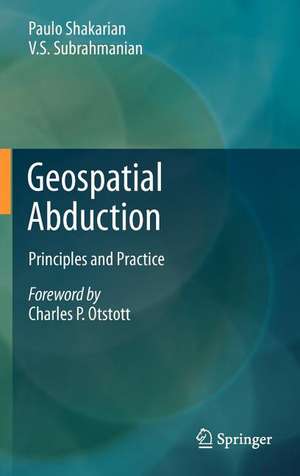
Geospatial Abduction
Autor Paulo Shakarian, V. S. Subrahmanianen Limba Engleză Hardback – 19 oct 2011
Preț: 343.90 lei
Preț vechi: 429.87 lei
-20%
Puncte Express: 516
Carte tipărită la comandă
Livrare economică 23 noiembrie-07 decembrie
Livrare prin curier în România Termenul estimat este afișat lângă disponibilitate.
Transport gratuit de la 400.00 lei Plată online sau ramburs, în funcție de opțiunile comenzii.
Retur gratuit în 14 zile Comandă securizată și suport în română.
Specificații
ISBN-13: 9781461417934
ISBN-10: 1461417937
Pagini: 184
Ilustrații: XVI, 168 p.
Dimensiuni: 160 x 241 x 15 mm
Greutate: 0.4 kg
Ediția:2011
Editura: Springer
Locul publicării:New York, NY, United States
ISBN-10: 1461417937
Pagini: 184
Ilustrații: XVI, 168 p.
Dimensiuni: 160 x 241 x 15 mm
Greutate: 0.4 kg
Ediția:2011
Editura: Springer
Locul publicării:New York, NY, United States
V-ar putea interesa
-
 Introduction to Cyber-Warfare: A Multidisciplinary ApproachPaulo Shakarian-14%Preț: 266.08 lei309.28 lei
 -
 Cybersecurity and Applied MathematicsLeigh Metcalf-29%Preț: 332.50 lei471.55 lei
 -
 Darkweb Cyber Threat Intelligence MiningJohn Robertson-20%Preț: 456.13 lei570.16 lei
 -
 -23%Preț: 487.76 lei633.45 lei
 -
 Preț: 419.59 lei
 -
 Information Theory in Computer Vision and Pattern RecognitionFrancisco Escolano Ruiz-20%Preț: 653.98 lei817.47 lei
 -
 Guide to Geometric Algebra in PracticeLeo Dorst-18%Preț: 974.82 lei1188.81 lei
 -
 Handbook of Computational Approaches to CounterterrorismV. S. Subrahmanian-20%Preț: 691.49 lei864.36 lei
 -
 A General Framework for Reasoning On InconsistencyMaria Vanina Martinez-20%Preț: 231.75 lei289.69 lei
 -
 Search TheorySteve Alpern-15%Preț: 670.48 lei788.80 lei
 -
 -15%Preț: 658.66 lei774.89 lei
 -
 Artificial Intelligence and Symbolic ComputationGonzalo A. Aranda-Corral-20%Preț: 317.84 lei397.30 lei
 -
 Diffusion in Social NetworksPaulo Shakarian-20%Preț: 334.74 lei418.43 lei
 -
 Algebra for CryptologistsAlko R. MeijerPreț: 526.70 lei
 -
 Mathematical Software - ICMS 2016Gert-Martin Greuel-20%Preț: 348.66 lei435.83 lei
 -
 -5%Preț: 1662.48 lei1749.98 lei
 -
 -5%Preț: 1055.44 lei1110.99 lei
 -
 Soft Methods for Data ScienceMaria Brigida Ferraro-20%Preț: 1250.59 lei1563.24 lei
 -
 -20%Preț: 330.21 lei412.76 lei
 -
 Information SecurityMatt Bishop-20%Preț: 353.67 lei442.09 lei
 -
 -20%Preț: 312.30 lei390.38 lei
 -
 Arithmetic of Finite FieldsSylvain Duquesne-20%Preț: 321.74 lei402.18 lei
 -
 Scalable Uncertainty ManagementWeiru Liu-20%Preț: 340.57 lei425.71 lei
 -
 -20%Preț: 319.42 lei399.28 lei
 -
 System Modeling and OptimizationChristian Pötzsche-54%Preț: 358.36 lei776.66 lei
 -
 On Meaningful Scientific LawsJean-Claude Falmagne-20%Preț: 344.00 lei430.00 lei
 -
 Preț: 370.54 lei
Public țintă
Professional/practitionerCuprins
Introduction.- Point-based Geospatial Abduction.- Region-Based Geospatial Abduction.- Geospatial Abduction with Adaptive Adversaries.- Two Real-World Geospatial Abduction Applications.- Index.
Recenzii
From the reviews:
“This monograph is an attempt to formalize abductive reasoning based on geospatial information. It includes conceptual definitions, algorithms for exact and approximate solutions, descriptions of heuristics, and examples of applying geospatial abduction to real-world problems. … The exposition is comparable to senior undergraduate or graduate-level texts in algorithms and computability theory. … This monograph will be a useful addition to the shelves of academics, students, and developers working with geospatial knowledge in a variety of domains.” (R. M. Malyankar, ACM Computing Reviews, June, 2012)
“This monograph is an attempt to formalize abductive reasoning based on geospatial information. It includes conceptual definitions, algorithms for exact and approximate solutions, descriptions of heuristics, and examples of applying geospatial abduction to real-world problems. … The exposition is comparable to senior undergraduate or graduate-level texts in algorithms and computability theory. … This monograph will be a useful addition to the shelves of academics, students, and developers working with geospatial knowledge in a variety of domains.” (R. M. Malyankar, ACM Computing Reviews, June, 2012)
Caracteristici
Provides the mathematics underlying geospatial abduction and the algorithms to solve them in practice Offers wide applicability in many different fields for practitioners and researchers Includes several lively, real-world examples that will explain the material very clearly to a reader Includes a web site dedicated to geospatial abduction, hosted at University of Maryland. In addition, the authors will record video lectures (30-60 minutes each) devoted to each chapter, as well as slides on each. These materials will supplement the book
Notă biografică
Paulo Shakarian is an associate professor at Arizona State University. His research focuses on symbolic AI and hybrid symbolic-ML systems. He received his Ph.D. from the University of Maryland, College Park. He is a past DARPA Military Fellow, AFOSR Young Investigator recipient, and his work earned multiple "best paper" awards.
Gerardo I. Simari is a professor at UNS, and a researcher at CONICET. His research focuses on AI and Databases, and reasoning under uncertainty. He received a PhD in computer science from University of Maryland College Park and later joined the Department of Computer Science, University of Oxford, where he was also a Fulford Junior Research Fellow of Somerville College.
Chitta Baral is a Professor at the Arizona State University, and a past President of KR Inc. His research interests include Knowledge Representation and Reasoning, NLP and Image Understanding and often involves combining logical reasoning with explicit knowledge and neural learning and reasoning with textual and perceptual inputs.
Bowen Xi is a Ph.D. student at Arizona State University, specializing in the field of Neural Symbolic AI. She is passionate about combining the strengths of neural networks and symbolic reasoning to advance the field of artificial intelligence. Bowen's research interests include developing novel algorithms and techniques that enable machines to learn and reason like humans.
Lahari Pokala is a student pursuing her Master's degree at Arizona State University, where she is majoring in Computer Science. Her interests lie in artificial intelligence and data engineering.