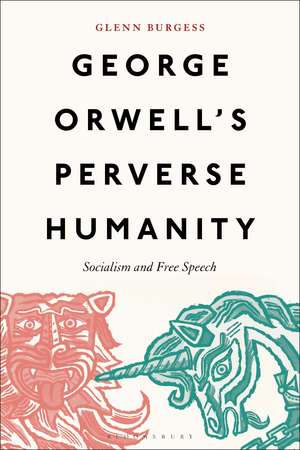
George Orwell's Perverse Humanity: Socialism and Free Speech
Autor Glenn Burgessen Limba Engleză Paperback – 4 mai 2023
Destinat nivelului de licență și cercetării academice, acest volum semnat de Glenn Burgess oferă o perspectivă riguroasă asupra unuia dintre cei mai influenți gânditori ai secolului XX. Observăm că, deși figura lui Orwell este omniprezentă în discursul public, ideologia sa socialistă rămâne adesea obscură sau distorsionată. Burgess reușește să demonstreze cum viziunea politică a lui Orwell nu a fost o respingere a liberalismului, ci o încercare de a-l completa prin socialism, punând libertatea de gândire în centrul oricărei reforme sociale.
Descoperim aici o analiză structurată meticulos, care pornește de la conceptul de „ownlife” (individualism și excentricitate) și parcurge evoluția autorului de la „anarhist conservator” la activist dedicat. Merită menționat faptul că Burgess nu se limitează la textele canonice, ci investighează experiențele concrete ale lui Orwell cu cenzura la BBC și activitatea sa în organizații precum Freedom Defence Committee. Această abordare forensică transformă portretul scriitorului dintr-o figură literară abstractă într-un gânditor politic angajat.
Cititorii familiarizați cu Hope Lies in the Proles de John Newsinger vor aprecia modul în care Burgess adâncește analiza contradicțiilor lui Orwell. În timp ce Newsinger se concentrează pe relația cu clasa muncitoare, Burgess pune accentul pe mecanismele libertății de exprimare și onestității intelectuale. Față de Liberty, Equality, and Humbug de David Dwan, care analizează opacitatea valorilor orwelliene, volumul de față oferă o clarificare istorică bazată pe arhive, situând opera lui Orwell în contextul tradiției politice engleze.
Preț: 153.86 lei
Preț vechi: 181.22 lei
-15%
Carte disponibilă
Livrare economică 19 mai-02 iunie
Livrare express 02-08 mai pentru 56.91 lei
Specificații
ISBN-10: 1501394657
Pagini: 280
Dimensiuni: 228 x 154 x 24 mm
Greutate: 0.44 kg
Editura: Bloomsbury Publishing
Colecția Bloomsbury Academic
Locul publicării:New York, United States
De ce să citești această carte
Această lucrare este esențială pentru studenții la științe politice și istorie literară care doresc să înțeleagă rădăcinile intelectuale ale lui Orwell dincolo de etichetele simpliste. Cititorul câștigă o viziune clară asupra modului în care libertatea individuală poate coexista cu justiția socială, primind un instrument critic pentru a naviga „războaiele culturale” contemporane unde numele lui Orwell este adesea folosit greșit.
Despre autor
Glenn Burgess este profesor de istorie la Universitatea din Hull și un reputat specialist în istoria gândirii politice britanice. Expertiza sa vastă, vizibilă în lucrări precum Absolute Monarchy and the Stuart Constitution sau British Political Thought 1500-1660, îi permite să plaseze ideile lui Orwell într-o perspectivă istorică de lungă durată. În timp ce alte lucrări ale sale, precum The New British History, explorează formarea identității naționale și constituționale, volumul de față reprezintă o extensie naturală a interesului său pentru modul în care libertățile civile interacționează cu autoritatea statului.
Descriere
Orwell is today claimed by the Left and Right, by neo-conservatives and neo-socialists. How is that possible? Part of the answer, as Glenn Burgess reveals, is that Orwell was an odd sort of socialist. The development of Orwell's socialism was, from the start, conditioned by his individualist and liberal commitments. The hopes he attached to socialism were for a fairer, more equal world that would permit human freedom and individuality to flourish, completing, not destroying, the work of liberalism. Freedom of thought was a central part of this, and its defence and use were essential parts of the struggle to ensure that socialism developed in a liberal, humane form that did not follow the totalitarian path of Soviet communism.
Written in celebration of Orwell's dictum, 'We hold that the most perverse human being is more interesting than the most orthodox gramophone record,' George Orwell's Perverse Humanity is a portrait of Orwell that captures these themes and provides a new understanding of him as a political thinker and activist. Based on archival research and new materials that affirm his work as an activist for freedom, it also uncovers a socialist ideology that has been obscured in just the way that the author feared it would be - associated in many people's minds with totalitarian unfreedom.
Cuprins
1. Orwell and the Culture Wars
2. How to Be Yourself (or Not): Orwell's Early Novels
3. The Expression on a Human Face
4. Individualism, Liberty, Socialism
Part I: Orwell's Socialism
1.. Before Orwell; Before Socialism: A Tory Anarchist?
2. The Birth of George Orwell's Socialism
3. The Development of Orwell's Socialism
(a). Peace, Empire and Internationalism
(b). Revolution and Political Violence
(c). Nostalgia, Progress, and Utopia
Part II: Orwell and Freedom of Thought
1. From Eric Blair to George Orwell: Englishness and Freedom
2. Libel, Obscenity and Politics: Orwell's Early Experience of Censorship
3. 'All Propaganda is Lies': Orwell, BBC Propaganda and Intellectual Responsibility
4. Writing for Freedom: Tribune, Animal Farm and Free Speech
5. Activist for Intellectual Freedom: (I) The Freedom Defence Committee
6. Activist for Intellectual Freedom: (II) The League for the Dignity and Rights of Man
7. Propaganda Again: Orwell, His List and the Information Research Department (IRD)
8. Freedom and Truth: Nineteen Eighty-Four
Index
Recenzii
Glenn Burgess synthesizes a massive number of primary and secondary texts and constructs an original and clear argument around them on a vitally important area - namely Orwell's ideas about socialism, free speech, freedom of thought, press freedom and censorship. It amounts to an important and fascinating addition to Orwellian scholarship.
Burgess's book is structured logically and straightforwardly... George Orwell's Perverse Humanity is detailed and often forensic in its methodology. It is, however, readable and fascinating.