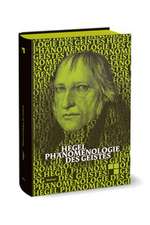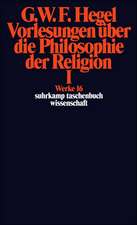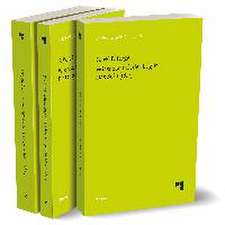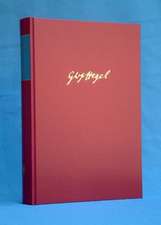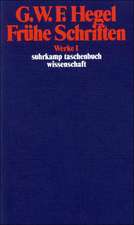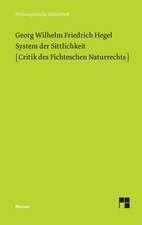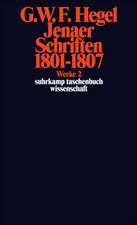
Jenaer Schriften 1801 - 1807
feb 2011
Paperback
Preț: 173.28 lei
17-23 zile | 6-12 zile

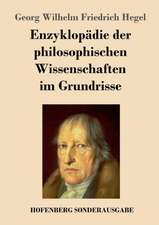
Georg Wilhelm Friedrich Hegel (; German: [ˈɡeːɔʁk ˈvɪlhɛlm ˈfʁiːdʁɪç ˈheːɡl̩]; 27 August 1770 – 14 November 1831) was a German philosopher. He is considered one of the most important figures in German idealism and one of the founding figures of Western philosophy, with his influence extending to the entire range of contemporary philosophical issues, from aesthetics to ontology and politics, both in the analytic and continental tradition.
Hegel's principal achievement was the development of a distinctive articulation of idealism, sometimes termed absolute idealism, in which the dualisms of, for instance, mind and nature and subject and object are overcome. In contrast to Immanuel Kant, who believes that the subject imposes rational a priori pure concepts of understanding upon the sense-data of intuitions, Hegel believes that the pure concepts are grounded in reality itself. Pure concepts are not applied subjectively to sense-impressions, but rather things exist for their concept. The unity of concept and reality is the Idea. The idea itself is dynamic, active, self-determining, self-moving, and purposive. The idea properly exists as life. In life, the parts of the body are unified for the final cause of actualizing the living organism. Non-organic nature is also grounded in the concept, but is only “latent” and not fully self-determining. Geist, or Spirit is the highest form of life and the idea. Geist is the collective purposive agency and genus of man. Geist is equally substance and subject, meaning that geist is not only a living organic substance, but also a subject involved in complex normative and social spaces. Hegel is also known for his dialectical logic, which is mostly contained within his Science of Logic. In this book, Hegel creates a presuppositionless logic of pure thought, which begins with pure being. In the logic, positions and ideas are examined and revealed to be immanently contradictory. The contradiction within the position and itself is sublated (In German, it is called Aufhebung), in which a new position is posited which negates the previous position's contradiction. An example of sublation is the contradictory nature of pure indeterminate being. Pure being is revealed to be both equal to and different from nothing. This contradiction within being is resolved with its sublation into becoming, in which nothing passes into being and being passes into nothing. However, becoming also reveals its own contradictions and is sublated into determinate being. The logic progresses along through contradictions and sublations until there are no more contradictions that can be sublated. This is the absolute, which for Hegel is the idea.
Hegel influenced a wide variety of thinkers and writers. For example, theologian Paul Tillich wrote that the historical dialectical thought of Hegel "has influenced world history more profoundly than any other structural analysis." In his work Systematic Theology, Tillich referred to Hegel's work as "perfect essentialism," later writing "essentialism was in Hegel's system fulfilled." Karl Barth described Hegel as a "Protestant Aquinas" while Maurice Merleau-Ponty wrote that "all the great philosophical ideas of the past century—the philosophies of Marx and Nietzsche, phenomenology, German existentialism, and psychoanalysis—had their beginnings in Hegel." Michael Hardt has highlighted that the roots of post-structuralism and its unifying basis lies, in large part, in a general opposition not to the philosophical tradition tout court but specifically to the "Hegelian tradition" dominating philosophy in the twentieth century prior to post-structuralism.
Hegel's work has been considered the "completion of philosophy" by some of the most influential thinkers in existentialism, post-structuralism, and twentieth-century theology. Jacques Derrida wrote of Hegel in his work Of Grammatology that "if there were a definition of Différance, it would be precisely the limit, the interruption, the destruction of the Hegelian dialectical synthesis wherever it operates." Martin Heidegger observed in his 1969 work Identity and Difference and in his personal Black Notebooks that Hegel's system in an important respect "consummates western philosophy" by completing the idea of the logos, the self-grounding ground, in thinking through the identification of Being and beings, which is "the theme of logic", writing "[I]t is... incontestable that Hegel, faithful to tradition, sees the matter of thinking in beings as such and as a whole, in the movement of Being from its emptiness to its developed fullness." Heidegger in various places further stated Hegel's thinking to be "the most powerful thinking of modern times."