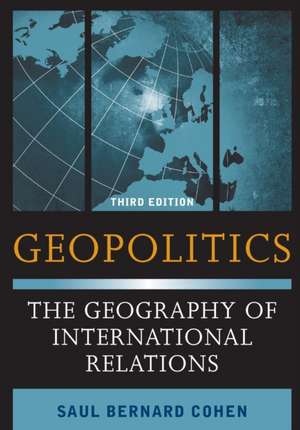
Geopolitics: The Geography of International Relations
Autor Saul Bernard Cohenen Limba Engleză Paperback – 25 noi 2014
În cadrul programelor de studii dedicate Relațiilor Internaționale și Geografiei Politice, lucrarea Geopolitics de Saul Bernard Cohen reprezintă un text fundamental pentru înțelegerea modului în care configurația fizică a lumii modelează deciziile de politică externă. Această a treia ediție, publicată de Bloomsbury Publishing sub amprenta Rowman & Littlefield, actualizează cadrul teoretic necesar interpretării dinamicii globale de după Războiul Rece, punând accent pe forțele ideologice și socio-culturale contemporane. Considerăm că forța acestui volum rezidă în capacitatea de a ancora teoria politică în realitatea geografică concretă.
Din punct de vedere structural, volumul progresează de la o trecere în revistă a teoriilor geopolitice și a structurilor globale spre o analiză regională extrem de detaliată. Remarcăm abordarea sistematică a zonelor de convergență și tensiune, precum „Shatterbelts” din Orientul Mijlociu și Africa Sub-sahariană, oferind o perspectivă nuanțată asupra instabilității regionale. Geopolitics extinde cadrul propus de Introduction to Geopolitics de Colin Flint prin integrarea unei analize mai profunde a cadrului fizic și uman, oferind studenților nu doar concepte, ci și instrumente de analiză spațială aplicată. Comparativ cu The Geopolitics Reader de Simon Dalby, care este o antologie de texte istorice, lucrarea lui Cohen oferă o sinteză teoretică unitară și actualizată la realitățile secolului XXI. Cele 22 de ilustrații și 16 tabele completează textul, facilitând vizualizarea fluxurilor de putere și a barierelor geografice care definesc ordinea mondială actuală.
Preț: 535.65 lei
Preț vechi: 741.15 lei
-28%
Carte tipărită la comandă
Livrare economică 27 noiembrie-11 decembrie
Specificații
ISBN-10: 1442223502
Pagini: 504
Ilustrații: 22 b/w illustrations; 16 tables
Dimensiuni: 174 x 252 x 30 mm
Greutate: 1.04 kg
Ediția:3 Rev ed.
Editura: Bloomsbury Publishing
Colecția Rowman & Littlefield
Locul publicării:New York, United States
V-ar putea interesa
-
 China's Western Horizon: Beijing and the New Geopolitics of EurasiaDaniel S. Markey-16%Preț: 204.67 lei243.23 lei
 -
 The Geopolitics ReaderSimon Dalby-15%Preț: 623.60 lei733.64 lei
 -
 The Grand Chessboard: American Primacy and Its Geostrategic ImperativesZbigniew Brzezinski-15%Preț: 126.87 lei148.56 lei
 -
 -43%Preț: 149.91 lei262.57 lei
 -
 Geopolitics, Geography and StrategyColin S. Gray-18%Preț: 1258.30 lei1534.51 lei
 -
 Nuclear Weapons and American Grand StrategyFrancis J. Gavin-24%Preț: 224.82 lei295.57 lei
De ce să citești această carte
Recomandăm această carte studenților și cercetătorilor care doresc să înțeleagă fundamentele geografice ale conflictelor moderne. Geopolitics oferă un avantaj analitic clar prin explicarea modului în care teritoriul și resursele dictează strategia marilor puteri. Este o resursă esențială pentru oricine dorește să depășească analizele politice abstracte și să înțeleagă mecanismele concrete care guvernează relațiile internaționale într-o lume în continuă schimbare.
Despre autor
Saul Bernard Cohen este o figură proeminentă în geografia politică mondială, deținând titlul de University Professor of Geography emerit la Hunter College, City University of New York. Cu o carieră academică distinsă, a servit ca director al Clark University Graduate School of Geography, una dintre cele mai prestigioase instituții de profil. Expertiza sa în analiza spațială și geostrategie este recunoscută la nivel internațional, lucrarea de față fiind considerată de critici un „magnum opus” al carierei sale, îmbinând rigoarea academică cu o înțelegere profundă a realităților politice globale.
Descriere
Written by one of the world's leading political geographers, this fully revised and updated textbook examines the dramatic changes wrought by ideological, economic, sociocultural, and demographic changes unleashed since the end of the Cold War. Saul Cohen considers these forces in the context of their human and physical settings and explores their geographical influence on foreign policy and international relations.
Cuprins
Chapter 2: Survey of Geopolitics
Chapter 3: Geopolitical Structure and Theory
Chapter 4: The Cold War and Its Aftermath
Chapter 5: North and Middle America
Chapter 6: South America
Chapter 7: Maritime Europe and the Maghreb
Chapter 8: Russia and the Eurasian Convergence Zone
Chapter 9: The East Asia Geostrategic Realm
Chapter 10: The Asia-Pacific Rim
Chapter 11: South Asia
Chapter 12: The Middle East Shatterbelt
Chapter 13: The Sub-Saharan African Shatterbelt
Chapter 14: Epilogue
Bibliography
Recenzii
[Geopolitics: The Geography of International Relations] provides accurate and well-structured information on geopolitics/international relations all around the world and hence makes a valuable reading for undergraduate students. For graduate students and scholars who specialize in Geopolitics, the book contains numerous interesting concepts and perspectives. These should be applied and refined in further research.
The third updated edition of Geopolitics: The Geography of International Relations is a pick for college-level social science and geography holdings alike, and comes form an author who assembles a geopolitical model to help readers understand the importance of geography to international relations. It blends geographic and human elements with political background and details that embed geopolitical theory in everyday life and world experiences, comes from one of the world's leading political geographers, and strives to avoid jargon so that it can reach a wider audience. This revised textbook considers the world changes brought about by economic, demographic and political forces since the end of the Cold War, and it discusses the different, changing, fluid geopolitical features of different countries and regions and how they interact. College-level readers will find this an involving, specific text.
I first learned about geopolitics from Saul Cohen's classic book, Geography and Politics in a World Divided. Cohen continues as the preeminent expert on geopolitics of our era. In this new edition of Geopolitics, he provides an unbiased and insightful overview of the world as it exists today, its axes of organization, and its tension points. The writing is clear and compelling as Cohen makes geopolitical theory accessible to all interested readers. Above all, Cohen reaffirms the overwhelming significance of a geographical perspective in understanding how the modern world operates and how it is likely to change in the future. All geographers, foreign area specialists, engaged citizens, and especially policy makers would do themselves an enormous favor by reading this book and absorbing its wisdom.
Saul Cohen has put together a remarkable geopolitical tour du monde that will help readers appreciate the relevance of geography to international relations. Unlike some recent geopolitical accounts that represent geography as a static, largely physical set of influences, Cohen emphasizes the dynamic mixture of physical and human geographical elements that bear on the tumultuous geopolitical world we inhabit. Avoiding jargon-laden prose, Cohen's book is as accessible as it is wide-ranging. Its empirical detail will expand readers' understanding of current events, and the author's unabashed willingness to offer his own interpretations of the geographical circumstances that bear on those events will likely stimulate reflection and discussion.
This is reality-based political geography at its best-a combination of deep factual knowledge of the world's major regions, including knowledge of their historical interaction as well as their current relations, with a panoptic world view, not of the shape of the globe as it should be but as it likely will be.
Cohen's magnum opus, and a brilliant work it is indeed. This text is monumental, profound, analytical, and grounded in sound theory and the real world. This is a book that must be read by students as well as all scholars, politicians, and others concerned with international relations.