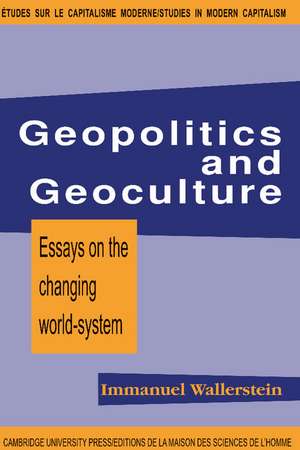
Geopolitics and Geoculture
Autor Immanuel Maurice Wallersteinen Limba Engleză Paperback – sep 1991
Observăm în literatura academică dedicată relațiilor internaționale o lacună în ceea ce privește integrarea dimensiunii culturale ca pilon structural al economiei-lume, dincolo de analizele pur politice sau economice. Geopolitics and Geoculture vine să completeze acest gol, oferind o sinteză a gândirii lui Immanuel Maurice Wallerstein din perioada 1982-1989. Putem afirma că acest volum nu este doar o cronică a prăbușirii blocului comunist, ci o demonstrație teoretică a modului în care declinul hegemoniei americane a precipitat reconfigurarea ordinii globale. Autorul propune conceptul inovator de „geocultură”, argumentând că, începând cu 1968, asistăm la o respingere a liberalismului universalist în favoarea unei focalizări pe identitate, rasism și sexism în interiorul sistemului. Găsim în această carte o continuitate directă cu temele din The Capitalist World-Economy, însă Geopolitics and Geoculture marchează o evoluție prin mutarea accentului de la mecanismele de producție spre suprastructura culturală care legitimează sistemul-mondial. Cartea acoperă aceeași arie tematică precum Global Formation de Christopher Chase-Dunn, dar cu o abordare mai interdisciplinară, care forțează granițele dintre științele sociale și umanioare. Stilul este cel caracteristic lui Immanuel Maurice Wallerstein: riguros, provocator și profund ancorat în ritmurile ciclice ale capitalismului istoric, oferind o perspectivă critică asupra evenimentelor ce au precedat unitatea europeană modernă.
Preț: 198.48 lei
Carte disponibilă
Livrare economică 23 octombrie-06 noiembrie
Specificații
ISBN-10: 0521406048
Pagini: 252
Dimensiuni: 152 x 229 x 16 mm
Greutate: 0.42 kg
Editura: Cambridge University Press
Locul publicării:Cambridge, United Kingdom
V-ar putea interesa
-
 The Spell of Language: Poststructuralism and SpeculationThomas G. PavelPreț: 238.51 lei
 -
 CanonsRobert von HallbergPreț: 196.85 lei
 -
 The Hooligan's Return: A MemoirNorman ManeaPreț: 407.00 lei
 -
 Poets in Their YouthEileen SimpsonPreț: 120.68 lei
 -
 Preț: 261.77 lei
 -
 Preț: 260.95 lei
 -
 Preț: 260.81 lei
 -
 The Modern World-System IVImmanuel WallersteinPreț: 261.79 lei
 -
 Epistemic Cultures – How the Sciences Make Knowledge (Paper)Karin Knorr KnorrPreț: 350.73 lei
 -
 Preț: 249.99 lei
 -
 HeterocosmicaLubomir DolezelPreț: 281.07 lei
 -
 World-Systems AnalysisImmanuel WallersteinPreț: 124.62 lei
 -
 The Future of NATO ExpansionZoltan BaranyPreț: 301.79 lei
 -
 The Persistent Power of Human RightsThomas RissePreț: 289.55 lei
 -
 The Global TransformationGeorge LawsonPreț: 253.55 lei
 -
 Just War and International OrderNicholas RenggerPreț: 218.76 lei
 -
 Preț: 458.62 lei
 -
 -15%Preț: 469.69 lei552.57 lei
 -
 Debating the CanonL. MorrisseyPreț: 393.91 lei
 -
 The Essential WallersteinImmanuel Maurice WallersteinPreț: 319.79 lei
 -
 BlindingMircea CartarescuPreț: 142.98 lei
 -
 Intersections, Interferences, InterdisciplinesGerald GillespiePreț: 443.16 lei
De ce să citești această carte
Recomandăm această carte cercetătorilor și studenților la științe politice sau sociologie care doresc să înțeleagă mecanismele profunde ale geopoliticii dincolo de evenimentele de suprafață. Cititorul câștigă un instrument critic de analiză a modului în care cultura este utilizată pentru a menține sau contesta puterea globală. Este o lectură esențială pentru a decoda tranziția de la ordinea Războiului Rece la actuala lume multipolară, prin prisma declinului hegemonic.
Despre autor
Immanuel Maurice Wallerstein a fost un cercetător proeminent la Yale University și director al Centrului Fernand Braudel. Este recunoscut la nivel mondial ca principalul arhitect al analizei sistemelor-mondiale, o perspectivă care a revoluționat sociologia istorică. Opera sa vastă, inclusiv trilogia monumentală The Modern World-System, explorează originile și dinamica economiei-lume capitaliste. În lucrări precum The Essential Wallerstein sau Dynamics of Global Crisis, el a investigat constant crizele structurale și mișcările antisistemice, rămânând unul dintre cei mai influenți intelectuali critici ai secolului XX, a cărui viziune asupra „geoculturii” continuă să modeleze dezbaterile contemporane despre globalizare.
Descriere scurtă
Cuprins
Recenzii
"This collection of essays is exceptional....likely to offer some refreshing, if controversial, views on present world affairs." Jan Nijman, The Professional Geographer