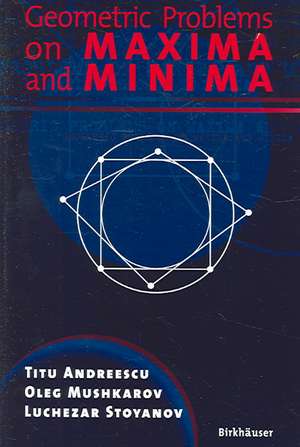
Geometric Problems on Maxima and Minima
Autor Titu Andreescu, Oleg Mushkarov, Luchezar Stoyanoven Limba Engleză Paperback – 8 dec 2005
Observăm că, în literatura matematică tradițională, studiul extremelor este aproape exclusiv rezervat analizei matematice și calculului diferențial. Geometric Problems on Maxima and Minima aduce o perspectivă proaspătă și necesară, demonstrând că intuiția geometrică poate oferi soluții elegante acolo unde formalismul algebric devine greoi. Această ediție din 2006 se distinge prin rigoarea pedagogică specifică autorilor Titu Andreescu, Oleg Mushkarov și Luchezar Stoyanov, care reușesc să transforme geometria euclidiană într-un instrument de optimizare extrem de puternic. Structura volumului facilitează o învățare progresivă. Prima parte este dedicată metodelor fundamentale, urmată de o clasificare a problemelor pe tipuri specifice, ceea ce permite cititorului să identifice rapid tiparele narative ale demonstrațiilor. Secțiunea finală de soluții și indicații transformă textul dintr-un simplu manual într-un instrument de lucru autodidact. Cititorii familiarizați cu Problem-Solving and Selected Topics in Euclidean Geometry de Sotirios E. Louridas vor aprecia aici concentrarea specifică pe inegalități și valori extreme, un domeniu care necesită o creativitate aparte față de geometria constructivă clasică. În contextul operei lui Titu Andreescu, acest titlu completează armonios lucrări precum Algebraic Inequalities: New Vistas sau Putnam and Beyond. Dacă în volumele anterioare accentul cădea pe structuri algebrice sau probleme de concurs multidisciplinare, aici observăm o rafinare a metodelor geometrice aplicate. Este o lucrare care nu se limitează la geometrie, ci face punți subtile către topologie și analiză, păstrând totodată un ton accesibil pentru studenții de nivel licență și pentru antrenorii de olimpiade.
Preț: 507.75 lei
Carte disponibilă
Livrare economică 07-21 noiembrie
Specificații
ISBN-10: 0817635173
Pagini: 264
Ilustrații: X, 264 p. 262 illus.
Dimensiuni: 154 x 238 x 22 mm
Greutate: 0.46 kg
Ediția:2006 edition
Editura: BIRKHAUSER BOSTON INC
Locul publicării:Boston, MA, United States
V-ar putea interesa
-
 Introduction to Recognition and Deciphering of PatternsMichael A. RadinPreț: 473.64 lei
 -
 Problems in Real AnalysisTeodora-Liliana Radulescu-15%Preț: 513.50 lei604.12 lei
 -
 102 Combinatorial ProblemsTitu Andreescu-17%Preț: 418.29 lei503.97 lei
 -
 103 Trigonometry ProblemsTitu Andreescu-15%Preț: 417.03 lei490.62 lei
 -
 Mathematical BridgesTitu AndreescuPreț: 336.77 lei
 -
 104 Number Theory ProblemsTitu Andreescu-15%Preț: 487.02 lei572.97 lei
 -
 Mathematical Olympiad ChallengesTitu AndreescuPreț: 458.06 lei
 -
 An Introduction to Diophantine EquationsTitu Andreescu-15%Preț: 538.69 lei633.75 lei
 -
 Mathematical Olympiad TreasuresTitu Andreescu-15%Preț: 550.78 lei647.97 lei
 -
 Preț: 203.16 lei
 -
 Methods of Solving Complex Geometry ProblemsEllina Grigorieva-15%Preț: 405.55 lei477.57 lei
 -
 Preț: 410.53 lei
 -
 Über Multiplikatoren zwischen verschiedenen Banach-RäumenHans-Jochem MertensPreț: 410.28 lei
 -
 Preț: 323.14 lei
 -
 Preț: 463.67 lei
 -
 Preț: 312.79 lei
 -
 Preț: 394.58 lei
 -
 Theory of Hypergeometric FunctionsKazuhiko Aomoto-15%Preț: 563.65 lei663.11 lei
 -
 Preț: 153.24 lei
 -
 Preț: 136.22 lei
 -
 BOUNDED SYMMETRIC DOMAINS IN BANACH SPACESCho-Ho Chu-18%Preț: 782.81 lei954.64 lei
 -
 MULTIFACETED NATURE OF CREATIVITY IN THE TEACH GEOMETRYAtara Shriki & Ilana Leven Dorit Patkin-18%Preț: 726.46 lei885.92 lei
 -
 ELEMENTARY OVERVIEW OF MATHEMATICAL STRUCTURES, ANGrandis Marco-15%Preț: 722.50 lei850.00 lei
 -
 Preț: 234.13 lei
 -
 GEOMETRIC INEQUALITIESLeng GangsongPreț: 168.53 lei
 -
 COMBINATORIAL EXTREMIZATIONFeng YuefengPreț: 170.66 lei
Public țintă
Lower undergraduateDe ce să citești această carte
Recomandăm această carte oricărui pasionat de matematică ce dorește să exploreze problemele de optimizare dincolo de algoritmii standard ai analizei. Veți câștiga o înțelegere profundă a proprietăților geometrice care guvernează valorile maxime și minime, beneficiind de expertiza unor antrenori de talie mondială. Este o resursă esențială pentru pregătirea concursurilor universitare și pentru dezvoltarea unei gândiri matematice creative.
Despre autor
Titu Andreescu este un matematician româno-american de prestigiu, cu un doctorat obținut la Universitatea de Vest din Timișoara, specializat în Analiza Diofantică. Cariera sa este marcată de o contribuție monumentală la pregătirea olimpicilor, servind timp de un deceniu ca antrenor al echipei SUA pentru Olimpiada Internațională de Matematică (IMO) și ca director al competițiilor matematice MAA. În prezent, este profesor la University of Texas at Dallas, continuând să publice lucrări fundamentale care fac legătura între rezultatele clasice și tehnicile moderne de rezolvare a problemelor neconvenționale.
Cuprins
Recenzii
"As an avid problem solver with a strong interest in inequalities…I am delighted to supplement my repertoire with the techniques illustrated in this volume…. The book contains hundreds of problems, classical and modern, all with hints or complete solutions…. Over the years, Titu Andreescu and various collaborators have used their experiences as teachers and as Olympiad coaches to produce a series of excellent problem-solving manuals…. The present volume continues that tradition and should appeal to a wide audience ranging from advanced high school students to professional mathematicians." –MAA
"The whole exposition of the book is kept at a sufficiently elementary level, so that it can be understood by high-school students. Apart from trying to be comprehensive in terms of types of problems and techniques for their solutions, the authors have tried to offer various different levels of difficulty making the book possible to use by people with different interests in mathematics, different abilities, and of different age groups." —V. Oproiu, Analele Stiintifice
"This excellent book, Geometric problems on maxima and minima, deals not only with these famous problems, but well over a hundred other such problems, many of which were completely novel and new to me. ... This book will certainly greatly appeal to highschool students, mathematics teachers, professional mathematicians, and puzzle enthusiasts. I would regard it as absolutely essential reading for students preparing for mathematics competitions around the world." (Michael de Villiers, The Mathematical Gazette, Vol. 92 (525), 2008)
Textul de pe ultima copertă
Key features and topics:
* Comprehensive selection of problems, including Greek geometry and optics, Newtonian mechanics, isoperimetric problems, and recently solved problems such as Malfatti’s problem
* Unified approach to the subject, with emphasis on geometric, algebraic, analytic, and combinatorial reasoning
* Presentation and application of classical inequalities, including Cauchy--Schwarz and Minkowski’s Inequality; basic results in calculus, such as the Intermediate Value Theorem; and emphasis on simple but useful geometric concepts, including transformations, convexity, and symmetry
* Clear solutions to the problems, often accompanied by figures
* Hundreds of exercises of varying difficulty, from straightforward to Olympiad-caliber
Written by a team of established mathematicians and professors, this work draws on the authors’ experience in the classroom and as Olympiad coaches. By exposing readers to a wealth of creative problem-solving approaches, the text communicates not only geometry but also algebra, calculus, and topology. Ideal for use at the junior and senior undergraduate level, as well as in enrichment programs and Olympiad training for advanced high school students, this book’s breadth and depth will appeal to a wide audience, from secondary school teachers and pupils to graduate students, professional mathematicians, and puzzleenthusiasts.