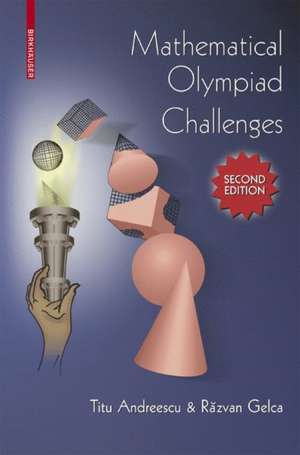
Mathematical Olympiad Challenges
Autor Titu Andreescu, Razvan Gelcaen Limba Engleză Paperback – 9 dec 2008
Remarcăm în Mathematical Olympiad Challenges o lucrare fundamentală semnată de Titu Andreescu și Razvan Gelca, personalități cu o autoritate incontestabilă în pedagogia matematică de performanță. Titu Andreescu, fost director al competițiilor matematice americane și antrenor al echipei de elită a SUA pentru Olimpiada Internațională de Matematică, își bazează metodologia pe decenii de cercetare în analiza diofantică și pe experiența directă în pregătirea olimpicilor de top. Această a doua ediție, publicată de birkhäuser, este concepută pentru a simula procesul creativ al matematicii reale într-un format condensat. Descoperim aici o structură riguroasă, organizată simetric între enunțuri și rezolvări. Cartea trece prin patru piloni esențiali: Geometrie și Trigonometrie, Algebră și Analiză, Teoria Numerelor și Combinatorică. Spre deosebire de Mathematics as Problem Solving de Alexander Soifer, care oferă o introducere mai narativă și relaxată pentru liceeni, volumul de față impune un ritm mai intens, specific nivelului universitar (undergraduate). Lucrarea extinde cadrul propus anterior de autor în Mathematical Bridges cu date noi și o orientare mai pregnantă spre intuiția rapidă necesară în mediul competitiv. Suntem de părere că valoarea acestui manual rezidă în modul în care tratează „eșecul constructiv” și explorarea căilor multiple de rezolvare. În timp ce Problem-Solving Strategies de Arthur Engel se concentrează pe o colecție vastă de tehnici pentru competiții internaționale, Mathematical Olympiad Challenges reușește să creeze o punte teoretică între problemele de concurs și matematica de cercetare, păstrând în același timp un stil concis și extrem de aplicat.
Preț: 473.61 lei
Carte tipărită la comandă
Livrare economică 07-21 decembrie
Specificații
ISBN-10: 0817645284
Pagini: 304
Ilustrații: XVII, 283 p. 108 illus.
Dimensiuni: 155 x 235 x 17 mm
Greutate: 0.46 kg
Ediția:2nd edition 2009
Editura: birkhäuser
Locul publicării:Boston, MA, United States
V-ar putea interesa
-
 Geometry, Symmetries, and Classical Physics: A MosaicManousos Markoutsakis-18%Preț: 1131.62 lei1380.03 lei
 -
 Problems in Real AnalysisTeodora-Liliana Radulescu-15%Preț: 513.50 lei604.12 lei
 -
 Geometric Problems on Maxima and MinimaTitu AndreescuPreț: 507.75 lei
 -
 103 Trigonometry ProblemsTitu Andreescu-15%Preț: 417.03 lei490.62 lei
 -
 Mathematical Olympiad TreasuresTitu Andreescu-15%Preț: 550.78 lei647.97 lei
 -
 Essential Linear Algebra with ApplicationsTitu AndreescuPreț: 403.92 lei
 -
 Geometry: A Comprehensive CourseDiana Marks-18%Preț: 714.31 lei871.11 lei
 -
 Putnam and BeyondR¿zvan Gelca-15%Preț: 452.85 lei532.76 lei
 -
 Macchine matematiche: Dalla storia alla scuolaMaria G. Bartolini BussiPreț: 303.52 lei
 -
 -18%Preț: 1757.37 lei2143.13 lei
 -
 Algorithmic and Computer Methods for Three-ManifoldsA. T. Fomenko-18%Preț: 857.00 lei1045.12 lei
 -
 Gauss Diagram Invariants for Knots and LinksT. Fiedler-15%Preț: 620.22 lei729.67 lei
 -
 Preț: 376.19 lei
 -
 Categories, Bundles and Spacetime TopologyC. T. Dodson-18%Preț: 898.48 lei1095.70 lei
 -
 -18%Preț: 1178.23 lei1436.86 lei
 -
 Preț: 363.50 lei
 -
 LECTURES ON ALGEBRAIC TOPOLOGYHaynes Miller-15%Preț: 405.17 lei476.67 lei
 -
 ANALY HYPERBOL GEOMETRY..(2ND ED)Ungar Abraham Albert-18%Preț: 1168.12 lei1424.54 lei
 -
 -18%Preț: 885.25 lei1079.56 lei
 -
 ELEMENT DIGITAL GEOMETRY, MATH MORPHO & DISCRETE OPTIMIZATIOKiselman Christer Oscar-18%Preț: 926.41 lei1129.76 lei
 -
 ALGEBRAIC TOPOLOGYGrandis Marco-15%Preț: 603.43 lei709.91 lei
 -
 THETA FUNCTIONS AND KNOTSGelca Razvan-18%Preț: 983.23 lei1199.06 lei
Public țintă
Lower undergraduateDe ce să citești această carte
Această carte este esențială pentru studenții și elevii de elită care doresc să își rafineze tehnicile de rezolvare a problemelor sub presiune. Dincolo de simpla pregătire pentru concursuri, cititorul câștigă o înțelegere profundă a legăturilor dintre algebră, geometrie și combinatorică. Este un instrument de antrenament mental condus de unul dintre cei mai respectați antrenori de matematică din lume, oferind soluții care dezvăluie eleganța din spatele calculelor complexe.
Despre autor
Titu Andreescu deține un doctorat de la Universitatea de Vest din Timișoara, cu o teză axată pe Analiza Diofantică. În prezent profesor la University of Texas at Dallas, cariera sa este strâns legată de excelența în competiții, servind ca lider și antrenor al echipei de matematică a SUA (IMO) între 1995 și 2002. Razvan Gelca, co-autorul său, completează această viziune academică prin expertiză în cercetare și educație universitară. Împreună, au publicat lucrări de referință precum Putnam and Beyond și Mathematical Bridges, consolidând o metodă de predare care pune accent pe gândirea critică și creativitate.
Descriere scurtă
Cuprins
Recenzii
"The authors are experienced problem solvers and coaches of mathematics teams. This expertise shows through and the result is a volume that would be a welcome addition to any mathematician's bookshelf."—MAA Online
"This [book] is…much more than just another collection of interesting, challenging problems, but is instead organized specifically for learning. The book expertly weaves together related problems, so that insights gradually become techniques, tricks slowly become methods, and methods eventually evolve into mastery…. The book is aimed at motivated high school and beginning college students and instructors. It can be used as a text for advanced problem-solving courses, for self-study, or as a resource for teachers and students training for mathematical competitions, and for teacher professional development, seminars, and workshops.
I strongly recommend this book for anyone interested in creative problem-solving in mathematics…. It has already taken up a prized position in my personal library, and is bound to provide me with many hours of intellectual pleasure."—The Mathematical Gazette
"The Olympiad book is easier to describe since the format of the Olympiad competition and the books it has spawned will be well known to most Gazette readers. … The authors have organised the material to reduce the pain … and to make the material a genuine learning experience for Olympian hopefuls and their teachers. … a valuable addition to the problem literature, and their organisational features are generally helpful rather than merely attempts to look different." (John Baylis, The Mathematical Gazette, July, 2004)
Textul de pe ultima copertă
New to the second edition:
* Completely rewritten discussions precede each of the 30 units, adopting a more user-friendly style with more accessible and inviting examples
* Many new or expanded examples, problems, and solutions
* Additional references and reader suggestions have been incorporated
Featuring enhanced motivation for advanced high school and beginning college students, as well as instructors and Olympiad coaches, this text can be used for creative problem-solving courses, professional teacher development seminars and workshops, self-study, or as a training resource for mathematical competitions.
-----
This [book] is…much more than just another collection of interesting, challenging problems, but is instead organized specifically for learning. The book expertly weaves together related problems, so that insights gradually become techniques, tricks slowly become methods, and methods eventually evolve into mastery…. The book is aimed at motivated high school and beginning college students and instructors...I strongly recommend this book for anyone interested in creative problem-solving in mathematics…. It has alreadytaken up a prized position in my personal library, and is bound to provide me with many hours of intellectual pleasure.
—The Mathematical Gazette (Review of the First Edition)