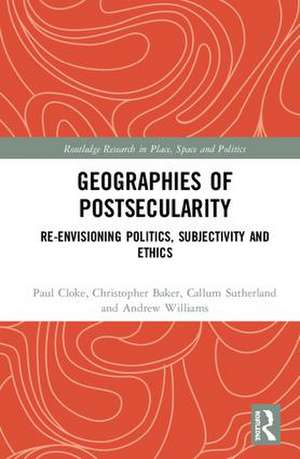
Geographies of Postsecularity: Re-envisioning Politics, Subjectivity and Ethics: Routledge Research in Place, Space and Politics
Autor Paul Cloke, Christopher Baker, Callum Sutherland, Andrew Williamsen Limba Engleză Hardback – 23 ian 2019
This is a valuable resource for students in several academic disciplines, including geography, sociology, politics, religious studies, international development and anthropology. It will be of great interest to secular and faith-based practitioners working in religion, spirituality, politics or more widely in public policy, urban planning and community development.
Din seria Routledge Research in Place, Space and Politics
- 8%
 Preț: 435.04 lei
 -
 Preț: 423.21 lei
 - 19%
 Preț: 538.38 lei
 -
 Preț: 444.29 lei
 - 15%
 Preț: 425.36 lei
 -
 Preț: 457.33 lei
 -
 Preț: 461.15 lei
 - 18%
 Preț: 1115.51 lei
 - 15%
 Preț: 425.92 lei
 -
 Preț: 464.26 lei
 - 18%
 Preț: 1112.38 lei
 -
 Preț: 420.06 lei
 -
 Preț: 444.29 lei
 - 8%
 Preț: 427.36 lei
 -
 Preț: 404.33 lei
 -
 Preț: 372.65 lei
 -
 Preț: 457.90 lei
 -
 Preț: 459.57 lei
 -
 Preț: 468.95 lei
 -
 Preț: 379.42 lei
 - 18%
 Preț: 1064.39 lei
 - 15%
 Preț: 530.97 lei
 - nou
 Preț: 1314.80 lei
 - 25%
 Preț: 1097.77 lei
 - 25%
 Preț: 1101.92 lei
 - nou
 Preț: 1221.26 lei
Preț: 1250.84 lei
Preț vechi: 1525.41 lei
-18%
Puncte Express: 1876
Carte tipărită la comandă
Livrare economică 18 noiembrie-02 decembrie
Livrare prin curier în România Termenul estimat este afișat lângă disponibilitate.
Transport gratuit pentru acest produs Plată online sau ramburs, în funcție de opțiunile comenzii.
Retur gratuit în 14 zile Comandă securizată și suport în română.
Specificații
ISBN-13: 9781138946736
ISBN-10: 1138946737
Pagini: 248
Ilustrații: 2
Dimensiuni: 156 x 234 x 15 mm
Greutate: 0.51 kg
Ediția:1
Editura: Taylor & Francis
Colecția Routledge
Seria Routledge Research in Place, Space and Politics
Locul publicării:Oxford, United Kingdom
ISBN-10: 1138946737
Pagini: 248
Ilustrații: 2
Dimensiuni: 156 x 234 x 15 mm
Greutate: 0.51 kg
Ediția:1
Editura: Taylor & Francis
Colecția Routledge
Seria Routledge Research in Place, Space and Politics
Locul publicării:Oxford, United Kingdom
V-ar putea interesa
-
 Human Geography: A Very Short IntroductionPatricia Daley-20%Preț: 56.81 lei71.01 lei
 -
 Locating the Kingdom of God: Performing Sacred BoundariesDr Karen J. Wenell-36%Preț: 549.68 lei862.83 lei
 -
 The Spirituality GapAbi MillarPreț: 107.69 lei
 -
 How (Not) to Be SecularJames K. A. SmithPreț: 107.04 lei
 -
 A New Index for Public Space: After DistancingTali HatukaPreț: 386.45 lei
 -
 Preț: 379.89 lei
 -
 -11%Preț: 159.83 lei178.59 lei
 -
 The Home We Build Together: Recreating SocietySir Jonathan Sacks-27%Preț: 66.23 lei90.54 lei
 -
 Urban GeographyAndrew E. G. JonasPreț: 260.75 lei
 -
 Welcome to the NeighbourhoodJane FallonPreț: 72.27 lei
 -
 Preț: 140.76 lei
 -
 The Making of Public SpaceArnaud EsquerrePreț: 166.33 lei
 -
 Empathy and ResistanceKristina LunzPreț: 109.62 lei
 -
 The Ethics of Extremity: On Hearing, Seeing, and Feeling Each OtherNelson Varas-Díaz-30%Preț: 538.99 lei771.16 lei
 -
 Secularism, Race, and the Politics of IslamophobiaSharmin Sadequee-23%Preț: 173.62 lei225.01 lei
 -
 -22%Preț: 241.79 lei308.65 lei
 -
 The Homegrown CityMatias EchanovePreț: 152.40 lei
 -
 An Architecture of HopeYvonne JewkesPreț: 135.46 lei
 -
 Philosophy of EducationLaura D'OlimpioPreț: 401.44 lei
Public țintă
Postgraduate and UndergraduateCuprins
1. Introduction 2. Genealogies 3. Subjectivities 4. Spaces 5. Political Practices 6. Wider Religious and Spatial Conditions 7. Conclusion
Notă biografică
Paul Cloke is Professor of Human Geography at the University of Exeter. He has longstanding research interests in the geographies of social marginalisation and exclusion, and in the political and ethical responses from Third Sector organisations to issues of social care and justice. His recent books include Swept Up Lives (with J May and S Johnsen; Wiley-Blackwell 2010); FBOs and Exclusion in European Cities (with J Beaumont; Policy Press 2012); and Working Faith (with J Beaumont and A Williams; Paternoster 2013).
Christopher Baker is William Temple Professor of Religion and Public Life at Goldsmiths, University of London, where he co-directs the Faiths and Civil Society Unit. His publications engage theology and religious studies with sociology, sociology of religion, human geography, planning, and policy studies. His edited volume Postsecular Cities: Space, Theory and Practice (with J. Beaumont; Continuum 2011) is a much-cited and authoritative text in this field.
Callum Sutherland is a Human Geographer based at the University of Exeter. His published work examines themes of religion, politics, and spiritual activism, with particular regard to Christian praxis and social justice.
Andrew Williams is Lecturer in Human Geography, Cardiff University, and specialises in questions of ethics, welfare, and politics. His latest books include Working Faith: Faith-Based Organisations and Urban Social Justice (with P Cloke and J Beaumont; Paternoster 2013) and Feeding Austerity? Ethical Ambiguity and Political Possibilities in UK Foodbanks (with L Cherry, P Cloke, and J May; Wiley-Blackwell, forthcoming).
Christopher Baker is William Temple Professor of Religion and Public Life at Goldsmiths, University of London, where he co-directs the Faiths and Civil Society Unit. His publications engage theology and religious studies with sociology, sociology of religion, human geography, planning, and policy studies. His edited volume Postsecular Cities: Space, Theory and Practice (with J. Beaumont; Continuum 2011) is a much-cited and authoritative text in this field.
Callum Sutherland is a Human Geographer based at the University of Exeter. His published work examines themes of religion, politics, and spiritual activism, with particular regard to Christian praxis and social justice.
Andrew Williams is Lecturer in Human Geography, Cardiff University, and specialises in questions of ethics, welfare, and politics. His latest books include Working Faith: Faith-Based Organisations and Urban Social Justice (with P Cloke and J Beaumont; Paternoster 2013) and Feeding Austerity? Ethical Ambiguity and Political Possibilities in UK Foodbanks (with L Cherry, P Cloke, and J May; Wiley-Blackwell, forthcoming).
Descriere
This book offers new insights on the concept of postsecularity and the associated idea of the postsecular city and public sphere. It provides a detailed account of how emergent postsecularity co-produces key spaces and subjectivities in contemporary urban life, as well as addressing criticisms levelled towards the concept of the postsecular. Though innovative empirical accounts, this book offers an in-depth examination of the ‘who’ and the ‘what’ that are created by the conditions of postsecularity. The book explores essential preconditions for the spaces and subjectivities of postsecular partnership, such as shared citizenship, tolerance, reflexive transformation and crossover narratives.