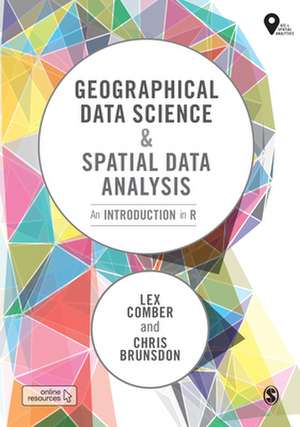
Geographical Data Science and Spatial Data Analysis: Spatial Analytics and GIS
Autor Lex Comber, Chris Brunsdonen Limba Engleză Paperback – 11 dec 2020
Whilst other books describe different flavours of Data Analytics in R and other programming languages, there are none that consider Spatial Data (i.e. the location attached to data), or that consider issues of inference, linking Big Data, Geography, GIS, Mapping and Spatial Analytics.
This is a ‘learning by doing’ textbook, building on the previous book by the same authors, An Introduction to R for Spatial Analysis and Mapping. It details the theoretical issues in analyses of Big Spatial Data and developing practical skills in the reader for addressing these with confidence.
Preț: 391.40 lei
Preț vechi: 501.79 lei
-22%
Puncte Express: 587
Carte disponibilă
Livrare economică 04-18 mai
Livrare express 18-24 aprilie pentru 37.35 lei
Specificații
ISBN-13: 9781526449368
ISBN-10: 1526449366
Pagini: 360
Dimensiuni: 170 x 244 x 20 mm
Greutate: 0.62 kg
Ediția:1
Editura: SAGE Publishing Ltd
Seria Spatial Analytics and GIS
Locul publicării:London, United Kingdom
ISBN-10: 1526449366
Pagini: 360
Dimensiuni: 170 x 244 x 20 mm
Greutate: 0.62 kg
Ediția:1
Editura: SAGE Publishing Ltd
Seria Spatial Analytics and GIS
Locul publicării:London, United Kingdom
Recenzii
This book is a must-read for anyone wishing to use R to analyse large spatial datasets. It is suitable for teachers and learners at all levels, building knowledge from the ground-up using relevant, real-world examples and easy to follow instructions.
Written by two renowned international experts, this is an excellent introductory book for students, teachers and researchers alike who have experience of using R and who want to further develop their skills in big data spatial science.
Written by two renowned international experts, this is an excellent introductory book for students, teachers and researchers alike who have experience of using R and who want to further develop their skills in big data spatial science.
Cuprins
Chapter 1: Introduction to Geographical Data Science and Spatial Data Analytics
Chapter 2: Data and Spatial Data in R
Chapter 3: A Framework for Processing Data: The Piping Syntax and dplyr
Chapter 4: Creating Databases and Queries in R
Chapter 5: EDA and Finding Structure in Data
Chapter 6: Modelling and Exploration of Data
Chapter 7: Applications of Machine Learning to Spatial Data
Chapter 8: Alternative Spatial Summaries and Visualisations
Chapter 9: Epilogue on the Principles of Spatial Data Analytics
Chapter 2: Data and Spatial Data in R
Chapter 3: A Framework for Processing Data: The Piping Syntax and dplyr
Chapter 4: Creating Databases and Queries in R
Chapter 5: EDA and Finding Structure in Data
Chapter 6: Modelling and Exploration of Data
Chapter 7: Applications of Machine Learning to Spatial Data
Chapter 8: Alternative Spatial Summaries and Visualisations
Chapter 9: Epilogue on the Principles of Spatial Data Analytics
Notă biografică
Alexis Comber, Lex, is Professor of Spatial Data Analytics at Leeds Institute for Data Analytics (LIDA) the University of Leeds. He worked previously at the University of Leicester where he held a chair in Geographical Information Science. His first degree was in Plant and Crop Science at the University of Nottingham and he completed a PhD in Computer Science at the Macaulay Institute, Aberdeen (now the James Hutton Institute) and the University of Aberdeen. This developed expert systems for land cover monitoring from satellite imagery and brought him into the world of spatial data, spatial analysis, and mapping.
Lex¿s research interests span many different application areas including environment, land cover / land use, demographics, public health, agriculture, bio-energy and accessibility, all of which require multi-disciplinary approaches. His research draws from methods in geocomputation, mathematics, statistics and computer science and he has extended techniques in operations research / location-allocation (what to put where), graph theory (cluster detection in networks), heuristic searches (how to move intelligently through highly dimensional big data), remote sensing (novel approaches for classification), handling divergent data semantics (uncertainty handling, ontologies, text mining) and spatial statistics (quantifying spatial and temporal process heterogeneity).
He has co-authored (with Chris Brunsdon) An Introduction to R for Spatial Analysis and Mapping, the first `how to book¿ for spatial analyses and mapping in R, the open source statistical software, now in its second edition.
Outside of academic work and in no particular order, Lex enjoys his vegetable garden, walking the dog and playing pinball (he is the proud owner of a 1981 Bally Eight Ball Deluxe).
Lex¿s research interests span many different application areas including environment, land cover / land use, demographics, public health, agriculture, bio-energy and accessibility, all of which require multi-disciplinary approaches. His research draws from methods in geocomputation, mathematics, statistics and computer science and he has extended techniques in operations research / location-allocation (what to put where), graph theory (cluster detection in networks), heuristic searches (how to move intelligently through highly dimensional big data), remote sensing (novel approaches for classification), handling divergent data semantics (uncertainty handling, ontologies, text mining) and spatial statistics (quantifying spatial and temporal process heterogeneity).
He has co-authored (with Chris Brunsdon) An Introduction to R for Spatial Analysis and Mapping, the first `how to book¿ for spatial analyses and mapping in R, the open source statistical software, now in its second edition.
Outside of academic work and in no particular order, Lex enjoys his vegetable garden, walking the dog and playing pinball (he is the proud owner of a 1981 Bally Eight Ball Deluxe).
Descriere
This book builds on the previous book by the same authors, An Introduction to R for Spatial Analysis and Mapping, to consider Spatial Data (ie the location attached to data), issues of inference, linking Big Data, Geography / GIS / Mapping and Spatial Analytics. A ‘learning by doing’ text book, it covers important theoretical issues and helps to develop practical skills in the reader for addressing these.