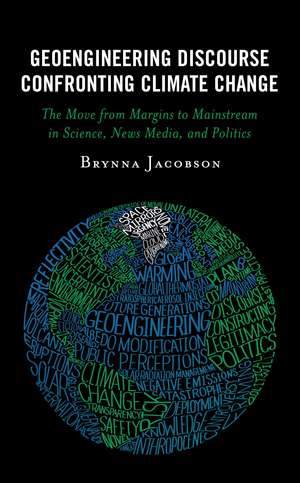
Geoengineering Discourse Confronting Climate Change: The Move from Margins to Mainstream in Science, News Media, and Politics
Autor Brynna Jacobsonen Limba Engleză Paperback – 15 mai 2024
Preț: 213.14 lei
Preț vechi: 298.49 lei
-29%
Puncte Express: 320
Carte tipărită la comandă
Livrare economică 10-24 august
Livrare prin curier în România Termenul estimat este afișat lângă disponibilitate.
Transport gratuit de la 400.00 lei Plată online sau ramburs, în funcție de opțiunile comenzii.
Retur gratuit în 14 zile Comandă securizată și suport în română.
Specificații
ISBN-13: 9781793635303
ISBN-10: 1793635307
Pagini: 282
Ilustrații: 4 b/w illustrations; 6 tables;
Dimensiuni: 150 x 228 x 22 mm
Greutate: 0.42 kg
Editura: Bloomsbury Publishing
Colecția Lexington Books
Locul publicării:New York, United States
ISBN-10: 1793635307
Pagini: 282
Ilustrații: 4 b/w illustrations; 6 tables;
Dimensiuni: 150 x 228 x 22 mm
Greutate: 0.42 kg
Editura: Bloomsbury Publishing
Colecția Lexington Books
Locul publicării:New York, United States
Cuprins
Acknowledgments
Acronyms
Section I: Climate, Geoengineering, Risk, and Modernity
Introduction: Climate Crisis, Global Risk, and Geoengineering
Chapter 1: Risk, Climate Politics, and the Challenge of Reflexive Modernization
Section II: Scientific Discourse and the Construction of Legitimacy
Chapter 2: Science Policy Reports and the Framing of Geoengineering
Chapter 3: Science Policy Reports and the Construction of Legitimacy: Research, Actors, and Public Engagement
Section III: Journalism and Presenting Geoengineering to the Public
Chapter 4: Geoengineering Presented to the Public: Narratives and Trends in News Media, 1991-2016
Chapter 5: News Media Framing and Discursive Presentation of Geoengineering
Section IV: Congressional Hearings
Chapter 6: Geoengineering in the Political Sphere: Congressional Hearings, 2009-2017
Section V: Technology and Reflexivity
Conclusion: Interconnections, High Technology, and Reflexive Modernization
References
About the Author
Acronyms
Section I: Climate, Geoengineering, Risk, and Modernity
Introduction: Climate Crisis, Global Risk, and Geoengineering
Chapter 1: Risk, Climate Politics, and the Challenge of Reflexive Modernization
Section II: Scientific Discourse and the Construction of Legitimacy
Chapter 2: Science Policy Reports and the Framing of Geoengineering
Chapter 3: Science Policy Reports and the Construction of Legitimacy: Research, Actors, and Public Engagement
Section III: Journalism and Presenting Geoengineering to the Public
Chapter 4: Geoengineering Presented to the Public: Narratives and Trends in News Media, 1991-2016
Chapter 5: News Media Framing and Discursive Presentation of Geoengineering
Section IV: Congressional Hearings
Chapter 6: Geoengineering in the Political Sphere: Congressional Hearings, 2009-2017
Section V: Technology and Reflexivity
Conclusion: Interconnections, High Technology, and Reflexive Modernization
References
About the Author
Recenzii
Is the possibility of geoengineering (i.e., carbon sequestration combined with atmospheric intervention) a welcome solution to the threat of climate change, or is it merely a smokescreen to allow further use of fossil fuels? Jacobson explores this and many other salient questions in this timely, well-researched book. The author is a sociologist, and this book is written as a high-level sociological critique, using techniques of discourse analysis against what the author posits as "key genres," i.e., science policy writing, news media articles, and congressional hearing transcripts, covering the period 1991-2017.. The text features extensive references and a useful index. Highly recommended. Faculty and professionals. General readers.
A timely analysis of how geoengineering has gained traction in climate policy discussions . Written in clear and accessible prose, this book offers valuable insights into the intersection of science, politics, and technology and is an essential reading for anyone seeking to understand the role of knowledge politics in shaping climate action.
Brynna Jacobson offers a comprehensive analysis of the discourses surrounding geoengineering (GE). Jacobson examines key issues, including the increasing normalization of GE, the linkage between research and deployment, and whose voices are dominant and whose are ignored. Most importantly, Jacobson shows how powerful actors vested in an ever-growing and carbon-intensive economy have replaced much of their efforts focused on promoting climate denial and skepticism with efforts to promote GE as the answer to the climate crisis. This is a timely book that should be of interest to scholars, students, and all concerned citizens.
Brynna Jacobson provides a reflexive analysis of the paradoxes that geoengineering evokes, refreshing in its account of the wider societal culture in which a narrative on how to 'solve' climate change through technological intervention could emerge.
If you're interested in understanding why there is so little movement on climate change in the USA, then this is a must read. Focusing on policy debates around geoengineering, Brynna Jacobson unpacks the popular and policy narratives that transform geoengineering from a fringe interest into a major techno-fix in climate policy. Jacobson shows how this cheerleading for geoengineering ends up stymying climate action.
A timely analysis of how geoengineering has gained traction in climate policy discussions . Written in clear and accessible prose, this book offers valuable insights into the intersection of science, politics, and technology and is an essential reading for anyone seeking to understand the role of knowledge politics in shaping climate action.
Brynna Jacobson offers a comprehensive analysis of the discourses surrounding geoengineering (GE). Jacobson examines key issues, including the increasing normalization of GE, the linkage between research and deployment, and whose voices are dominant and whose are ignored. Most importantly, Jacobson shows how powerful actors vested in an ever-growing and carbon-intensive economy have replaced much of their efforts focused on promoting climate denial and skepticism with efforts to promote GE as the answer to the climate crisis. This is a timely book that should be of interest to scholars, students, and all concerned citizens.
Brynna Jacobson provides a reflexive analysis of the paradoxes that geoengineering evokes, refreshing in its account of the wider societal culture in which a narrative on how to 'solve' climate change through technological intervention could emerge.
If you're interested in understanding why there is so little movement on climate change in the USA, then this is a must read. Focusing on policy debates around geoengineering, Brynna Jacobson unpacks the popular and policy narratives that transform geoengineering from a fringe interest into a major techno-fix in climate policy. Jacobson shows how this cheerleading for geoengineering ends up stymying climate action.