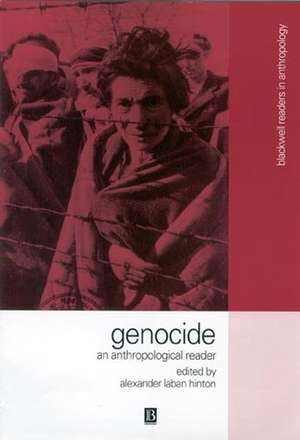
Genocide C
Autor Hinton Editat de Alexander L. Hintonen Limba Engleză Hardback – 27 dec 2001
Preț: 897.17 lei
Preț vechi: 1229.00 lei
-27%
Puncte Express: 1346
Carte tipărită la comandă
Livrare economică 07-21 noiembrie
Livrare prin curier în România Termenul estimat este afișat lângă disponibilitate.
Transport gratuit pentru acest produs Plată online sau ramburs, în funcție de opțiunile comenzii.
Retur gratuit în 14 zile Comandă securizată și suport în română.
Specificații
ISBN-13: 9780631223542
ISBN-10: 0631223541
Pagini: 396
Dimensiuni: 183 x 260 x 26 mm
Greutate: 0.94 kg
Editura: Wiley
Locul publicării:Chichester, United Kingdom
ISBN-10: 0631223541
Pagini: 396
Dimensiuni: 183 x 260 x 26 mm
Greutate: 0.94 kg
Editura: Wiley
Locul publicării:Chichester, United Kingdom
V-ar putea interesa
-
 Golden Harvest: Events at the Periphery of the HolocaustJan Tomasz Gross-21%Preț: 76.97 lei97.15 lei
 -
 -20%Preț: 261.58 lei326.55 lei
 -
 Genocide: A ReaderJens Meierhenrich-31%Preț: 1004.45 lei1453.48 lei
 -
 -13%Preț: 278.89 lei321.91 lei
 -
 -18%Preț: 393.11 lei479.16 lei
 -
 Preț: 131.17 lei
 -
 What is Genocide?Martin ShawPreț: 157.12 lei
 -
 The Other SchindlersAgnes Grunwald-SpierPreț: 106.60 lei
 -
 A Time to SpeakHelen LewisPreț: 68.45 lei
 -
 The Woman without a NumberIby KnillPreț: 123.39 lei
 -
 Under the Shadow of Death: Memoirs of a Survivor of the Armenian GenocideGarabed Hagop Aaronian-16%Preț: 207.04 lei246.55 lei
 -
 -27%Preț: 66.74 lei91.67 lei
 -
 -27%Preț: 66.13 lei91.14 lei
 -
 Mrs Mahoneys Secret WarClaudia StrachanPreț: 92.59 lei
 -
 -24%Preț: 189.08 lei249.92 lei
Public țintă
students and scholars of social and cultural anthropology, genocide studies, sociology, political science, and history as well as general readersNotă biografică
Alexander Laban Hinton is Assistant Professor in the Department of Sociology and Anthropology and a faculty fellow in the Center for Global Change and Governance at Rutgers University, Newark. He is the editor of Biocultural Approaches to the Emotions (1999) and Annihilating Difference: The Anthropology of Genocide (2002), an edited collection of new research articles
Cuprins
Acknowledgements. . Introduction: Genocide and Anthropology: Alexander Laban Hinton.
Part I: Conceptual Foundations.
1. Genocide. ( Raphaël Lemkin).
2. Text of the UN Genocide Convention.
3. Genocide: Its Political Use in the Twentieth Century. (Leo Kuper).
4. Genocide: A Sociological Perspective. (Helen Fein).
5. Eichmann in Jerusalem: A Report on the Banality of Evil. (Hannah Arendt).
6. Modernity and the Holocaust. (Zygmunt Bauman).
Part II: Genocide, History, and Modernity.
7. Victims of Progress. (John H. Bodley).
8. Culture of Terror - Space of Death: Roger Casement's Putumayo Report and the Explanation of Torture. (Michael Taussig).
9. National Socialist Germany. (Eric R. Wolf).
Part III: Manufacturing Difference and "Purification".
10. "Ethnic Cleansing": A Metaphor for Our Time? (Akbhar S. Ahmed).
11. Imagined Communities and Real Victims: Self-Determination and Ethnic Cleansing in Yugoslavia. (Robert M. Hayden).
12. A Head for an Eye: Revenge in the Cambodian Genocide. (Alexander Laban Hinton).
13. Dead Certainty: Ethnic Violence in the Era of Globalization: Arjun Appadurai.
Part IV: Coping and Understanding.
14. Fear as a Way of Life. (Linda Green).
15. The Myth of Global Ethnic Conflict. (John R. Bowen).
16. Speechless Emissaries: Refugees, Humanitarianism, and Dehistoricization. (Liisa H. Malkki).
Appendix: Websites on Genocide.
Index.
Part I: Conceptual Foundations.
1. Genocide. ( Raphaël Lemkin).
2. Text of the UN Genocide Convention.
3. Genocide: Its Political Use in the Twentieth Century. (Leo Kuper).
4. Genocide: A Sociological Perspective. (Helen Fein).
5. Eichmann in Jerusalem: A Report on the Banality of Evil. (Hannah Arendt).
6. Modernity and the Holocaust. (Zygmunt Bauman).
Part II: Genocide, History, and Modernity.
7. Victims of Progress. (John H. Bodley).
8. Culture of Terror - Space of Death: Roger Casement's Putumayo Report and the Explanation of Torture. (Michael Taussig).
9. National Socialist Germany. (Eric R. Wolf).
Part III: Manufacturing Difference and "Purification".
10. "Ethnic Cleansing": A Metaphor for Our Time? (Akbhar S. Ahmed).
11. Imagined Communities and Real Victims: Self-Determination and Ethnic Cleansing in Yugoslavia. (Robert M. Hayden).
12. A Head for an Eye: Revenge in the Cambodian Genocide. (Alexander Laban Hinton).
13. Dead Certainty: Ethnic Violence in the Era of Globalization: Arjun Appadurai.
Part IV: Coping and Understanding.
14. Fear as a Way of Life. (Linda Green).
15. The Myth of Global Ethnic Conflict. (John R. Bowen).
16. Speechless Emissaries: Refugees, Humanitarianism, and Dehistoricization. (Liisa H. Malkki).
Appendix: Websites on Genocide.
Index.
Descriere
During the 20th century tens of millions of people were annihilated by genocidal regimes. This title lays the foundation for an 'anthropology of genocide' by gathering together the seminal texts for learning about and understanding this phenomenon.