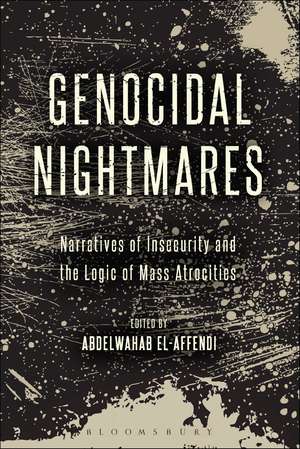
Genocidal Nightmares: Narratives of Insecurity and the Logic of Mass Atrocities
Editat de Professor Abdelwahab El-Affendien Limba Engleză Paperback – 28 iul 2016
Preț: 278.18 lei
Preț vechi: 369.61 lei
-25%
Puncte Express: 417
Carte tipărită la comandă
Livrare economică 02-16 decembrie
Livrare prin curier în România Termenul estimat este afișat lângă disponibilitate.
Transport gratuit de la 400.00 lei Plată online sau ramburs, în funcție de opțiunile comenzii.
Retur gratuit în 14 zile Comandă securizată și suport în română.
Specificații
ISBN-13: 9781501320231
ISBN-10: 1501320238
Pagini: 272
Ilustrații: 5 halftone illus
Dimensiuni: 152 x 229 x 14 mm
Greutate: 0.36 kg
Ediția:NIPPOD
Editura: Bloomsbury Publishing
Colecția Bloomsbury Academic
Locul publicării:New York, United States
ISBN-10: 1501320238
Pagini: 272
Ilustrații: 5 halftone illus
Dimensiuni: 152 x 229 x 14 mm
Greutate: 0.36 kg
Ediția:NIPPOD
Editura: Bloomsbury Publishing
Colecția Bloomsbury Academic
Locul publicării:New York, United States
V-ar putea interesa
-
 Hitler's FuriesWendy Lower-18%Preț: 76.40 lei93.73 lei
 -
 Genocide: A ReaderJens Meierhenrich-31%Preț: 1004.45 lei1453.48 lei
 -
 What Is Genocide?Martin ShawPreț: 159.91 lei
 -
 -28%Preț: 74.44 lei102.92 lei
 -
 Writing History, Writing TraumaDominick LacapraPreț: 224.73 lei
 -
 -26%Preț: 69.29 lei93.70 lei
 -
 -15%Preț: 201.19 lei237.24 lei
 -
 -27%Preț: 533.09 lei726.20 lei
 -
 Losing the DeadLisa Appignanesi-26%Preț: 52.27 lei71.06 lei
 -
 GiantsEilat NegevPreț: 71.97 lei
 -
 -23%Preț: 200.68 lei259.48 lei
Cuprins
Preface
Foreword:Dr Francis Deng
Chapter I: Introduction: Narrating the Precariousness of Human Decency
Abdelwahab El-Affendi
Chapter II: Killer Narratives: Collective Nightmares and the Construction of Narrative Communities of Insecurity
Abdelwahab El-Affendi
Chapter III:
Imagining Nationhood, Framing Postcoloniality: Narrativising Nigeria Through the Kinesis Of (Hi)Story
James Tar Tsaaior
Chapter IV:
Sudanese Stories: Narratives of Grievance, Distrust and Fatalism in Recurrent Violence
Alex de Waal
Chapter V:
General Elections and Narratives of Violent Conflict:
The Land Question and Civic Competence in Kenya
Kenneth Inyani Simala
Chapter VI:
The Violence of Security, Lethal Representations, and Hindu Nationalism in India
Dibyesh Anand
Chapter VII:
Memories of Victimhood in Serbia and Croatia from the 1980s to the Disintegration of Yugoslavia
Slobodan G. Markovich
Chapter VIII:
Insecurity, Victimhood, Self and Other: The Case of Israel and Palestine
Ilan Pappe
Chapter IX:
Resistance Narratives: Palestinian Women, Islam and Insecurity
Mari Holt
Chapter X:
State Insecurity and Intergroup Violence: The Case of Modern Iraq
Ali A. Allawi
Chapter XI:
Islamophobia as a Securitisation Narrative: The Exclusionary Logic of Imperial Geopolitics Nafeez Mosaddeq Ahmed
Chapter XII:
Killer Narratives in Western Popular Culture
Anas S. Al-Shaikh-Ali
Concluding Remarks
Authors' Biographies
Foreword:Dr Francis Deng
Chapter I: Introduction: Narrating the Precariousness of Human Decency
Abdelwahab El-Affendi
Chapter II: Killer Narratives: Collective Nightmares and the Construction of Narrative Communities of Insecurity
Abdelwahab El-Affendi
Chapter III:
Imagining Nationhood, Framing Postcoloniality: Narrativising Nigeria Through the Kinesis Of (Hi)Story
James Tar Tsaaior
Chapter IV:
Sudanese Stories: Narratives of Grievance, Distrust and Fatalism in Recurrent Violence
Alex de Waal
Chapter V:
General Elections and Narratives of Violent Conflict:
The Land Question and Civic Competence in Kenya
Kenneth Inyani Simala
Chapter VI:
The Violence of Security, Lethal Representations, and Hindu Nationalism in India
Dibyesh Anand
Chapter VII:
Memories of Victimhood in Serbia and Croatia from the 1980s to the Disintegration of Yugoslavia
Slobodan G. Markovich
Chapter VIII:
Insecurity, Victimhood, Self and Other: The Case of Israel and Palestine
Ilan Pappe
Chapter IX:
Resistance Narratives: Palestinian Women, Islam and Insecurity
Mari Holt
Chapter X:
State Insecurity and Intergroup Violence: The Case of Modern Iraq
Ali A. Allawi
Chapter XI:
Islamophobia as a Securitisation Narrative: The Exclusionary Logic of Imperial Geopolitics Nafeez Mosaddeq Ahmed
Chapter XII:
Killer Narratives in Western Popular Culture
Anas S. Al-Shaikh-Ali
Concluding Remarks
Authors' Biographies
Recenzii
Crossing disciplinary boundaries, Genocidal Nightmares deepens our understanding on how ordinary people can lend support to mass atrocities. The key contribution of this superbly edited volume is on the framing of historical and political grievances to create "narrative of insecurity" than can make acts of gross violence appear humane and righteous. With special sensitivity to the global rise of Islamophobia, this book will be of interest to students and scholars of genocide, human rights, terrorism, racism and political authoritarianism. Members of the broader reading public interested in these debates will benefit from this extremely timely and important intellectual contribution.
The saddest comment on us as humans is that the narratives in this volume will come as news to so many of us. Even more disturbing is how much we need still to learn the most basic fact of life: all individuals-regardless of skin color, religious commitment, or culture-suffer alike. All bleed, all feel pain when mistreated, all grieve over the loss of loved ones, property, and personal freedom. The many excellent and wrenching discussions set forth by the authors of this volume drive home such basic facts. Would that their efforts be rewarded by such a volume never again needing to be written. Until that day, we must be grateful to each one of them for reminding us of what it means to be human.
This engaging book explores how stories and ideas can poison minds and societies, turning us against one another as we become entangled in 'killer narratives.' But it also illuminates how we can prevent mass atrocities by strengthening shared identities that reject the politics of the machete, the concentration camp and the death squad.
The saddest comment on us as humans is that the narratives in this volume will come as news to so many of us. Even more disturbing is how much we need still to learn the most basic fact of life: all individuals-regardless of skin color, religious commitment, or culture-suffer alike. All bleed, all feel pain when mistreated, all grieve over the loss of loved ones, property, and personal freedom. The many excellent and wrenching discussions set forth by the authors of this volume drive home such basic facts. Would that their efforts be rewarded by such a volume never again needing to be written. Until that day, we must be grateful to each one of them for reminding us of what it means to be human.
This engaging book explores how stories and ideas can poison minds and societies, turning us against one another as we become entangled in 'killer narratives.' But it also illuminates how we can prevent mass atrocities by strengthening shared identities that reject the politics of the machete, the concentration camp and the death squad.