
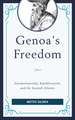
Genoa's Freedom: Entrepreneurship, Republicanism, and the Spanish Atlantic: Empires and Entanglements in the Early Modern World
Autor Matteo Saloniaen Limba Engleză Hardback – 24 feb 2017

Preț: 614.37 lei
Preț vechi: 911.10 lei
-33%
Puncte Express: 922
Carte tipărită la comandă
Livrare economică 05-19 decembrie
Livrare prin curier în România Termenul estimat este afișat lângă disponibilitate.
Transport gratuit pentru acest produs Plată online sau ramburs, în funcție de opțiunile comenzii.
Retur gratuit în 14 zile Comandă securizată și suport în română.
Specificații
ISBN-13: 9781498534215
ISBN-10: 149853421X
Pagini: 244
Ilustrații: 2 b/w photos;
Dimensiuni: 159 x 238 x 19 mm
Greutate: 0.5 kg
Editura: Bloomsbury Publishing
Colecția Lexington Books
Seria Empires and Entanglements in the Early Modern World
Locul publicării:New York, United States
ISBN-10: 149853421X
Pagini: 244
Ilustrații: 2 b/w photos;
Dimensiuni: 159 x 238 x 19 mm
Greutate: 0.5 kg
Editura: Bloomsbury Publishing
Colecția Lexington Books
Seria Empires and Entanglements in the Early Modern World
Locul publicării:New York, United States
V-ar putea interesa
-
 Edward III and the Triumph of EnglandRichard BarberPreț: 138.23 lei
 -
 EuropeBrendan Simms-25%Preț: 103.84 lei138.14 lei
 -
 Vanished KingdomsNorman Davies-17%Preț: 116.62 lei139.83 lei
 -
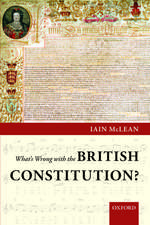 What's Wrong with the British Constitution?Iain McLean-21%Preț: 403.37 lei509.75 lei
 -
 Eva BraunHeike B. GortemakerPreț: 114.07 lei
 -
 Masters of the PostDuncan Campbell-SmithPreț: 201.80 lei
 -
 City of FortuneRoger CrowleyPreț: 94.41 lei
 -
 How to be a VictorianRuth Goodman-18%Preț: 78.16 lei94.97 lei
 -
 The Last Days of HitlerHugh Trevor Roper-35%Preț: 60.93 lei93.04 lei
 -
 The Victims Return: Survivors of the Gulag After StalinStephen F. Cohen-16%Preț: 146.51 lei174.34 lei
 -
 For Honour and FameNigel SaulPreț: 121.31 lei
 -
 The Festival of Britain: A Land and Its PeopleHarriet Atkinson-25%Preț: 181.35 lei240.79 lei
Cuprins
Part I: Entrepreneurship and Libertà
Chapter 1: Economy, Everyday Life, and the Expansion of Genoa's Colonies
Chapter 2: The Business Network of Giovanni da Pontremoli and Genoa's Anti-Tyrannical Institutions
Chapter 3: Self-Government and Self-Perception: Foreign Protectors, Cosmopolitanism, and the Genoese Identity
Part II: Spain's "Diabolical" Friends
Chapter 4: Ferdinand the Catholic's Perception of the Genoese and of Their Role in His Economic Policy
Chapter 5: Rejecting the "Machiavellian" State: Genoa's Regimes from the French Fury to the Second Hispanic-Genoese Alliance
Chapter 6: Beginnings of a "Genoese Atlantic"? Tracing the Genoese Experience in Sixteenth-Century Spanish America
Chapter 1: Economy, Everyday Life, and the Expansion of Genoa's Colonies
Chapter 2: The Business Network of Giovanni da Pontremoli and Genoa's Anti-Tyrannical Institutions
Chapter 3: Self-Government and Self-Perception: Foreign Protectors, Cosmopolitanism, and the Genoese Identity
Part II: Spain's "Diabolical" Friends
Chapter 4: Ferdinand the Catholic's Perception of the Genoese and of Their Role in His Economic Policy
Chapter 5: Rejecting the "Machiavellian" State: Genoa's Regimes from the French Fury to the Second Hispanic-Genoese Alliance
Chapter 6: Beginnings of a "Genoese Atlantic"? Tracing the Genoese Experience in Sixteenth-Century Spanish America
Recenzii
Matteo Salonia elegantly and persuasively recasts the history of Genoa by showing the deep roots of Genoese enterprise in the Atlantic and as far away as Chile, roots that he traces back to Genoese colonists halfway across the world, on the shores of the Black Sea and in Tunis in the thirteenth and fourteenth centuries. Underlying his approach is a subtle appreciation of the distinctive entrepreneurial outlook of the Genoese, compared to their Venetian rivals.
This scholarly but readable book is a welcome addition to our knowledge of the extraordinary Italian city-states of the late middle ages and the early Renaissance and their contributions to Western ideas of republicanism and political and economic freedom.
This scholarly but readable book is a welcome addition to our knowledge of the extraordinary Italian city-states of the late middle ages and the early Renaissance and their contributions to Western ideas of republicanism and political and economic freedom.