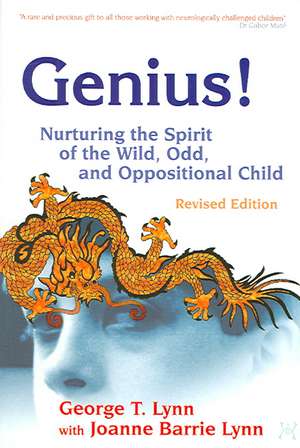
Genius!: Nurturing the Spirit of the Wild, Odd, and Oppositional Child – Revised Edition
Autor George Lynnen Limba Engleză Paperback – 4 noi 2005
Drawing on their experiences with their own son, who has TS, George T. Lynn and Joanne Barrie Lynn offer a positive parenting philosophy and successful strategies for creating an affirmative social and emotional environment that unlocks the potential genius in 'neurologically eccentric' children. The authors emphasize the importance of identifying the signs of giftedness, providing the necessary care and mentoring, and using medication with due consideration of its benefits and limitations. They also acknowledge the need to confront the `dark side' of atypical neurology - obsessiveness, self-centredness and hyperactivity - and offer helpful advice on ensuring parents' and carers' own emotional, spiritual, and physical well-being.
This book will be an essential tool for parents and carers to help bring out the best in their AD child and help him explore his full potential in life. This revised edition also includes additional material on working with older age groups.
Preț: 132.73 lei
Preț vechi: 164.84 lei
-19%
Puncte Express: 199
Carte disponibilă
Livrare economică 05-19 noiembrie
Livrare prin curier în România Termenul estimat este afișat lângă disponibilitate.
Transport gratuit de la 400.00 lei Plată online sau ramburs, în funcție de opțiunile comenzii.
Retur gratuit în 14 zile Comandă securizată și suport în română.
Specificații
ISBN-13: 9781843108207
ISBN-10: 1843108208
Pagini: 271
Dimensiuni: 154 x 232 x 16 mm
Greutate: 0.42 kg
Ediția:Revised
Editura: JESSICA KINGSLEY PUBLISHERS
Colecția Jessica Kingsley Publishers
Locul publicării:London, United Kingdom
ISBN-10: 1843108208
Pagini: 271
Dimensiuni: 154 x 232 x 16 mm
Greutate: 0.42 kg
Ediția:Revised
Editura: JESSICA KINGSLEY PUBLISHERS
Colecția Jessica Kingsley Publishers
Locul publicării:London, United Kingdom
V-ar putea interesa
-
 The Diving-Bell and the ButterflyJean-Dominique BaubyPreț: 69.71 lei
 -
 Cry Silent TearsJoe PetersPreț: 72.13 lei
 -
 -13%Preț: 304.32 lei349.68 lei
 -
 A Stuntman's Guide to Surviving Ground ZeroSebastian Paul SiebertPreț: 164.25 lei
 -
 Preț: 79.43 lei
 -
 -20%Preț: 163.74 lei203.49 lei
 -
 Managing with Asperger SyndromeMalcolm Johnson-21%Preț: 156.03 lei198.15 lei
 -
 Everyday Heaven: Journeys Beyond the Stereotypes of AutismDonna Williams-20%Preț: 143.97 lei181.05 lei
 -
 Preț: 204.58 lei
 -
 The Development of Autism: A Self-Regulatory PerspectiveThomas L. Whitman-20%Preț: 168.43 lei209.53 lei
 -
 -21%Preț: 115.75 lei146.15 lei
 -
 -24%Preț: 124.90 lei164.08 lei
Recenzii
The Lynns' account of parenting their son with TS is augmented with information that all parents of children with atypical neurology will find compelling. From the pros and cons of medication to coping with impulsivity and rage, this revised edition also includes additional information on older children.
This is a very good book... after reading a few pages, and some of the many case histories, I was completely absorbed. I kept writing the words 'compelling', 'intriguing' and 'fascinating' in my notes. Every chapter gives in-depth advice, based on practical experience, of how parents can help their child. This advice could also be translated into the school or therapeutic setting. This book is overwhelmingly positive, but realistic, and makes one feel that there can be a hopeful future for youngsters with these difficulties, if only we can guide their creativity. It will be valuable for any professional involved with people with these difficulties and their families, or anyone seeking to gain insight into these perplexing conditions.
This update of the 2004 edition quotes Einstein that "every child is born a genius." Drawing on their experiences as the parents of a son with Tourette syndrome and case studies of children with such conditions as autism, attention deficit disorder, and depression, the Lynns (who are health professionals) offer parents/caregivers tips for unlocking the potential of "neurologically eccentric" children while nurturing themselves.
The title of the book actually refers to young people with Tourette's Syndrome, Asperger's Syndrome, Attention Deficit Hyperactivity Disorder and bipolar disorder. Genius! left me feeling positive about the potential of these young people who I increasingly come into contact with. I have learnt how essential it is for parents to get their children involved with other parties, specialists and the community as a whole.
A rare and precious gift to all those working with neurologically challenged children.
This is a very good book... after reading a few pages, and some of the many case histories, I was completely absorbed. I kept writing the words 'compelling', 'intriguing' and 'fascinating' in my notes. Every chapter gives in-depth advice, based on practical experience, of how parents can help their child. This advice could also be translated into the school or therapeutic setting. This book is overwhelmingly positive, but realistic, and makes one feel that there can be a hopeful future for youngsters with these difficulties, if only we can guide their creativity. It will be valuable for any professional involved with people with these difficulties and their families, or anyone seeking to gain insight into these perplexing conditions.
This update of the 2004 edition quotes Einstein that "every child is born a genius." Drawing on their experiences as the parents of a son with Tourette syndrome and case studies of children with such conditions as autism, attention deficit disorder, and depression, the Lynns (who are health professionals) offer parents/caregivers tips for unlocking the potential of "neurologically eccentric" children while nurturing themselves.
The title of the book actually refers to young people with Tourette's Syndrome, Asperger's Syndrome, Attention Deficit Hyperactivity Disorder and bipolar disorder. Genius! left me feeling positive about the potential of these young people who I increasingly come into contact with. I have learnt how essential it is for parents to get their children involved with other parties, specialists and the community as a whole.
A rare and precious gift to all those working with neurologically challenged children.
Cuprins
Editor's Preface. Author's Preface. Acknowledgements. The Spirit in the Bottle. Introduction. 1. First Criterion: Caregivers Recognize the AD Child's Genius. 2. Second Criterion: Caregivers are Attuned to the AD Child. 3. Third Criterion: Caregivers Help the Child Discover a Great Story That Moves Him Forward. 4. Fourth Criterion: Caregivers Build the AD Child's Participation in a Community. 5. Fifth Criterion: Caregivers Address Physical Factors and Medication. 6. Sixth Criterion: Caregivers Help the AD Child Re-member Himself. Introduction to Part II. Seventh Criterion: Caregivers Practice High-Level Wellness in Their Own Lives.7. Self-Care Rule Number One: Live on Purpose! 8. Self-Care Rule Number Two: Live Free! 9. Self-Care Rule Number Three: Cultivate Love in Your Life. 10. The Peril of Neglecting to Nourish the Genius of the AD Child. 11. How Learning Disabilities Frustrate the Expression of Positive Genius. Conclusion. Appendix. The Field of Nurturing Awareness Checklist. Notes. Epigrams by Chapter. References. Subject index. Author index.