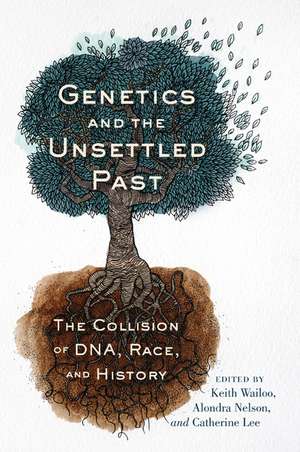
Genetics and the Unsettled Past: The Collision of DNA, Race, and History: Rutgers Studies on Race and Ethnicity
Editat de Keith Wailoo, Alondra Nelson, Catherine Leeen Limba Engleză Hardback – 15 mar 2012
Our genetic markers have come to be regarded as portals to the past. Analysis of these markers is increasingly used to tell the story of human migration; to investigate and judge issues of social membership and kinship; to rewrite history and collective memory; to right past wrongs and to arbitrate legal claims and human rights controversies; and to open new thinking about health and well-being. At the same time, in many societies genetic evidence is being called upon to perform a kind of racially charged cultural work: to repair the racial past and to transform scholarly and popular opinion about the “nature” of identity in the present.
Genetics and the Unsettled Past considers the alignment of genetic science with commercial genealogy, with legal and forensic developments, and with pharmaceutical innovation to examine how these trends lend renewed authority to biological understandings of race and history.
This unique collection brings together scholars from a wide range of disciplines—biology, history, cultural studies, law, medicine, anthropology, ethnic studies, sociology—to explore the emerging and often contested connections among race, DNA, and history. Written for a general audience, the book’s essays touch upon a variety of topics, including the rise and implications of DNA in genealogy, law, and other fields; the cultural and political uses and misuses of genetic information; the way in which DNA testing is reshaping understandings of group identity for French Canadians, Native Americans, South Africans, and many others within and across cultural and national boundaries; and the sweeping implications of genetics for society today.
Genetics and the Unsettled Past considers the alignment of genetic science with commercial genealogy, with legal and forensic developments, and with pharmaceutical innovation to examine how these trends lend renewed authority to biological understandings of race and history.
This unique collection brings together scholars from a wide range of disciplines—biology, history, cultural studies, law, medicine, anthropology, ethnic studies, sociology—to explore the emerging and often contested connections among race, DNA, and history. Written for a general audience, the book’s essays touch upon a variety of topics, including the rise and implications of DNA in genealogy, law, and other fields; the cultural and political uses and misuses of genetic information; the way in which DNA testing is reshaping understandings of group identity for French Canadians, Native Americans, South Africans, and many others within and across cultural and national boundaries; and the sweeping implications of genetics for society today.


Preț: 863.94 lei
Preț vechi: 1183.47 lei
-27%
Puncte Express: 1296
Carte tipărită la comandă
Livrare economică 05-19 decembrie
Livrare prin curier în România Termenul estimat este afișat lângă disponibilitate.
Transport gratuit pentru acest produs Plată online sau ramburs, în funcție de opțiunile comenzii.
Retur gratuit în 14 zile Comandă securizată și suport în română.
Specificații
ISBN-13: 9780813552545
ISBN-10: 0813552540
Pagini: 370
Ilustrații: 2 illustrations
Dimensiuni: 156 x 235 x 25 mm
Greutate: 0.68 kg
Ediția:None
Editura: Rutgers University Press
Colecția Rutgers University Press
Seria Rutgers Studies on Race and Ethnicity
ISBN-10: 0813552540
Pagini: 370
Ilustrații: 2 illustrations
Dimensiuni: 156 x 235 x 25 mm
Greutate: 0.68 kg
Ediția:None
Editura: Rutgers University Press
Colecția Rutgers University Press
Seria Rutgers Studies on Race and Ethnicity
V-ar putea interesa
-
 How Cancer Crossed the Color LineKeith Wailoo-17%Preț: 283.80 lei340.30 lei
 -
 Transnational Migrations: The Indian DiasporaWilliam Safran-18%Preț: 1115.87 lei1360.82 lei
 -
 -15%Preț: 463.90 lei545.76 lei
 -
 Preț: 305.86 lei
 -
 Ideology and Christianity in JapanKiri Paramore-15%Preț: 462.09 lei543.63 lei
 -
 -34%Preț: 638.16 lei961.38 lei
 -
 Recovering the Frontier StateRasul Bakhsh RaisPreț: 391.28 lei
 -
 Odom OracleSherri Paty BarberPreț: 156.90 lei
 -
 Latino/a Thought: Culture, Politics, and SocietyFrancisco H. Vázquez-31%Preț: 483.35 lei695.70 lei
 -
 The Hausa of NigeriaFrank A. Salamone-24%Preț: 319.14 lei417.62 lei
 -
 -27%Preț: 258.22 lei354.13 lei
 -
 -23%Preț: 378.54 lei493.66 lei
 -
 -23%Preț: 648.96 lei842.80 lei
 -
 TechnicolorAlondra NelsonPreț: 296.53 lei
 -
 Preț: 113.55 lei
 -
 Preț: 378.58 lei
 -
 -29%Preț: 111.00 lei157.04 lei
 -
 Dark EdgesCatherine LeePreț: 102.82 lei
 -
 Saving Jackson's ToothJeff ShnallPreț: 156.07 lei
 -
 Chassidic Ecstasy in MusicShmuel BarzilaiPreț: 451.05 lei
 -
 Prise de décision en politique étrangère et géopolitiqueVincent Legrand-22%Preț: 370.86 lei475.09 lei
 -
 Inside Hillview High SchoolHyacinth EvansPreț: 305.78 lei
Notă biografică
KEITH WAILOO is the Townsend Martin Professor of History and Public Affairs at Princeton University and the author or editor of several books, including Katrina’s Imprint: Race and Vulnerability in America (Rutgers University Press), How Cancer Crossed the Color Line, and Dying in the City of the Blues: Sickle Cell Anemia and the Politics of Race and Health.
ALONDRA NELSON is an associate professor of sociology at Columbia University. She is the author of Body and Soul: The Black Panther Party and the Fight Against Medical Discrimination and coeditor of Technicolor: Race, Technology, and Everyday Life.
CATHERINE LEE is an assistant professor of sociology and a faculty associate at the Institute for Health at Rutgers University. She is completing a book entitled Fictive Kin: Family Reunification and the Meaning of Race in Immigration Policy.
ALONDRA NELSON is an associate professor of sociology at Columbia University. She is the author of Body and Soul: The Black Panther Party and the Fight Against Medical Discrimination and coeditor of Technicolor: Race, Technology, and Everyday Life.
CATHERINE LEE is an assistant professor of sociology and a faculty associate at the Institute for Health at Rutgers University. She is completing a book entitled Fictive Kin: Family Reunification and the Meaning of Race in Immigration Policy.
Cuprins
Acknowledgments
Introduction: Genetic Claims and the Unsettled Past
Part I: History, Race, and the Genome Era
1. Who Am I? Genes and the Problem of Historical Identity
2. Reconciliation Projects: From Kinship to Justice
3. The Unspoken Significance of Gender in Constructing Kinship, Race, and Nation
Part II: Decoding the Genomic Age
4. A Biologist's Perspective on DNA and Race in the Genomics Era
5. The Dilemma of Classification: The Past in the Present
6. The Informationalization of Race: Communication, Databases, and the Digital Coding of the Genome
7. Forensic DNA Phenotyping: Continuity and Change in the History of Race, Genetics, and Policing
8. Forensic DNA and the Inertial Power of Race in American Legal Practice
9. Making History via DNA, Making DNA from History: Deconstructing the Race-Disease Connection in Admixture Mapping
10. Waiting on the Promise of Prescribing Precision: Race in the Era of Pharmacogenomics
Part III: Stories Told in Blood
11. French Families, Paper Facts: Genetics, Nation, and Explanation
12. Categorization, Census, and Multiculturalism: Molecular Politics and the Material of Nation
13. "It's a Living History, Told by the Real Survivors of the Times--DNA": Anthropological Genetics in the Tradition of Biology as Applied History
14. Cells, Genes, and Stories: HeLa's Journey from Labs to Literature
15. The Case of the Genetic Ancestor
16. Making Sense of Genetics, Culture, and History: A Case Study of a Native Youth Education Program
17. Humanitarian DNA Identification in Post-Apartheid South Africa
Conclusions: The Unsettled Past
18. Forbidden or Forsaken? The (Mis)Use of a Forbidden Knowledge Argument in Research on Race, DNA, and Disease
19. Genetic Claims and Credibility: Revisiting History and Remaking Race
Contributors
Index
Introduction: Genetic Claims and the Unsettled Past
Part I: History, Race, and the Genome Era
1. Who Am I? Genes and the Problem of Historical Identity
2. Reconciliation Projects: From Kinship to Justice
3. The Unspoken Significance of Gender in Constructing Kinship, Race, and Nation
Part II: Decoding the Genomic Age
4. A Biologist's Perspective on DNA and Race in the Genomics Era
5. The Dilemma of Classification: The Past in the Present
6. The Informationalization of Race: Communication, Databases, and the Digital Coding of the Genome
7. Forensic DNA Phenotyping: Continuity and Change in the History of Race, Genetics, and Policing
8. Forensic DNA and the Inertial Power of Race in American Legal Practice
9. Making History via DNA, Making DNA from History: Deconstructing the Race-Disease Connection in Admixture Mapping
10. Waiting on the Promise of Prescribing Precision: Race in the Era of Pharmacogenomics
Part III: Stories Told in Blood
11. French Families, Paper Facts: Genetics, Nation, and Explanation
12. Categorization, Census, and Multiculturalism: Molecular Politics and the Material of Nation
13. "It's a Living History, Told by the Real Survivors of the Times--DNA": Anthropological Genetics in the Tradition of Biology as Applied History
14. Cells, Genes, and Stories: HeLa's Journey from Labs to Literature
15. The Case of the Genetic Ancestor
16. Making Sense of Genetics, Culture, and History: A Case Study of a Native Youth Education Program
17. Humanitarian DNA Identification in Post-Apartheid South Africa
Conclusions: The Unsettled Past
18. Forbidden or Forsaken? The (Mis)Use of a Forbidden Knowledge Argument in Research on Race, DNA, and Disease
19. Genetic Claims and Credibility: Revisiting History and Remaking Race
Contributors
Index
Recenzii
"This sterling and absolutely needed collection probes the political and historical meanings of DNA, shaping our understanding of human connections and ourselves. Arguing for a multidisciplinary approach to these contentious concerns, this book should be widely read and discussed…a masterpiece."
"Intellectually and analytically strong, this volume comes together in a fluid melding of many different voices and perspectives that, when taken together, provide the richest and best collection of scholarship on the topic."
"Few collections have so successfully straddled the divide between biology and humanities in relation to race. This work will be widely read and cited."
Descriere
Genetics and the Unsettled Past considers the alignment of genetic science with commercial trends in genealogy, with legal and forensic developments, and with pharmaceutical innovation to examine how these trends lend renewed authority to biological understandings of race and history. Essays by scholars across a wide range of disciplines—biology, history, cultural studies, law, medicine, anthropology, ethnic studies, sociology—explore the emerging and often contested connections among race, DNA, and history.