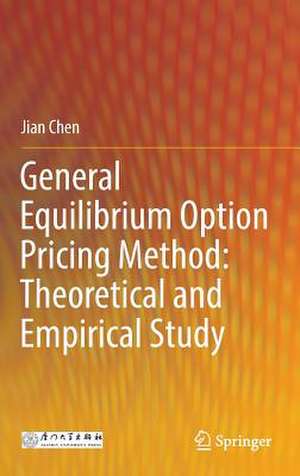
General Equilibrium Option Pricing Method: Theoretical and Empirical Study
Autor Jian Chenen Limba Engleză Hardback – 20 apr 2018
This book mainly addresses the general equilibrium asset pricing method in two aspects: option pricing and variance risk premium. First, volatility smile and smirk is the famous puzzle in option pricing. Different from no arbitrage method, this book applies the general equilibrium approach in explaining the puzzle. In the presence of jump, investors impose more weights on the jump risk than the volatility risk, and as a result, investors require more jump risk premium which generates a pronounced volatility smirk. Second, based on the general equilibrium framework, this book proposes variance risk premium and empirically tests its predictive power for international stock market returns.
Preț: 663.03 lei
Preț vechi: 780.03 lei
-15%
Puncte Express: 995
Carte tipărită la comandă
Livrare economică 30 noiembrie-14 decembrie
Livrare prin curier în România Termenul estimat este afișat lângă disponibilitate.
Transport gratuit pentru acest produs Plată online sau ramburs, în funcție de opțiunile comenzii.
Retur gratuit în 14 zile Comandă securizată și suport în română.
Specificații
ISBN-13: 9789811074271
ISBN-10: 9811074275
Pagini: 176
Ilustrații: XI, 164 p. 31 illus., 10 illus. in color.
Dimensiuni: 160 x 241 x 16 mm
Greutate: 0.38 kg
Ediția:1st ed. 2018
Editura: Springer
Locul publicării:Singapore, Singapore
ISBN-10: 9811074275
Pagini: 176
Ilustrații: XI, 164 p. 31 illus., 10 illus. in color.
Dimensiuni: 160 x 241 x 16 mm
Greutate: 0.38 kg
Ediția:1st ed. 2018
Editura: Springer
Locul publicării:Singapore, Singapore
Cuprins
Chapter1.Introduction.- Chapter2.General Equilibrium Option Pricing Models.- Chapter3.Simulation Comparison.- Chapter4.Empirical Comparison.- Chapter5.Fanning Preference and Option Pricing.- Chapter6.Jump Size Distribution and Option Pricing.- Chapter7.Risk Aversion Estimated From Variance Risk Premium.-Chapter8.Predictability of Variance Risk Premium: Hong Kong Evidence.- Chapter9.Predictability of Variance Risk Premium:Other International Evidence.- Chapter10.Predictability of Variance Risk Premium:A Comparison Study.- Chapter11.Conclusions.
Textul de pe ultima copertă
This book mainly addresses the general equilibrium asset pricing method in two aspects: option pricing and variance risk premium. First, volatility smile and smirk is the famous puzzle in option pricing. Different from no arbitrage method, this book applies the general equilibrium approach in explaining the puzzle. In the presence of jump, investors impose more weights on the jump risk than the volatility risk, and as a result, investors require more jump risk premium which generates a pronounced volatility smirk. Second, based on the general equilibrium framework, this book proposes variance risk premium and empirically tests its predictive power for international stock market returns.
Notă biografică
Dr. Jian Chen received the B.E. and M.E. degrees from Zhejiang University, Hangzhou, China, in 1998 and 2001, respectively, and the Ph.D. degree in Electrical Engineering from Clemson University, Clemson, SC, USA, in 2005. He was Research Fellow with the University of Michigan, Ann Arbor, MI, USA, from 2006 to 2008, where he was involved in fuel cell modeling and control. In 2013, he joined the Department of Control Science and Engineering, Zhejiang University, where he is currently Professor with the School of Mechanical Engineering, Zhejiang University. His research interests include modeling and controlling fuel cell systems, vehicle control and intelligence, visual servo techniques, battery management systems, and nonlinear control. Dr. Quan Ouyang received the Bachelor's degree in Automation from Huazhong University of Science and Technology, Wuhan, China, in 2013 and the Ph.D. degree in Control Science and Engineering from Zhejiang University, Hangzhou, China, in 2018. In 2022, he joined Chalmers University of Technology as the Marie Sk¿odowska-Curie Actions- Postdoctoral Fellow. He is currently Associate Professor with the College of Automation Engineering, Nanjing University of Aeronautics and Astronautics, Nanjing, China. His research interests mainly include battery management, modeling and control of fuel cell systems, and nonlinear control. Dr. Zhisheng Wang received the B.E. degree in Hydromechanical Automation from Xi'an Aeronautical University, Xi'an, China, in 1990, and the M.S and Ph.D. degrees in Navigation Guidance and Control from Northwestern Polytechnical University, Xi'an, China, in 1999 and 2002, respectively. In 2002, he joined the College of Automation Engineering, Nanjing University of Aeronautics and Astronautics (NUAA), Nanjing, China, where he is currently Full Professor with the Department of Automation Control Engineering. From 2002 to 2004, he was Postdoctoral Fellow with the College of Automation Engineering, NUAA. From 2008 to 2010, he was Postdoctoral Fellow with the School of Mechanical Engineering and Automation, National University of Defense Technology, Changsha, China. From 2010 to 2011, he was Visiting Professor with Stockholm University, Stockholm, Sweden. His research interests include information fusion, battery management, fusion control, and computer vision.