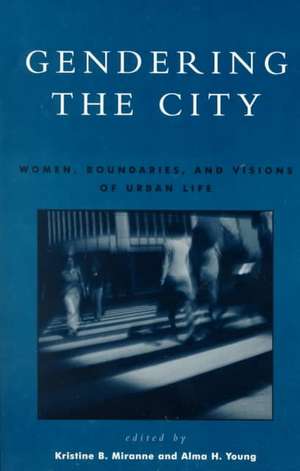
Gendering the City: Women, Boundaries, and Visions of Urban Life
Editat de Kristine B. Miranne, Alma H. Young Contribuţii de Caroline Andrew, Marilyn Bruin, Christine C. Cook, Sue Crull, Judith A. Garber, Melissa R. Gilbert, Helen Harrison, Sue A. Hendler, Beth Moore Milroy, Evelyn Peters, Marsha Ritzdorf, Daphne Spain, Jennifer E. Subbanen Limba Engleză Paperback – 19 ian 2000
Preț: 306.84 lei
Preț vechi: 385.82 lei
-20%
Puncte Express: 460
Carte tipărită la comandă
Livrare economică 08-22 iunie
Specificații
ISBN-13: 9780847694518
ISBN-10: 0847694518
Pagini: 240
Dimensiuni: 146 x 227 x 17 mm
Greutate: 0.35 kg
Ediția:0240
Editura: Bloomsbury Publishing
Colecția Rowman & Littlefield
Locul publicării:New York, United States
ISBN-10: 0847694518
Pagini: 240
Dimensiuni: 146 x 227 x 17 mm
Greutate: 0.35 kg
Ediția:0240
Editura: Bloomsbury Publishing
Colecția Rowman & Littlefield
Locul publicării:New York, United States
V-ar putea interesa
-
 Goddesses in Older WomenJean Shinoda BolenPreț: 91.71 lei
 -
 -16%Preț: 137.67 lei164.25 lei
 -
 Women's Writing on the First World WarAgnès Cardinal-23%Preț: 281.02 lei364.45 lei
 -
 Lady Mary Wortley Montagu: Comet of the EnlightenmentIsobel Grundy-29%Preț: 401.24 lei568.85 lei
 -
 -15%Preț: 299.76 lei351.30 lei
 -
 -20%Preț: 428.68 lei535.44 lei
 -
 Women and the Military in EuropeI. EulrietPreț: 371.93 lei
 -
 -18%Preț: 704.03 lei858.57 lei
 -
 The Demands of MotherhoodL. SmythPreț: 373.56 lei
 -
 On Becoming Fearless: A road map for womenArianna Stassinopoulos HuffingtonPreț: 95.08 lei
 -
 A Midwife's TaleLaurel Thatcher Ulrich-20%Preț: 92.75 lei116.36 lei
 -
 Can't Buy My LoveJean KilbournePreț: 104.99 lei
 -
 Preț: 222.72 lei
 -
 Teahouse of the AlmightyPatricia SmithPreț: 89.89 lei
 -
 The Tattooed LadyAmelia Klem OsterudPreț: 119.49 lei
 -
 Women and PunishmentPat CarlenPreț: 395.00 lei
Cuprins
Chapter 1 Introduction
Part 2 Part I: Visible or Invisible? Gendered Urban Boundaries
Chapter 3 1 Not Named or Identified: Politics and the Search for Anonymity in the City
Chapter 4 2 The Two Major Living Realities: Urban Services Needs of First Nations Women in Canadian Cities
Part 5 Part II: Intersections of Gendered Boundaries: Race, Class, and Ethnicity
Chapter 6 3 Identity, Difference, and the Geographies of Working Poor Women's Survival Strategies
Chapter 7 4 Boundaries Cracked: Gendering Literacy, Empowering Women, and Building Community
Chapter 8 5 Black Women as City Builders
Chapter 9 6 Women Embounded: Intersections of Public Housing Policy and Welfare Reform
Part 10 Part III: Challenging Planned Boundaries
Chapter 11 7 Theorizing Canadian Planning History: Women's Gender and Feminist Perspectives
Chapter 12 8 Resisting Boundaries? Using Safety Audits for Women
Chapter 13 9 Sex, Lies, and Urban Life: How Municipal Planning Marginalizes African-American Women and Their Families
Chapter 14 10 Manipulating Constraints: Women's Housing and the Metropolitan Context
Chapter 15 Epilogue: Cracks, Light, Energy
Part 2 Part I: Visible or Invisible? Gendered Urban Boundaries
Chapter 3 1 Not Named or Identified: Politics and the Search for Anonymity in the City
Chapter 4 2 The Two Major Living Realities: Urban Services Needs of First Nations Women in Canadian Cities
Part 5 Part II: Intersections of Gendered Boundaries: Race, Class, and Ethnicity
Chapter 6 3 Identity, Difference, and the Geographies of Working Poor Women's Survival Strategies
Chapter 7 4 Boundaries Cracked: Gendering Literacy, Empowering Women, and Building Community
Chapter 8 5 Black Women as City Builders
Chapter 9 6 Women Embounded: Intersections of Public Housing Policy and Welfare Reform
Part 10 Part III: Challenging Planned Boundaries
Chapter 11 7 Theorizing Canadian Planning History: Women's Gender and Feminist Perspectives
Chapter 12 8 Resisting Boundaries? Using Safety Audits for Women
Chapter 13 9 Sex, Lies, and Urban Life: How Municipal Planning Marginalizes African-American Women and Their Families
Chapter 14 10 Manipulating Constraints: Women's Housing and the Metropolitan Context
Chapter 15 Epilogue: Cracks, Light, Energy
Recenzii
Gendering the City provides a significant contribution to urban studies, balancing critiques of domination with analyses of how groups and individuals have actively carved out spaces that resist and reconfigure dominant gender regimes. The collection draws on a wide range of empirical work, conducted in both Canada and the United States, to explore the diversity of women's experiences. It is both grounded and provocative.
Gendering the City represents a contemporary collection of essays that examine a diversity of women's experiences while successfully adhering to the main theme of visible and invisible boundaries. The political positioning of the book both deconstructs the silencing of women and provides refreshingly innovative ways of rethinking spatial knowledges of the urban environment.
In Gendering the City, Kristine Miranne and Alma Young have brought together an interesting collection of essays about Canadian and U.S. cities. Although the topic, approach, and tone of the chapters of this volume are predictably varied, the editors have done an admirable job in focusing the material on the broad issue of boundaries. The book itself is a slim, attractive volume. The bibliographies and notes are at the end of each chapter and there is a thorough index to the entire volume. The editors have done their job well. The book is valuable, particularly in its attention to race, ethnicity and class in women's lives.
This volume would make an excellent resource for readings in urban studies courses. The wide range of topics covered makes the work useful in a range of courses, or for a variety of topics within a survey course. Gendering the City makes a strong contribution in this area.
An important and useful collection with an impressive mix of senior and junior scholars. The gendered-boundaries concept puts the arguments in fresh perspective, and the material on African-American women and indigenous women is a welcome addition.
Gendering the City represents a contemporary collection of essays that examine a diversity of women's experiences while successfully adhering to the main theme of visible and invisible boundaries. The political positioning of the book both deconstructs the silencing of women and provides refreshingly innovative ways of rethinking spatial knowledges of the urban environment.
In Gendering the City, Kristine Miranne and Alma Young have brought together an interesting collection of essays about Canadian and U.S. cities. Although the topic, approach, and tone of the chapters of this volume are predictably varied, the editors have done an admirable job in focusing the material on the broad issue of boundaries. The book itself is a slim, attractive volume. The bibliographies and notes are at the end of each chapter and there is a thorough index to the entire volume. The editors have done their job well. The book is valuable, particularly in its attention to race, ethnicity and class in women's lives.
This volume would make an excellent resource for readings in urban studies courses. The wide range of topics covered makes the work useful in a range of courses, or for a variety of topics within a survey course. Gendering the City makes a strong contribution in this area.
An important and useful collection with an impressive mix of senior and junior scholars. The gendered-boundaries concept puts the arguments in fresh perspective, and the material on African-American women and indigenous women is a welcome addition.