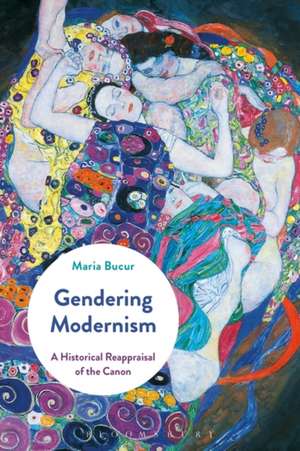
Gendering Modernism: A Historical Reappraisal of the Canon
Autor Professor Maria Bucuren Limba Engleză Paperback – 21 sep 2017
Focusing primarily on the connections between North American and European modernists, Maria Bucur explains why it is imperative that we consider the gender angles of modernism as a way to understand the legacies of the movement. She provides an overview of the scholarship on modernism and an analysis of how definitions of modernism have evolved with that scholarship. Interweaving vivid case studies from before the Great War to the interwar period - looking at individual modernists from Ibsen to Picasso, Hannah Höch to Josephine Baker - she covers various fields such as art, literature, theatre and film, whilst also demonstrating how modernism manifested itself in the major social-political and cultural shifts of the 20th century, including feminism, psychology, sexology, eugenics, nudism, anarchism, communism and fascism.
This is a fresh and wide-ranging investigation of modernism which expands our definition of the movement, integrating gender analysis and thereby opening up new lines of enquiry. Written in a lively and accessible style, Gendering Modernism is a crucial intervention into the literature which should be read by all students and scholars of the modernist movement as well 20th-century history and gender studies more broadly.
Preț: 169.95 lei
Preț vechi: 213.44 lei
-20%
Puncte Express: 255
Carte tipărită la comandă
Livrare economică 13-27 octombrie
Livrare prin curier în România Termenul estimat este afișat lângă disponibilitate.
Transport gratuit de la 400.00 lei Plată online sau ramburs, în funcție de opțiunile comenzii.
Retur gratuit în 14 zile Comandă securizată și suport în română.
Specificații
ISBN-13: 9781350026254
ISBN-10: 1350026255
Pagini: 168
Ilustrații: 7 bw illus
Dimensiuni: 150 x 232 x 12 mm
Greutate: 0.23 kg
Editura: Bloomsbury Publishing
Colecția Bloomsbury Academic
Locul publicării:London, United Kingdom
ISBN-10: 1350026255
Pagini: 168
Ilustrații: 7 bw illus
Dimensiuni: 150 x 232 x 12 mm
Greutate: 0.23 kg
Editura: Bloomsbury Publishing
Colecția Bloomsbury Academic
Locul publicării:London, United Kingdom
V-ar putea interesa
-
 Amazing Tales for Making Men out of BoysNeil OliverPreț: 92.37 lei
 -
 SaltMark KurlanskyPreț: 107.93 lei
 -
 The City in HistoryLewis MumfordPreț: 197.36 lei
 -
 Wealth And Poverty Of NationsDavid S. LandesPreț: 121.94 lei
 -
 War and Peace and WarPeter TurchinPreț: 103.21 lei
 -
 The Making of PeaceWilliamson MurrayPreț: 252.50 lei
 -
 BirthTina Cassidy-5%Preț: 99.00 lei104.21 lei
 -
 The Crusades Through Arab EyesAmin MaaloufPreț: 110.03 lei
 -
 The Age of Genius: The Seventeenth Century and the Birth of the Modern MindProfessor A. C. Grayling-36%Preț: 77.21 lei120.16 lei
 -
 -28%Preț: 66.09 lei91.62 lei
 -
 The Making of India: The Untold Story of British EnterpriseKartar Lalvani-39%Preț: 146.35 lei238.96 lei
 -
 Chronologica: The Incredible Years That Defined HistoryBloomsbury Publishing-17%Preț: 108.62 lei130.43 lei
Cuprins
Prologue
Introduction: What Sort of Rebellion?
1. Modernism before the Great War
2. Modernism Flourishes
3. The Modernist Canon: How Did it Come About?
4. A New Set of Criteria: Rebellion, Rejection, and Reimagining Modernism
Conclusion
Selected Bibliography
Index
Introduction: What Sort of Rebellion?
1. Modernism before the Great War
2. Modernism Flourishes
3. The Modernist Canon: How Did it Come About?
4. A New Set of Criteria: Rebellion, Rejection, and Reimagining Modernism
Conclusion
Selected Bibliography
Index
Recenzii
Gendering Modernism definitely opens many new horizons for those who are interested in the evolution of gender norms and its influence on the formation of the modernist canon.
A useful introduction, contributing to the still very necessary task of keeping feminist issues visible.
Written with a rare clarity, concision, and lucidity, Gendering Modernism builds up a rich texture of references and details that cumulatively haul the highly neglected female dimension of modernism out of oblivion. The wealth of references and wide-ranging supportive bibliography give scholarly weight and substance to the three theses, resulting in a work which is a hybrid of essay, programmatic tract, and scholarly history. This highly readable, powerful book is relevant to both modernism and feminism studies, as well as to the cultural and political history of the period 1880-1945. It is rare to see a feminist perspective explored with such a deep sense of ambivalence and complexity, so that it amplifies and enhances traditional narratives instead of exploding them.
In true modernist spirit, Maria Bucur upsets the canon. Just as modernists rejected tradition and created new ways of seeing the world, this thought-provoking book argues that focusing on gender changes how we should evaluate modernism. Was modernism truly revolutionary if many of its practitioners adhered to traditional gender norms? Simultaneously erudite and accessible, Gendering Modernism asks its readers to rethink their fundamental assumptions about modernism and its icons.
A useful introduction, contributing to the still very necessary task of keeping feminist issues visible.
Written with a rare clarity, concision, and lucidity, Gendering Modernism builds up a rich texture of references and details that cumulatively haul the highly neglected female dimension of modernism out of oblivion. The wealth of references and wide-ranging supportive bibliography give scholarly weight and substance to the three theses, resulting in a work which is a hybrid of essay, programmatic tract, and scholarly history. This highly readable, powerful book is relevant to both modernism and feminism studies, as well as to the cultural and political history of the period 1880-1945. It is rare to see a feminist perspective explored with such a deep sense of ambivalence and complexity, so that it amplifies and enhances traditional narratives instead of exploding them.
In true modernist spirit, Maria Bucur upsets the canon. Just as modernists rejected tradition and created new ways of seeing the world, this thought-provoking book argues that focusing on gender changes how we should evaluate modernism. Was modernism truly revolutionary if many of its practitioners adhered to traditional gender norms? Simultaneously erudite and accessible, Gendering Modernism asks its readers to rethink their fundamental assumptions about modernism and its icons.