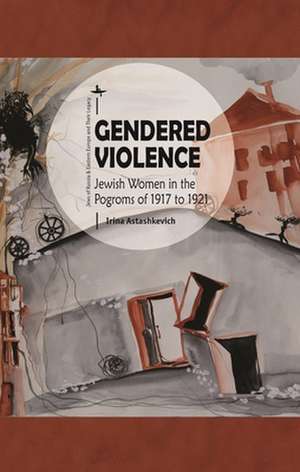
Gendered Violence: Jewish Women in the Pogroms of 1917 to 1921: Jews of Russia & Eastern Europe and Their Legacy
Autor Irina Astashkevichen Limba Engleză Paperback – 9 noi 2018
This is a groundbreaking study of an important and neglected topic. Between 1917 and 1921, rape was used as a strategic weapon in the genocidal anti-Jewish violence—the pogroms—that erupted in Ukraine. During this period, at least 100,000 Jews died and unknown numbers of Jewish women were raped. The book is based on the in-depth study of the scores of survivor narratives that have been all but forgotten for almost a century. It analyzes how the victimized Jewish communities experienced trauma, how they expressed it, the motives of the perpetrators, and the part played by rape in furthering the pogroms’ objectives.






Preț: 166.76 lei
Preț vechi: 217.22 lei
-23%
Puncte Express: 250
Carte disponibilă
Livrare economică 09-23 noiembrie
Livrare express 23-29 octombrie pentru 72.86 lei
Livrare prin curier în România Termenul estimat este afișat lângă disponibilitate.
Transport gratuit de la 400.00 lei Plată online sau ramburs, în funcție de opțiunile comenzii.
Retur gratuit în 14 zile Comandă securizată și suport în română.
Specificații
ISBN-13: 9781618119995
ISBN-10: 1618119990
Pagini: 170
Dimensiuni: 159 x 238 x 9 mm
Greutate: 0.25 kg
Editura: Academic Studies Press
Colecția Academic Studies Press
Seria Jews of Russia & Eastern Europe and Their Legacy
Locul publicării:Boston, MA, United States
ISBN-10: 1618119990
Pagini: 170
Dimensiuni: 159 x 238 x 9 mm
Greutate: 0.25 kg
Editura: Academic Studies Press
Colecția Academic Studies Press
Seria Jews of Russia & Eastern Europe and Their Legacy
Locul publicării:Boston, MA, United States
Cuprins
Acknowledgements
Introduction
CHAPTER I
CHAPTER II
CHAPTER III
CHAPTER IV
CHAPTER V
CHAPTER VI
Conclusion
BIBLIOGRAPHY
Recenzii
“Astashkevich’s study opens new and urgent lines of thinking in the historiography of interethnic violence in Eastern Europe and Ukraine. By grappling with the ways sexual violence co-constituted antisemitic violence during the Ukrainian War of Independence, Astashkevich gestures toward the ways mass rape and sexual violence have been foundational to the trauma of the region and to the generational trauma of Ukraine’s far-flung Jews. Her book is one of the most theoretically inflected pieces of feminist scholarship to deal with the Ukrainian War of Independence. Because of that, Astashkevich helps us to understand the modernizing forces that worked to bring mass rape into relationship with genocidal violence. This stimulating monograph the deserves attention of anyone interested in Jewish history, antisemitism, sexual violence, Ukrainian history, gender history, and the history of atrocity.” —Meghann Pytka, Northwestern University, H-Poland
Notă biografică
Irina Astashkevich, a visiting research associate of the Tauber Institute, holds a PhD from Brandeis University. She received her MA in History, Jewish History and Archives from the Project Judaica - a joint project of the Russian State University of Humanities, Historical Archival Institute, Jewish Theological Seminary of America, and the YIVO Institute of Jewish Research in New York. She has worked in various archives in Russia, Lithuania, and the US, as well as in Jewish philanthropic organizations, such as the American Jewish Joint Distribution Committee in Moscow.