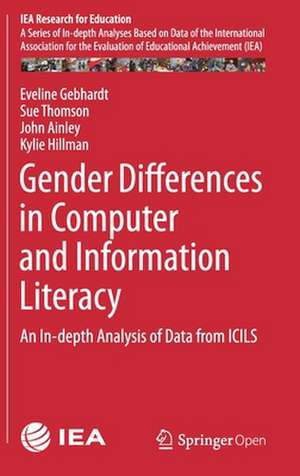
Gender Differences in Computer and Information Literacy: IEA Research for Education, cartea 8
Autor Eveline Gebhardt, Sue Thomson, John Ainley, Kylie Hillmanen Limba Engleză Hardback – 11 oct 2019
When computer technology was first introduced in schools, there was a prevailing belief that information and communication technologies were ‘boys’ toys’; boys were assumed to have more positive attitudes toward using computer technologies. As computer technologies have become more established throughout societies, gender gaps in students’ computer and information literacy appear to be closing, although studies into gender differences remain sparse.
The IEA’s International Computer and Information Literacy Study (ICILS) is designed to discover how well students are prepared for study, work, and life in the digital age. Despite popular beliefs, a critical finding of ICILS 2013 was that internationally girls tended to score more highly than boys, so why are girls still not entering technology-based careers to the same extent as boys?
Readers will learn how male and female studentsdiffer in their computer literacy (both general and specialized) and use of computer technology, and how the perceptions held about those technologies vary by gender.
Din seria IEA Research for Education
-
 Preț: 402.00 lei
 -
 Preț: 369.10 lei
 -
 Preț: 408.01 lei
 -
 Preț: 390.72 lei
 -
 Preț: 336.84 lei
 -
 Preț: 341.13 lei
 -
 Preț: 328.27 lei
 -
 Preț: 334.81 lei
 -
 Preț: 416.28 lei
 -
 Preț: 433.84 lei
 -
 Preț: 364.08 lei
 -
 Preț: 409.98 lei
 -
 Preț: 381.56 lei
 -
 Preț: 363.87 lei
 - nou
 Preț: 323.83 lei
Preț: 404.92 lei
Puncte Express: 607
Carte tipărită la comandă
Livrare economică 23-28 noiembrie
Livrare prin curier în România Termenul estimat este afișat lângă disponibilitate.
Transport gratuit pentru acest produs Plată online sau ramburs, în funcție de opțiunile comenzii.
Retur gratuit în 14 zile Comandă securizată și suport în română.
Specificații
ISBN-13: 9783030262020
ISBN-10: 3030262022
Pagini: 88
Ilustrații: XI, 73 p. 5 illus., 1 illus. in color.
Dimensiuni: 160 x 241 x 11 mm
Greutate: 0.26 kg
Ediția:1st ed. 2019
Editura: Springer
Colecția IEA Research for Education
Seria IEA Research for Education
Locul publicării:Cham, Switzerland
ISBN-10: 3030262022
Pagini: 88
Ilustrații: XI, 73 p. 5 illus., 1 illus. in color.
Dimensiuni: 160 x 241 x 11 mm
Greutate: 0.26 kg
Ediția:1st ed. 2019
Editura: Springer
Colecția IEA Research for Education
Seria IEA Research for Education
Locul publicării:Cham, Switzerland
Cuprins
1. Introduction to Gender Differences in Computer and Information Literacy.- 2. Data and Methods Used for ICILS 2013.- 3. Student Achievement and Beliefs Related to Computer Information Literacy.- 4. Students’ Interest and Enjoyment In, and Patterns of Use of ICT.- 5. Teacher Gender and ICT.- 6. What have we learned about gender differences in ICT?.- References.
Textul de pe ultima copertă
This open access book presents a systematic investigation into internationally comparable data gathered in ICILS 2013. It identifies differences in female and male students’ use of, perceptions about, and proficiency in using computer technologies. Teachers’ use of computers, and their perceptions regarding the benefits of computer use in education, are also analyzed by gender.
When computer technology was first introduced in schools, there was a prevailing belief that information and communication technologies were ‘boys’ toys’; boys were assumed to have more positive attitudes toward using computer technologies. As computer technologies have become more established throughout societies, gender gaps in students’ computer and information literacy appear to be closing, although studies into gender differences remain sparse.
The IEA’s International Computer and Information Literacy Study (ICILS) is designed to discover how well students are prepared for study, work, and life in the digital age. Despite popular beliefs, a critical finding of ICILS 2013 was that internationally girls tended to score more highly than boys, so why are girls still not entering technology-based careers to the same extent as boys?
Readers will learn how male and female studentsdiffer in their computer literacy (both general and specialized) and use of computer technology, and how the perceptions held about those technologies vary by gender.
When computer technology was first introduced in schools, there was a prevailing belief that information and communication technologies were ‘boys’ toys’; boys were assumed to have more positive attitudes toward using computer technologies. As computer technologies have become more established throughout societies, gender gaps in students’ computer and information literacy appear to be closing, although studies into gender differences remain sparse.
The IEA’s International Computer and Information Literacy Study (ICILS) is designed to discover how well students are prepared for study, work, and life in the digital age. Despite popular beliefs, a critical finding of ICILS 2013 was that internationally girls tended to score more highly than boys, so why are girls still not entering technology-based careers to the same extent as boys?
Readers will learn how male and female studentsdiffer in their computer literacy (both general and specialized) and use of computer technology, and how the perceptions held about those technologies vary by gender.
Caracteristici
Large-scale study of gender and computer literacy Based on ICILS data collected from almost 60,000 Grade 8 students and 35,000 teachers in 21 education systems Provides rich information about how students and teachers use information and communication technologies