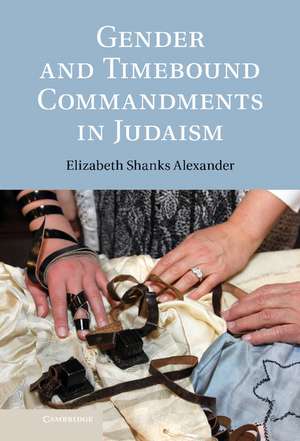
Gender and Timebound Commandments in Judaism
Autor Elizabeth Shanks Alexanderen Limba Engleză Hardback – 21 apr 2013
Vezi toate premiile Carte premiată
Găsim în Gender and Timebound Commandments in Judaism o analiză riguroasă a mecanismelor prin care textele rabinice timpurii au modelat identitatea de gen în iudaism. Elizabeth Shanks Alexander pornește de la examinarea listelor de diferențe masculin-feminin și a modului în care s-a formulat categoria poruncilor pozitive determinate de timp. Autoarea propune un exercițiu de deconstrucție a viziunii populare, demonstrând că această regulă de exceptare a femeilor nu a fost creată inițial pentru a le structura viața religioasă, ci a devenit un instrument de „inginerie socială” abia după ce a suferit mutații de sens în timpul transmiterii sale.
Structura volumului reflectă o progresie clară: prima parte analizează realitatea socială tanaitică, a doua urmărește interpretările talmudice (cum ar fi transformarea tefillin-ului într-o poruncă independentă de timp), iar ultima parte se concentrează pe ritualuri specifice precum Shema și studiul Torei. Această abordare metodologică este o evoluție firească a temelor explorate de autoare în Transmitting Mishnah, unde a investigat complexitatea tradiției orale. Dacă în lucrarea anterioară se concentra pe procesul de transmitere, aici aplică acea expertiză pentru a înțelege cum evoluția textului a dus la separarea spațiilor de cult: sinagoga pentru bărbați și căminul pentru femei.
Suntem de părere că volumul reprezintă o alternativă necesară la A Question of Sex? Gender and Difference in the Hebrew Bible and Beyond de Deborah W. Rooke pentru cursurile de studii iudaice și gen. Avantajul major adus de Alexander este focalizarea strictă pe „stratul tanaitic” și pe modul în care prescripțiile au evoluat din simple descrieri ale realității, oferind o perspectivă mai tehnică asupra legislației religioase față de abordările mai largi, sociologice, ale altor lucrări din domeniu.
Preț: 696.41 lei
Preț vechi: 782.48 lei
-11%
Carte tipărită la comandă
Livrare economică 25 noiembrie-09 decembrie
Specificații
ISBN-10: 1107035562
Pagini: 300
Ilustrații: 2 tables
Dimensiuni: 152 x 229 x 21 mm
Greutate: 0.52 kg
Ediția:New.
Editura: Cambridge University Press
Colecția Cambridge University Press
Locul publicării:New York, United States
V-ar putea interesa
-
 Out of the ShadowsByers NinaPreț: 291.46 lei
 -
 Women, Armies, and Warfare in Early Modern EuropeJohn A. Lynn IIPreț: 231.09 lei
 -
 Gender EqualityLinda C. McclainPreț: 464.92 lei
 -
 Redefining RapeEstelle B. FreedmanPreț: 214.51 lei
 -
 My Unsentimental EducationDebra MonroePreț: 147.61 lei
 -
 UndeterredRania Habiby AndersonPreț: 100.42 lei
 -
 Medieval WomenEileen PowerPreț: 136.70 lei
 -
 The Rise of the Female ExecutivePeninah Thomson-5%Preț: 372.02 lei391.60 lei
 -
 Pretty/Funny: Women Comedians and Body PoliticsLinda MizejewskiPreț: 223.78 lei
 -
 -21%Preț: 59.02 lei74.85 lei
De ce să citești această carte
Recomandăm această carte cercetătorilor și studenților interesați de intersecția dintre dreptul religios și identitatea de gen. Cititorul câștigă o înțelegere profundă a modului în care normele halahice nu sunt statice, ci rezultatul unor negocieri textuale complexe. Este un titlu esențial pentru a înțelege de ce anumite ritualuri (precum studiul Torei) au devenit piloni ai identității masculine, oferind un argument istoric solid care depășește clișeele despre rolul femeii în iudaismul antic.
Despre autor
Elizabeth Shanks Alexander este conferențiar în studii religioase la Universitatea din Virginia, specializată în iudaismul antic. Deținătoare a unui doctorat la Yale University (1998), ea a predat anterior la Smith și Haverford Colleges. Expertiza sa în procesele de transmitere a tradiției orale este recunoscută internațional, fiind autoarea volumului Transmitting Mishnah publicat tot de Cambridge University Press. Cercetarea sa pentru acest volum a fost susținută de un prestigios grant Brandeis Hadassah, consolidându-i poziția de voce autorizată în studiul textelor rabinice din perspectivă academică și feministă.
Descriere scurtă
Cuprins
Recenzii
'Slicing through centuries of ideological (ab)use of the rabbinic exemption of women from timebound, positive commandments, Alexander carefully and judiciously enables her readers to see the exemption - for the first time - for what it is and what it is not. Combining philological exactitude with the methods of the broader humanities, she disables traditional religious, academic, and even feminist misunderstandings of the exemption, restores it to its original context, and analyzes it afresh with tools drawn from ritual and gender studies. The pay-off is rich - and utterly surprising.' Christine Hayes, Weis Professor of Religious Studies in Classical Judaica, Yale University, Connecticut
'Alexander's examination of the rationale behind women's exemption from timebound mitzvoth contributes to the growing investigation of halakhic development from a gendered perspective. Remarkable for its incisiveness and clarity, as well as its freedom from commonly held presumptions regarding the relationship between rabbinic law and social engineering of gender, this study has much to offer scholars and historians interested in the interplay between rabbinic law and culture, as well as those seeking possible ramifications for Jewish women in our day.' Tamar Ross, Bar Ilan University, Israel
'Professor Alexander has produced a model study. Utilizing with equal facility the tools of the exegete, the literary historian, the historian of ideas, and the constructive theologian, she makes a profound case for the centrality of the Shema - as ritual praxis and intellectual resource - in the shaping of rabbinic notions of gender and the role of women in the emerging rabbinic movement of late antiquity. This is a book that deserves to be studied and re-studied, its message to be impressed on the minds of a whole generation of scholars.' Martin S. Jaffee, University of Washington
'Careful, meticulous, learned scholarship informs the study by Elizabeth Shanks Alexander on gender and Jewish law. A breakthrough work in analyzing both the primary sources and the contemporary scholarship on this key issue concerning women and Judaism.' Susannah Heschel, Eli Black Professor of Jewish Studies, Dartmouth College, New Hampshire
'We are indebted to Elizabeth Shanks Alexander for what surely will be the definitive exploration of the development of women's roles in Judaism in relationship to the construct of positive timebound commandments. Her persistence, scholarship, and clearly explicated erudition epitomize the best fruits of the Jewish feminist enterprise.' Jewish Book Council
'This novel approach to gender in the earliest stratum of rabbinic texts concerns the rule that women are exempt from positive commandments occasioned by time … The author acknowledges the role of the feminist critiques and debates of recent decades regarding women's exemption or exclusion from some key Jewish ritual matters but seeks to show that much of the substance of these debates is informed by later rereadings of the Mishnah.' Religious Studies Review
Descriere
Premii
- National Jewish Book Award Finalist, 2013