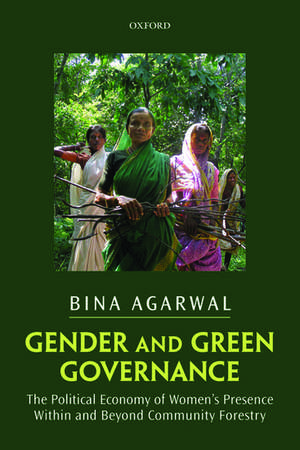
Gender and Green Governance: The Political Economy of Women's Presence Within and Beyond Community Forestry
Autor Bina Agarwalen Limba Engleză Paperback – 18 iul 2013
Problema centrală pe care o rezolvăm prin analiza volumului Gender and Green Governance este ignorarea sistematică a variabilei de gen în modelele economice de guvernare verde. În timp ce literatura existentă s-a limitat adesea la a constata absența femeilor din structurile de decizie, Bina Agarwal inversează perspectiva: ce se întâmplă, concret, atunci când femeile participă activ la gestionarea resurselor forestiere? Descoperim aici că incluziunea nu este doar o chestiune de echitate socială, ci un factor determinant pentru rezultatele conservării și subzistenței rurale.
Reținem rigoarea statistică neobișnuită pentru acest domeniu, autoarea utilizând date primare colectate din India și Nepal pentru a demonstra cum prezența femeilor modifică prioritățile de utilizare a pădurii. Complementar lucrării Gender, Development and Environmental Governance de Seema Arora-Jonsson, care explorează diversitatea actorilor la nivel global, volumul de față se concentrează pe mecanismele economice și politice specifice care pot consolida puterea de negociere a femeilor în fața statului și a comunității.
Această lucrare reprezintă o evoluție firească în opera autoarei. Dacă în A Field of One's Own Bina Agarwal stabilea importanța proprietății asupra pământului, iar în Gender Challenges oferea o privire de ansamblu asupra politicilor publice, în Gender and Green Governance ea aplică aceste lentile teoretice asupra „bunurilor comune” (the commons). Analiza nu se oprește la simpla reprezentare numerică, ci investighează dacă clasa socială a femeilor care guvernează influențează accesul la combustibil domestic curat, oferind soluții practice pentru responsabilizarea guvernamentală.
Preț: 385.92 lei
Preț vechi: 445.91 lei
-13%
Carte tipărită la comandă
Livrare economică 18-23 iunie
Specificații
ISBN-10: 0199683026
Pagini: 516
Ilustrații: 11 Boxes, 12 Figures, 94 Tables
Dimensiuni: 155 x 235 x 29 mm
Greutate: 0.73 kg
Editura: OUP OXFORD
Colecția OUP Oxford
Locul publicării:Oxford, United Kingdom
V-ar putea interesa
-
 Uncommon GroundPatrick GalbraithPreț: 139.45 lei
 -
 -26%Preț: 139.58 lei187.93 lei
 -
 -31%Preț: 414.15 lei598.39 lei
 -
 Gender Challenges: Volumes 1, 2 and 3Bina Agarwal-23%Preț: 1290.95 lei1676.57 lei
 -
 Feminist Conservation: Politics and Power in Madagascar's Marine CommonsMerrill Baker-MedardPreț: 249.37 lei
 -
 Gendered Bodies, Social Exclusions: Contemporary Issues in Women's StudiesAishika ChakrabortyPreț: 354.82 lei
 -
 Preț: 385.96 lei
 -
 Preț: 358.44 lei
 -
 Wild Woman: Empowering Stories from Women who Work in NaturePhilippa Forrester-28%Preț: 54.03 lei74.93 lei
 -
 The Living-Green MythMichael ManiatesPreț: 315.83 lei
 -
 In Search of Green ChinaMa TianjiePreț: 153.07 lei
 -
 Why Women Will Save the PlanetFriends Of the Earth-36%Preț: 84.02 lei131.75 lei
 -
 -20%Preț: 82.26 lei103.17 lei
 -
 The Stronger SexStarre VartanPreț: 111.57 lei
 -
 -9%Preț: 976.94 lei1073.57 lei
 -
 Atlantic FuriesMidge GilliesPreț: 185.00 lei
 -
 Nature, Culture, and InequalityThomas PikettyPreț: 89.20 lei
 -
 -24%Preț: 786.15 lei1034.41 lei
 -
 -18%Preț: 1066.28 lei1300.34 lei
 -
 Lean & Green: Best PracticeDaniel ReichertPreț: 434.09 lei
De ce să citești această carte
Această carte este esențială pentru specialiștii în politici publice și economiști care doresc să înțeleagă legătura matematică dintre diversitatea de gen și eficiența ecologică. Cititorul va câștiga un cadru analitic riguros pentru a implementa strategii de guvernare participativă, învățând cum să transforme barierele instituționale în oportunități de conservare durabilă prin parteneriate strategice între silvicultură și societatea civilă.
Despre autor
Bina Agarwal este profesoară de economie a dezvoltării și mediului la Universitatea din Manchester. Economistă de renume mondial, cariera sa este marcată de pionierat în analiza intersecției dintre gen, proprietate și resurse naturale. Opera sa, care include volume fundamentale precum A Field of One's Own și analize asupra ideilor lui Amartya Sen, a influențat decisiv politicile de dezvoltare în Asia de Sud. Expertiza sa este recunoscută internațional, fiind o voce autoritară în dezbaterile despre incluziune socială și economie feministă.
Descriere
Recenzii
Gender and Green Governance will rightly be acknowledged as a classic not just in environmental studies, but in studies of development, governance, public action and public service delivery more broadly ... It is a rigorous, engaged and deeply serious exploration of the conditions under which the greater involvement of women in forest management committees improves the quality of environmental (or green) governance ... it is a landmark text.
[A] tour de force ... rigorous, insightful and broad-ranging ... The book is innovative at more levels than one can list.
An impressive study of women and community forestry in India and Nepal.
Path-breaking...an immense contribution not only to ecological economics but also to political science, rural sociology, and energy studies...a landmark contribution with depth and insight.
An immense, novel contribution to the literature and a milestone in the ongoing debate on forest governance, gender, rural energy and political economy...exceptional.
A timely reminder of the need for broad-based "Green Governance" which is inclusive of women. While focused on the forestry sector, the book very convincingly establishes the principle of community participation in management, conservation and sustainable use of dwindling natural resources.
Bina Agarwal has crafted a book of central importance in today's world. Both women and their connections with forests have been under-represented in the field, in academic research, and in policy. With analytical rigour and originality, Agarwal bridges these major gaps in our understanding of the difference women can make, when they are actively involved in forest governance.
Beautifully written and soundly argued, this book makes an outstanding contribution to the fields of both environmental economics and governance. Drawing on over a decade of fieldwork in India and Nepal, and eschewing easy generalizations, Bina Agarwal offers a richly layered and insightful treatment of the effects of women's presence in local bodies governing village forests.
A nuanced analysis that demonstrates the value of mixed-methods approaches ... an important book.
Cutting across areas of economics, environmental studies, political economy, gender studies, local green governance and public policy, this book needs to be read by all...this is a book for the people.