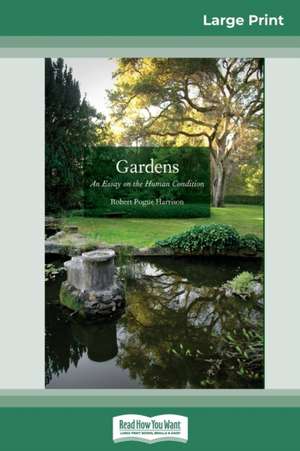
Gardens
Autor Robert Pogue Harrisonen Limba Engleză Paperback – 13 mai 2011
Preț: 258.11 lei
Puncte Express: 387
Carte tipărită la comandă
Livrare economică 04-10 decembrie
Livrare prin curier în România Termenul estimat este afișat lângă disponibilitate.
Transport gratuit de la 400.00 lei Plată online sau ramburs, în funcție de opțiunile comenzii.
Retur gratuit în 14 zile Comandă securizată și suport în română.
Specificații
ISBN-13: 9780369321633
ISBN-10: 0369321634
Pagini: 516
Dimensiuni: 156 x 234 x 27 mm
Greutate: 0.72 kg
Editura: ReadHowYouWant
ISBN-10: 0369321634
Pagini: 516
Dimensiuni: 156 x 234 x 27 mm
Greutate: 0.72 kg
Editura: ReadHowYouWant
V-ar putea interesa
-
 The RamayanaR. K. Narayan-19%Preț: 63.70 lei78.35 lei
 -
 The Secret of the Three Cities: An Introduction to Hindu Sakta TantrismDouglas Renfrew BrooksPreț: 335.42 lei
 -
 The Dominion of the DeadRobert Pogue HarrisonPreț: 174.21 lei
 -
 Abraham Geiger and the Jewish JesusSusannah Heschel-8%Preț: 612.40 lei665.64 lei
 -
 The Silence of Sodom: Homosexuality in Modern CatholicismMark D. JordanPreț: 301.91 lei
 -
 Preț: 164.37 lei
 -
 Preț: 179.41 lei
 -
 Mystical Poems of RumiJalal al-Din RumiPreț: 138.98 lei
 -
 Religion For DummiesMarc GellmanPreț: 139.70 lei
 -
 Talmudic StoriesRubensteinPreț: 321.78 lei
 -
 In Praise of the GoddessDevadatta KaliPreț: 140.50 lei
 -
 -23%Preț: 1102.51 lei1431.83 lei
Notă biografică
Robert Pogue Harrison is the Rosina Pierotti Professor in Italian Literature and chairs the Department of French and Italian at Stanford University. He is the author of The Body of Beatrice, Forests: The Shadow of Civilization, The Dominion of the Dead, Gardens: An Essay on the Human Condition, and Juvenescence: A Cultural History of Our Age, the latter three published by the University of Chicago Press. He is a member of the American Academy of Arts and Sciences. He is also host of the radio program Entitled Opinions on Stanford's station KZSU 90.1.
Cuprins
Preface
Acknowledgments
1 The Vocation of Care
2 Eve
3 The Human Gardener
4 Homeless Gardens
5 “Mon jardin à moi”
6 Academos
7 The Garden School of Epicurus
8 Boccaccio’s Garden Stories
9 Monastic, Republican, and Princely Gardens
10 A Note on Versailles
11 On the Lost Art of Seeing
12 Sympathetic Miracles
13 The Paradise Divide: Islam and Christianity
14 Men Not Destroyers
Acknowledgments
1 The Vocation of Care
2 Eve
3 The Human Gardener
4 Homeless Gardens
5 “Mon jardin à moi”
6 Academos
7 The Garden School of Epicurus
8 Boccaccio’s Garden Stories
9 Monastic, Republican, and Princely Gardens
10 A Note on Versailles
11 On the Lost Art of Seeing
12 Sympathetic Miracles
13 The Paradise Divide: Islam and Christianity
14 Men Not Destroyers
15 The Paradox of the Age
Epilogue
Appendixes
1 From The Decameron, Giovanni Boccaccio
2 From Mr. Palomar, Italo Calvino
3 “The Garden,” Andrew Marvell
4 A Note on Islamic Carpet Gardens
Notes
Works Cited
Index
Epilogue
Appendixes
1 From The Decameron, Giovanni Boccaccio
2 From Mr. Palomar, Italo Calvino
3 “The Garden,” Andrew Marvell
4 A Note on Islamic Carpet Gardens
Notes
Works Cited
Index
Recenzii
“The year’s most thought-provoking, original, and weighty garden book is Gardens. . . . Reading Harrison’s book is like strolling down a path through a well-cultivated, richly sown, light-dappled woodland. . . . Just as in the making of a garden, there’s no end to the wonder; the journey is everything.”
"The rabbis of the Talmud counseled you that if you are planting a tree and someone tells you that the Messiah has come, you should finish planting your tree and then go out to investigate. Robert Pogue Harrison implies something similar in his rich and beguiling Gardens. Gardens, though they offer peace and repose, are islands of care, he writes, not a refuge from it. That is why they are important, since care is what makes us human. . . . In many ways Gardens is a personal essay as much as it is a work of scholarship. Mr. Harrison has planted his own garden of beautiful quotations and provocative speculation, and it is an absorbing and stimulating place to spend time."
“In this book’s two great predecessors, Forests and The Dominion of the Dead, Robert Pogue Harrison took two preoccupying images of the human psyche and considered them with a depth and originality that revealed their unlimited and unbroken presence in every assumption and moment of our lives. Gardens he describes modestly as an essay, but it has, or at least suggests, the same kind of pervasive presence of an underlying human impulse in our relation to the world around us. He does it with eloquence, grace, and erudition rooted in the literatures of his four native languages (including Turkish) that informed his earlier books. The range of his perspective on the human myth suggests that he may be our Bachelard.”
"Gardening, to me, is foreign soil. . . . And yet I find myself completely besotted by a new book titlted Gardens: An Essay on the Human Condition, by Robert Pogue Harrison. The author . . . is one of the very best cultural critics at work today. he is a man of deep learning, immense generosity of spirit, passionate curiosity and manifold rhetorical gifts. . . . As I read this exraordinary, luminous book, I found myself envying my green-thumbed buddies and their serenity-inducing, life-affirming ritual—earthworms and all."
"This book is about gardens as a metaphor for the human condition. It is not about the history of designed gardens or of gardening as a practice. Harrison draws freely and with brilliance from 5,000 years of Western literature and criticism, including works on philosophy and garden history. . . . Harrison is a careful as well as an inspiring scholar."
"Harrison is a cultural historian alive to the poetry of science as well as insights poetry offers to the natural history of humankind. In Gardens, he explores the meanings of gardening, from the lofty height of Homer and the Bible to the poignant plots tended by homeless people in New York. Our fascination with gardens endures, even as the gardens themselves come and go with the seasons. They're not meant to last, Harrison reminds us; it's their job to 'reenchant the present.'"
"Harrison's engaging, verdant prose invites reads in, much like flowers and fountains encourage visitors to linger in resplendent gardens, and the extensive bibliography encourages reads to continue their education."
"I'm not sure that I'd sell my shirt for any living critic. But if there had to be one, it would unquestionably be Robert Pogue Harrison, whose study of Forests . . . has the true quality of literature, not criticism--it stays with you, like an amiable ghost, long after you have read it. Though more modest in scope, this new book [Gardens], is similarly destined to become a classic."
"The Year's Best Nonfiction"
"'Gardens' does a beautiful job of letting us see how our histories, literatures and religions have explored and exploited this place where the soul meets the soil."