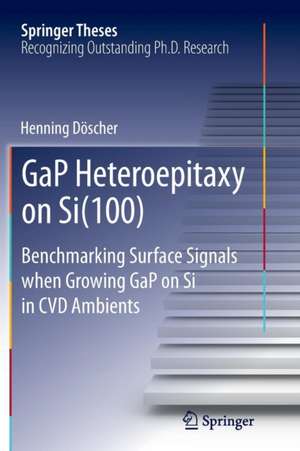
GaP Heteroepitaxy on Si(100): Springer Theses
Autor Henning Döscheren Limba Engleză Paperback – 3 sep 2016
Din seria Springer Theses
- 18%
 Preț: 960.54 lei
 - 15%
 Preț: 617.28 lei
 -
 Preț: 373.68 lei
 - 18%
 Preț: 749.08 lei
 -
 Preț: 372.05 lei
 - 18%
 Preț: 1336.71 lei
 - 15%
 Preț: 618.91 lei
 - 18%
 Preț: 962.00 lei
 -
 Preț: 379.10 lei
 -
 Preț: 375.86 lei
 - 18%
 Preț: 909.08 lei
 -
 Preț: 384.20 lei
 - 18%
 Preț: 1060.72 lei
 - 18%
 Preț: 1064.50 lei
 - 18%
 Preț: 1067.54 lei
 - 15%
 Preț: 618.91 lei
 - 18%
 Preț: 908.31 lei
 - 15%
 Preț: 621.42 lei
 - 18%
 Preț: 1061.89 lei
 -
 Preț: 373.40 lei
 - 15%
 Preț: 623.27 lei
 -
 Preț: 374.23 lei
 - 15%
 Preț: 614.78 lei
 - 15%
 Preț: 619.58 lei
 - 15%
 Preț: 620.03 lei
 - 18%
 Preț: 1065.27 lei
 - 15%
 Preț: 619.14 lei
 - 18%
 Preț: 961.40 lei
 - 18%
 Preț: 1067.54 lei
 - 18%
 Preț: 1329.13 lei
 - 18%
 Preț: 964.49 lei
 - 18%
 Preț: 1172.17 lei
 - 18%
 Preț: 1068.71 lei
 - 18%
 Preț: 966.67 lei
 - 18%
 Preț: 1172.94 lei
 - 18%
 Preț: 906.80 lei
 - 18%
 Preț: 959.13 lei
 - 15%
 Preț: 617.77 lei
 - 15%
 Preț: 620.73 lei
 - 18%
 Preț: 1169.91 lei
 - 15%
 Preț: 615.93 lei
 - 18%
 Preț: 853.71 lei
 -
 Preț: 375.86 lei
 - 18%
 Preț: 1063.77 lei
 -
 Preț: 407.71 lei
 - 15%
 Preț: 614.32 lei
 - 15%
 Preț: 618.21 lei
 - 15%
 Preț: 615.02 lei
 - 15%
 Preț: 615.68 lei
Preț: 612.38 lei
Preț vechi: 720.45 lei
-15%
Puncte Express: 919
Carte tipărită la comandă
Livrare economică 06-20 iunie
Specificații
ISBN-13: 9783319379555
ISBN-10: 3319379550
Pagini: 160
Ilustrații: XIV, 143 p. 80 illus., 33 illus. in color.
Dimensiuni: 155 x 235 x 9 mm
Greutate: 0.25 kg
Ediția:Softcover reprint of the original 1st edition 2013
Editura: Springer
Colecția Springer Theses
Seria Springer Theses
Locul publicării:Cham, Switzerland
ISBN-10: 3319379550
Pagini: 160
Ilustrații: XIV, 143 p. 80 illus., 33 illus. in color.
Dimensiuni: 155 x 235 x 9 mm
Greutate: 0.25 kg
Ediția:Softcover reprint of the original 1st edition 2013
Editura: Springer
Colecția Springer Theses
Seria Springer Theses
Locul publicării:Cham, Switzerland
V-ar putea interesa
-
 Bands and Photons in III-V Semiconductor Quantum StructuresIgor Vurgaftman-24%Preț: 581.60 lei764.59 lei
 -
 Semiconductor Manufacturing Risk HandbookVincent A. Degiorgio-9%Preț: 1207.80 lei1327.25 lei
 -
 Semiconductors and SemimetalsZetian Mi-42%Preț: 1008.21 lei1734.13 lei
 -
 -9%Preț: 1191.03 lei1308.82 lei
 -
 -26%Preț: 1715.87 lei2332.44 lei
 -
 Strained Silicon HeterostructuresC K Maiti-18%Preț: 810.54 lei988.47 lei
 -
 -26%Preț: 600.15 lei807.21 lei
 -
 New Research on SemiconductorsThomas B Elliot-30%Preț: 1324.50 lei1899.23 lei
 -
 Advances in Applied Physics ResearchGabriel Waters-26%Preț: 978.12 lei1315.32 lei
 -
 Surface Defects in Wide-Bandgap LiF, SiO2, and ZnO CrystalsUtkirjon SharopovPreț: 367.42 lei
 -
 -23%Preț: 746.73 lei969.78 lei
 -
 Semiconductor Quantum Structures - Growth and StructuringClaus F. Klingshirn-27%Preț: 2893.47 lei3963.65 lei
 -
 Springer Handbook of Crystal GrowthGovindhan Dhanaraj-18%Preț: 2199.71 lei2682.57 lei
 -
 GaN and Related MaterialsStephen J. Pearton-9%Preț: 793.02 lei871.45 lei
 -
 -15%Preț: 611.43 lei719.34 lei
 -
 -15%Preț: 610.71 lei718.48 lei
 -
 III-Nitride Based Light Emitting Diodes and ApplicationsTae-Yeon Seong-24%Preț: 1314.12 lei1729.10 lei
 -
 Structure and Electronic Properties of Ultrathin In Films on Si(111)Shigemi Terakawa-24%Preț: 993.17 lei1306.80 lei
 -
 -18%Preț: 909.56 lei1109.21 lei
 -
 -18%Preț: 1079.67 lei1316.67 lei
Cuprins
Introduction.- Experimental.- Si(100) surfaces in chemical vapor environments.- GaP(100) and InP(100) surfaces.- GaP growth on Si(100) and anti-phase disorder.- Conclusion.
Notă biografică
Dr. Henning Döscher
TU Ilmenau
Institut für Physik, FG Photovoltaik
Ehrenbergstr. 29
98693 Ilmenau
TU Ilmenau
Institut für Physik, FG Photovoltaik
Ehrenbergstr. 29
98693 Ilmenau
Textul de pe ultima copertă
Epitaxial integration of III-V semiconductors on silicon substrates has been desired over decades for high application potential in microelectronics, photovoltaics, and beyond. The performance of optoelectronic devices is still severely impaired by critical defect mechanisms driven by the crucial polar-on-nonpolar heterointerface. This thesis reports almost lattice-matched growth of thin gallium phosphide films as a viable model system for III-V/Si(100) interface investigations. The impact of antiphase disorder on the heteroepitaxial growth surface provides quantitative optical in situ access to one of the most notorious defect mechanisms, even in the vapor phase ambient common for compound semiconductor technology. Precise control over the surface structure of the Si(100) substrates prior to III-V nucleation prevents the formation of antiphase domains. The hydrogen-based process ambient enables the preparation of anomalous double-layer step structures on Si(100), highly beneficial for subsequent III-V integration.
Caracteristici
Winner of a 2012 German Physical Society Dissertation Award An important contribution to improving optoelectronic devices and performance of photovoltaic materials Interesting for all experimentalists working on the integration of III-V semiconductors and silicon