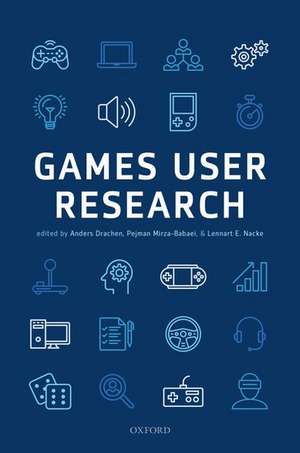
Games User Research
Editat de Anders Drachen, Pejman Mirza-Babaei, Lennart Nackeen Limba Engleză Hardback – 25 ian 2018
Preț: 339.15 lei
Preț vechi: 469.27 lei
-28%
Puncte Express: 509
Carte tipărită la comandă
Livrare economică 27 noiembrie-08 decembrie
Livrare prin curier în România Termenul estimat este afișat lângă disponibilitate.
Transport gratuit de la 400.00 lei Plată online sau ramburs, în funcție de opțiunile comenzii.
Retur gratuit în 14 zile Comandă securizată și suport în română.
Specificații
ISBN-13: 9780198794844
ISBN-10: 0198794843
Pagini: 550
Dimensiuni: 163 x 236 x 33 mm
Greutate: 1.09 kg
Editura: OUP OXFORD
Colecția OUP Oxford
Locul publicării:Oxford, United Kingdom
ISBN-10: 0198794843
Pagini: 550
Dimensiuni: 163 x 236 x 33 mm
Greutate: 1.09 kg
Editura: OUP OXFORD
Colecția OUP Oxford
Locul publicării:Oxford, United Kingdom
V-ar putea interesa
-
 How a Game LivesJacob Geller-20%Preț: 191.62 lei239.53 lei
 -
 Sketching User Experiences: The WorkbookSaul Greenberg-17%Preț: 123.24 lei149.00 lei
 -
 -40%Preț: 270.23 lei450.65 lei
 -
 -20%Preț: 390.52 lei488.14 lei
 -
 -39%Preț: 483.04 lei798.37 lei
 -
 The ScoreC. Thi NguyenPreț: 194.17 lei
 -
 Universal Principles of UXIrene Pereyra-21%Preț: 174.36 lei221.50 lei
 -
 The Pocket Universal Principles of UXIrene Pereyra-20%Preț: 79.13 lei98.81 lei
 -
 Vgc: The 2025 Guide to Video GamesMedia LtdPreț: 231.63 lei
 -
 Lean UX, 3e (hardcover)Jeff Gothelf-20%Preț: 248.04 lei310.05 lei
 -
 User Experience DesignSatyam Kantamneni-20%Preț: 169.35 lei211.69 lei
 -
 User Experience ResearchMarty Gage-20%Preț: 176.58 lei220.72 lei
 -
 Communicating the User ExperienceRichard Caddick-20%Preț: 198.38 lei247.97 lei
 -
 -20%Preț: 480.56 lei600.70 lei
 -
 User Experience Design: A Practical IntroductionGavin Allanwood-7%Preț: 179.72 lei192.43 lei
 -
 Level Up! The Guide to Great Video Game DesignScott Rogers-20%Preț: 256.39 lei320.49 lei
 -
 -20%Preț: 412.10 lei515.12 lei
 -
 -20%Preț: 102.20 lei127.75 lei
 -
 Interaction and Player Research in Game DevelopmentTicianne Darin-20%Preț: 470.42 lei588.02 lei
 -
 UX for XRCornel Hillmann-20%Preț: 196.27 lei245.34 lei
Recenzii
Games user research has come a long way in the last 2 decades, and this book is a testament to that progress. With chapters on lab setup and recruiting all the way to doing research on VR, this book covers it all. It will be a great resource for those getting into the field as well as industry veterans. I can confidently say that if you are involved in games user research there will be something of value to you in this book.
User research is a commonly underestimated but incredibly important part of the design and ongoing evolution interactive products. Anyone building interactive applications should consider and evaluate the user experience, and in games there is a great deal of knowledge on this. Games User Research unlocks that knowledge and makes it actionable for everyone.
Over the last 15 years, game user research has evolved into a distinct and innovative field, spearheading methods like data analytics or biometrics for user research. Yet researchers and students in HCI and games had no easy entryway into this body of work -- until now. Game User Research is poised to become the reference handbook and default textbook of the field: comprehensive, succinct, and accessible. This book has been long overdue.
Game user research is a vital part of game development, but getting a handle on how to work with players to improve the game experience can be challenging. This book is loaded with wisdom from dozens of professionals across industry and academia, and provides an invaluable resource on how to build the best strategy for user research.
For a startup providing predictive analytics solutions for digital games, this book is a great compendium and contains a precious list of use cases. It does not only cover game analytics in detail but also presents a great overview on the state-of-the-art in game user research.
So many books, so little time: this is the must read for anyone in industry working on gameful experiences.
The Games User Research book gathers a broad spectrum of methods from the perspective of experts from both industry and academy. It will no doubt prove valuable to anyone interested in getting up to speed on this important topic.
If you have an interest in understanding the science of interaction design in games, just read this book.
This book is an impressive community effort with the editors incorporating the work of dozens of contributors, which makes for a thorough overview filled with a diversity of perspectives around games user research, and an invaluable resource for us all.
From practical methods and pragmatic takeaways across the wide spectrum of game development, to more thoughtful future-thinking topics, this book is a wonderful entry point into the burgeoning field of games user research.
User research is a commonly underestimated but incredibly important part of the design and ongoing evolution interactive products. Anyone building interactive applications should consider and evaluate the user experience, and in games there is a great deal of knowledge on this. Games User Research unlocks that knowledge and makes it actionable for everyone.
Over the last 15 years, game user research has evolved into a distinct and innovative field, spearheading methods like data analytics or biometrics for user research. Yet researchers and students in HCI and games had no easy entryway into this body of work -- until now. Game User Research is poised to become the reference handbook and default textbook of the field: comprehensive, succinct, and accessible. This book has been long overdue.
Game user research is a vital part of game development, but getting a handle on how to work with players to improve the game experience can be challenging. This book is loaded with wisdom from dozens of professionals across industry and academia, and provides an invaluable resource on how to build the best strategy for user research.
For a startup providing predictive analytics solutions for digital games, this book is a great compendium and contains a precious list of use cases. It does not only cover game analytics in detail but also presents a great overview on the state-of-the-art in game user research.
So many books, so little time: this is the must read for anyone in industry working on gameful experiences.
The Games User Research book gathers a broad spectrum of methods from the perspective of experts from both industry and academy. It will no doubt prove valuable to anyone interested in getting up to speed on this important topic.
If you have an interest in understanding the science of interaction design in games, just read this book.
This book is an impressive community effort with the editors incorporating the work of dozens of contributors, which makes for a thorough overview filled with a diversity of perspectives around games user research, and an invaluable resource for us all.
From practical methods and pragmatic takeaways across the wide spectrum of game development, to more thoughtful future-thinking topics, this book is a wonderful entry point into the burgeoning field of games user research.
Notă biografică
Dr. Anders Drachen, Ph.D. is a veteran Data Scientist, Professor at the Digital Creativity Labs, University of York (UK). His multiple award-winning work in data- and game science is focused on game analytics and business intelligence. His research and professional work is carried out in collaboration with companies spanning the industry. He is one of the most published scientists worldwide on game analytics, virtual economics, user research, game data mining, and user profiling. He is a former member of the board of the IGDA SIG on Game User Research.Lennart Nacke, PhD, is the director of the HCI Games Group and an associate professor for human-computer interaction and game design at the University of Waterloo. He is a world-leading authority on the cognitive and emotional aspects of player experience in video games, with a special focus on physiological metrics and gameful design. He has authored more than 100 research publications on these topics, which have been cited more than 8,000 times. He is also working as a gamification and user experience consultant. He chaired the Computer-Human Interaction (CHI) PLAY 2014 and Gamification 2013 conferences, and is currently the chair of the CHI PLAY steering committee. He is an editor of multiple research journals and a subcommittee co-chair of CHI 2017 and CHI 2018. He has served on the steering committee of the International Game Developers Association Special Interest Group on Games User Research and loves the GUR community.Dr. Pejman Mirza-Babaei is an Assistant Professor for Human-Computer Interaction and Games User Research at the University of Ontario Institute of Technology. He is also the User Research Director at Execution Labs, Montreal. He has been involved with the Games User Research community since 2009, where he has published more than 40 articles, co-organized workshops and courses in international conferences. He has contributed to more than 22 published commercial games, including awards winning titles such as Pewdiepie Legend of the Brofist, Crysis 2, and Weirdwood Manor among many others.
Cuprins
- 1: Anders Drachen, Pejman Mirza-Babaei, and Lennart Nacke: Introduction to Games User Research
- 2: Veronica Zammitto: Games User Research as part of the Development Process in the Game Industry: Challenges and Best Practices
- 3: David Tisserand: It's All About Process
- 4: Ian Livingston: Post-launch in Game User Research
- 5: Graham McAllister: User experience maturity levels: Evaluating and improving Game User Research practices
- 6: Sebastian Long: Designing A Games User Research Lab From Scratch
- 7: Michael C. Medlock: An Overview of GUR Methods
- 8: Graham McAllister and Sebastian Long: A Framework for Player Research
- 9: Florian Brühlmann and Elisa D. Mekler: Surveys in Games User Research
- 10: Steve Bromley: Interviewing Players
- 11: Mirweis Sangin: Observing the Player Experience
- 12: Tom Knoll: The Think Aloud Protocol
- 13: Michael C. Medlock: The Rapid Iterative Test and Evaluation Method (RITE)
- 14: Heather Desurvire and Dennis Wixon: Heuristic Uncovered for Game User Researchers and Game Designers
- 15: Janne Paavilainen: Heuristic Evaluation of Playability: Examples from Social Games Research and Free-to-Play Heuristics
- 16: Lennart Nacke: Introduction to Biometrics Measures for Game User Research
- 17: Pierre Chalfoun, Jonathan Dankoff: Developing actionable biometric insights for production teams: case studies and key learnings
- 18: Pejman Mirza-Babaei: Reporting User Research Findings to the Development Team
- 19: Anders Drachen and Shawn Connor: Game Analytics for Game User Research
- 20: Lysiane Charest: Punching Above Your Weight: How small studios can leverage data for an unfair advantage
- 21: Pejman Mirza-Babaei and Thomas Galati: Affordable and Data-Driven User Research for Indie Studios
- 22: Guillaume Louvel: Play as if you were home
- 23: James Berg: Dissecting the Dragon: GUR for Dragon Age: Inquisition
- 24: Julien Huguenin: Running User Tests with Limited Resources and Experience
- 25: Johan Dorell and Björn Berg Marklund: Starting from Scratch: Pragmatic and Scalable Guidelines to Impactful Games User Research
- 26: Steven Schirra and Brooke White: Strategies for Understanding and Researching Mobile Games in Context
- 27: Kathrin Gerling, Conor Linehan and Regan Mandryk: Involving Players With Special Needs in Games User Research
- 28: Nick Yee and Nicolas Ducheneaut: Gamer Motivation Profiling: Uses and Applications
- 29: Johanna Pirker: Social Network Analysis in Games User Research
- 30: Ben Lewis-Evans: A short guide to user testing for simulation sickness in Virtual Reality
- 31: Anders Drachen, Pejman Mirza-Babaei, and Lennart Nacke: Front lines in Games User Research