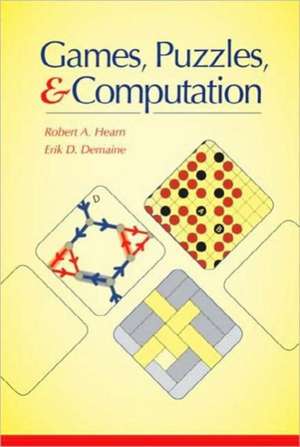
Games, Puzzles, and Computation: AK Peters/CRC Recreational Mathematics Series
Autor Robert A. Hearn, Erik D. Demaineen Limba Engleză Hardback – 30 iun 2009
Din seria AK Peters/CRC Recreational Mathematics Series
- 14%
 Preț: 889.21 lei
 - 11%
 Preț: 616.27 lei
 -
 Preț: 298.28 lei
 -
 Preț: 386.78 lei
 -
 Preț: 270.76 lei
 - 14%
 Preț: 833.06 lei
 -
 Preț: 245.92 lei
 -
 Preț: 217.34 lei
 - 8%
 Preț: 467.87 lei
 -
 Preț: 277.42 lei
 - 8%
 Preț: 552.87 lei
 -
 Preț: 357.41 lei
 -
 Preț: 300.02 lei
 -
 Preț: 280.45 lei
 -
 Preț: 377.56 lei
 -
 Preț: 229.83 lei
 -
 Preț: 449.82 lei
 -
 Preț: 323.93 lei
 -
 Preț: 285.65 lei
 - 8%
 Preț: 463.05 lei
 - 18%
 Preț: 1357.72 lei
 -
 Preț: 240.41 lei
 - 18%
 Preț: 724.09 lei
 -
 Preț: 351.02 lei
 -
 Preț: 237.26 lei
 - 18%
 Preț: 1259.34 lei
 -
 Preț: 379.50 lei
 - 13%
 Preț: 1271.72 lei
 -
 Preț: 477.59 lei
 - 8%
 Preț: 433.43 lei
 - 18%
 Preț: 1415.48 lei
 - 15%
 Preț: 441.60 lei
 - 18%
 Preț: 1516.18 lei
 - 9%
 Preț: 663.16 lei
 -
 Preț: 317.72 lei
 - 15%
 Preț: 611.12 lei
 -
 Preț: 367.60 lei
 -
 Preț: 224.95 lei
 - 18%
 Preț: 1500.80 lei
 -
 Preț: 247.47 lei
Preț: 894.29 lei
Preț vechi: 1090.60 lei
-18%
Puncte Express: 1341
Carte tipărită la comandă
Livrare economică 21 noiembrie-05 decembrie
Livrare prin curier în România Termenul estimat este afișat lângă disponibilitate.
Transport gratuit pentru acest produs Plată online sau ramburs, în funcție de opțiunile comenzii.
Retur gratuit în 14 zile Comandă securizată și suport în română.
Specificații
ISBN-13: 9781568813226
ISBN-10: 1568813228
Pagini: 248
Ilustrații: illustrations
Dimensiuni: 152 x 229 x 15 mm
Greutate: 0.46 kg
Ediția:New.
Editura: CRC Press
Colecția A K Peters/CRC Press
Seria AK Peters/CRC Recreational Mathematics Series
Locul publicării:United States
ISBN-10: 1568813228
Pagini: 248
Ilustrații: illustrations
Dimensiuni: 152 x 229 x 15 mm
Greutate: 0.46 kg
Ediția:New.
Editura: CRC Press
Colecția A K Peters/CRC Press
Seria AK Peters/CRC Recreational Mathematics Series
Locul publicării:United States
V-ar putea interesa
-
 Preț: 117.86 lei
 -
 Handbook of Mathematical EconomicsM.D. Intriligator-21%Preț: 376.76 lei475.75 lei
 -
 Geometric Folding AlgorithmsErik. D Demaine-20%Preț: 460.92 lei576.15 lei
 -
 Do You Get the Point?Dee GoldsteinPreț: 64.02 lei
 -
 Game TheorySteven Tadelis-14%Preț: 503.24 lei585.17 lei
 -
 Preț: 59.48 lei
 -
 Theory of Conditional GamesWynn C. Stirling-20%Preț: 378.02 lei472.53 lei
 -
 Repeated GamesJean-Francois Mertens-11%Preț: 440.74 lei495.20 lei
 -
 Mathematical Game Theory and ApplicationsVladimir Mazalov-23%Preț: 638.02 lei828.59 lei
 -
 Game TheoryK. H. EricksonPreț: 74.66 lei
 -
 Game Theory for BusinessK. H. EricksonPreț: 74.66 lei
 -
 Twice Magic Squares 5 by 5Kermit RosePreț: 40.13 lei
 -
 Alphametics as Expressed in Recreational Mathematics MagazineCharles AshbacherPreț: 51.06 lei
 -
 Game TheoryBrian CleggPreț: 78.35 lei
 -
 Equals(me)Schablin, TimothyPreț: 45.20 lei
 -
 Equals(me) RadicalsSchablin, TimothyPreț: 45.20 lei
 -
 Regularity Theory for Mean-Field Game SystemsDiogo A. GomesPreț: 449.86 lei
 -
 The Selten School of Behavioral EconomicsAxel Ockenfels-15%Preț: 642.06 lei755.37 lei
 -
 -15%Preț: 568.96 lei669.36 lei
 -
 Differential GamesJiongmin Yong-15%Preț: 638.17 lei750.79 lei
Cuprins
Introduction. I Games in General. The Constraint-Logic Formalism. Constraint-Logic Games. Zero-Player Games (Simulations). One-Player Games (Puzzles). Two-Player Games. Team Games. Perspectives on Part I. II Games in Particular. One-Player Games (Puzzles). Two-Player Games. Perspectives on Part II. Conclusions. Appendices. Survey of Games and Their Complexities. Computational-Complexity Reference. Deterministic Constraint Logic Activation Sequences. Constraint-Logic Quick Reference
Notă biografică
Robert A. Hearn, Dartmouth College, Hanover, New Hampshire, USA
Erik Demaine, Massachusetts Institute of Technology, Cambridge, USA
Erik Demaine, Massachusetts Institute of Technology, Cambridge, USA
Recenzii
"… the games also provide an extremely well-suited platform for the introduction of a unified method for determining complexity using constraint logic … considers not only mathematically oriented games, but also games that may well be suitable for non-mathematicians … The book also contains a comprehensive overview of known results on the complexity of games and therefore with its 177 references is also an excellent reference book on the topic … warmly recommended for anyone who likes games and wants to know more about their (mathematical) complexity."
—Internaionale Mathematische Nachrichten, December 2012 "Games, Puzzles, and Computation will serve well in roles similar to that of Garey and Johnson’s book. In particular, the text would work exceedingly well as a reference for what’s known in the subfield of game/puzzle complexity or for self-study by someone familiar with basic computational complexity principles who is interested in learning more about the complexity of games and puzzles. It would also serve well as supplementary material to an upper-level undergraduate or entry-level graduate special topics course in game/puzzle complexity. It could also be used as the primary text for such a course (in principle) given extra preparation by the instructor … ."
—Daniel Apon, SIGACT News, September 2011
"The authors show that there are underlying mathematical reasons that games and puzzles are challenging (which perhaps explains why they are so much fun). Complementarily, they also show that games and puzzles can serve as powerful models of computation — quite different from the usual models of automata and circuits — offering a new way of thinking about computation."
—L'Enseignement Mathematique, December 2009
"… intriguing book … Hearn and Demaine present an elegant family of benchmarks they have developed, allowing them to settle open questions on the complexity of various games. … and the authors certainly provide plenty to mull over. The publisher A K Peters has done a quite nice job of production, as well. All in all, this is a book well worth looking into."
—Leon Harkleroad, MAA Reviews, December 2009
"This book will be of interest to advanced readers working in this area."
—Brian Borchers, CHOICE, February 2010
—Internaionale Mathematische Nachrichten, December 2012 "Games, Puzzles, and Computation will serve well in roles similar to that of Garey and Johnson’s book. In particular, the text would work exceedingly well as a reference for what’s known in the subfield of game/puzzle complexity or for self-study by someone familiar with basic computational complexity principles who is interested in learning more about the complexity of games and puzzles. It would also serve well as supplementary material to an upper-level undergraduate or entry-level graduate special topics course in game/puzzle complexity. It could also be used as the primary text for such a course (in principle) given extra preparation by the instructor … ."
—Daniel Apon, SIGACT News, September 2011
"The authors show that there are underlying mathematical reasons that games and puzzles are challenging (which perhaps explains why they are so much fun). Complementarily, they also show that games and puzzles can serve as powerful models of computation — quite different from the usual models of automata and circuits — offering a new way of thinking about computation."
—L'Enseignement Mathematique, December 2009
"… intriguing book … Hearn and Demaine present an elegant family of benchmarks they have developed, allowing them to settle open questions on the complexity of various games. … and the authors certainly provide plenty to mull over. The publisher A K Peters has done a quite nice job of production, as well. All in all, this is a book well worth looking into."
—Leon Harkleroad, MAA Reviews, December 2009
"This book will be of interest to advanced readers working in this area."
—Brian Borchers, CHOICE, February 2010
Descriere
This book explores the underlying mathematical reasons for why games and puzzles are challenging and so much fun. It shows how games and puzzles can serve as powerful models of computation, offering a new way of thinking about computation. The appendices provide a substantial survey of all known results in the field of game complexity, serving as a reference guide for readers interested in the computational complexity of particular games or interested in open problems about such complexities.