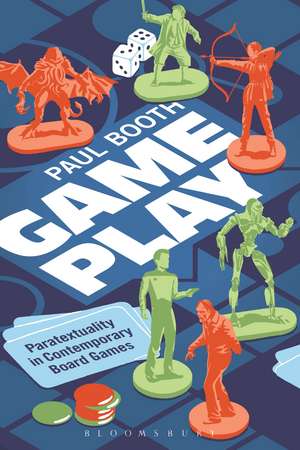
Game Play: Paratextuality in Contemporary Board Games
Autor Dr. Paul Boothen Limba Engleză Paperback – 18 iun 2015
The popularity of these complex board games mirrors the rise of more complex cult media products. In Game Play: Paratextuality in Contemporary Board Games, Paul Booth examines complex board games based on book, TV, and film franchises, including Doctor Who, The Walking Dead, Lord of the Rings, Star Trek, The Hunger Games and the worlds of H.P. Lovecraft. How does a game represent a cult world? How can narratives cross media platforms? By investigating the relationship between these media products and their board game versions, Booth illustrates the connections between cult media, gameplay, and narrative in a digital media environment.
Preț: 207.60 lei
Preț vechi: 257.59 lei
-19%
Puncte Express: 311
Carte tipărită la comandă
Livrare economică 30 noiembrie-14 decembrie
Livrare prin curier în România Termenul estimat este afișat lângă disponibilitate.
Transport gratuit de la 400.00 lei Plată online sau ramburs, în funcție de opțiunile comenzii.
Retur gratuit în 14 zile Comandă securizată și suport în română.
Specificații
ISBN-13: 9781628927436
ISBN-10: 1628927437
Pagini: 264
Ilustrații: 25 bw illus
Dimensiuni: 152 x 232 x 18 mm
Greutate: 0.38 kg
Editura: Bloomsbury Publishing
Colecția Bloomsbury Academic
Locul publicării:New York, United States
ISBN-10: 1628927437
Pagini: 264
Ilustrații: 25 bw illus
Dimensiuni: 152 x 232 x 18 mm
Greutate: 0.38 kg
Editura: Bloomsbury Publishing
Colecția Bloomsbury Academic
Locul publicării:New York, United States
V-ar putea interesa
-
 -17%Preț: 61.06 lei73.45 lei
 -
 The Mandala Coloring Book, Volume IIJim GogartyPreț: 95.04 lei
 -
 Chess DevelopmentsKevin Goh Wei MingPreț: 147.43 lei
 -
 The Chess Tactics Detection WorkbookVolker SchleputzPreț: 190.17 lei
 -
 Opening RepertoireJovanka HouskaPreț: 149.38 lei
 -
 BronsteinSteve GiddinsPreț: 131.39 lei
 -
 Smerdon's ScandinavianDavid SmerdonPreț: 263.85 lei
 -
 Python StrategyTigran PetrosianPreț: 176.59 lei
 -
 Chess Player's BibleAl Lawrence-16%Preț: 99.48 lei117.89 lei
 -
 Bug BingoLaurence King PublishingPreț: 138.64 lei
 -
 Mikhail Tal's Best Games 2 The World ChampionTibor Karolyi-15%Preț: 139.73 lei165.35 lei
 -
 Grandmaster Repertoire 1A – The CatalanBoris Avrukh-14%Preț: 145.22 lei169.51 lei
 -
 Grandmaster Repertoire 20 – Semi-SlavLars Schandorff-17%Preț: 136.00 lei163.13 lei
Cuprins
Introduction
Part I: Understanding Games
Chapter 1 - Ludifying Lovecraft in Arkham Horror
Chapter 2 - Lord of the Rings as Convergent Gameplay
Chapter 3 - Transmedia Pathos and Plot in The Walking Dead
Part II: Understanding Media
Chapter 4 - Battlestar Galactica and Spimatic Meaning in Games
Chapter 5 - Mutability and Materiality in Star Trek
Chapter 6 - The Hunger Games and Fan Paratextual Participation
Chapter 7 - Narratives and Databases in Game of Thrones
Conclusion - Ludic Interaction in Doctor Who
Bibliography
Glossary of Terms
Index
Part I: Understanding Games
Chapter 1 - Ludifying Lovecraft in Arkham Horror
Chapter 2 - Lord of the Rings as Convergent Gameplay
Chapter 3 - Transmedia Pathos and Plot in The Walking Dead
Part II: Understanding Media
Chapter 4 - Battlestar Galactica and Spimatic Meaning in Games
Chapter 5 - Mutability and Materiality in Star Trek
Chapter 6 - The Hunger Games and Fan Paratextual Participation
Chapter 7 - Narratives and Databases in Game of Thrones
Conclusion - Ludic Interaction in Doctor Who
Bibliography
Glossary of Terms
Index
Recenzii
Booth's approach demonstrates exemplary textual analysis of games ... This book is that rare combination of solid critical methodologies alongside such clear enthusiasm for the subject matter that anyone with an interest in the hobby could enjoy just as easily as those in the academic fields of Game, Media or Film Studies.
Booth's Paratextuality in Contemporary Board Games is a valuable addition to the field of adaptation studies and will hopefully inspire more research on the fascinating subject of board games.
Having chosen a Cylon Leader character, Booth commandeers a fine act of infiltration, working licensed board games' way into the Galactica of media studies, showing exactly how and why it matters - both by itself and as an outgrowth of other media properties - as successfully as an unchecked centurion edging down the boarding party track on its way to certain victory. Highly recommended.
Licensed board games based on popular media franchises have long been considered bereft of creative output, if they were considered at all. Paul Booth challenges that assumption by delving deeply and respectfully into that world, arguing for more nuanced considerations of board games as paratextual adaptations of their respective universes. Bringing together studies of fandom, media universes and games, Game Play offers a sustained and rewarding examination of contemporary licensed board games.
Paul Booth's Game Play: Paratextuality in Contemporary Board Games is a ground-breaking piece of work. Demonstrating a keen eye for detail, critical analysis and genuine affection for the art of play Booth has produced a much-needed book that shines light on an often overlooked area of popular culture. With chapters on major franchise board games like Star Trek and The Lord of the Rings and those based on acclaimed weird fiction writer H.P. Lovecraft Game Play offers us new ways of understanding the joys and social practices of board game culture. Fans and scholars alike will want to read this - and then go break out the dice!
Booth's Paratextuality in Contemporary Board Games is a valuable addition to the field of adaptation studies and will hopefully inspire more research on the fascinating subject of board games.
Having chosen a Cylon Leader character, Booth commandeers a fine act of infiltration, working licensed board games' way into the Galactica of media studies, showing exactly how and why it matters - both by itself and as an outgrowth of other media properties - as successfully as an unchecked centurion edging down the boarding party track on its way to certain victory. Highly recommended.
Licensed board games based on popular media franchises have long been considered bereft of creative output, if they were considered at all. Paul Booth challenges that assumption by delving deeply and respectfully into that world, arguing for more nuanced considerations of board games as paratextual adaptations of their respective universes. Bringing together studies of fandom, media universes and games, Game Play offers a sustained and rewarding examination of contemporary licensed board games.
Paul Booth's Game Play: Paratextuality in Contemporary Board Games is a ground-breaking piece of work. Demonstrating a keen eye for detail, critical analysis and genuine affection for the art of play Booth has produced a much-needed book that shines light on an often overlooked area of popular culture. With chapters on major franchise board games like Star Trek and The Lord of the Rings and those based on acclaimed weird fiction writer H.P. Lovecraft Game Play offers us new ways of understanding the joys and social practices of board game culture. Fans and scholars alike will want to read this - and then go break out the dice!