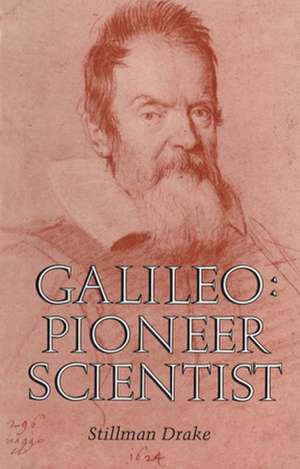
Galileo
Autor Stillman Drakeen Limba Engleză Paperback – 15 dec 1990
Among the findings he presents in this volume are the steps that led to discovery of the pendulum law and the law of fall, by which Galileo opened the road to modern physics; Galileo's path to the new astronomy of Copernicus, closely linked to his first essays in physics; his subsequent misgivings and final reassurances provided by the telescope.
Drake focuses on Galileo's pioneering work in physics, previously unknown, and shows that time has not diminished its value. He also considers some of the factors that played a part in the development of physics, its classical Greek beginnings, the medieval interlude, the contribution of some of Galileo's contemporaries, and the resistance of others to his new science of motion. We see in a new light the relation of that science to modern dynamics, created by Newton half a century later.
Galileo is better known as an astronomer than as a modern physicist. Drake sheds new light here too as he explores Galileo's pioneer invention of satellite astronomy, his sighting of Neptune two and one-half centuries before that planet was identified, and his proposal of a cosmogony based on speeds of freely falling bodies.
With this book Drake confirms Galileo as the first recognizably modern scientist, in both his methods and results.
Preț: 331.08 lei
Puncte Express: 497
Carte tipărită la comandă
Livrare economică 14-28 noiembrie
Livrare prin curier în România Termenul estimat este afișat lângă disponibilitate.
Transport gratuit de la 400.00 lei Plată online sau ramburs, în funcție de opțiunile comenzii.
Retur gratuit în 14 zile Comandă securizată și suport în română.
Specificații
ISBN-13: 9780802076076
ISBN-10: 0802076076
Pagini: 280
Dimensiuni: 151 x 228 x 22 mm
Greutate: 0.39 kg
Ediția:2nd edition
Editura: University of Toronto Press
ISBN-10: 0802076076
Pagini: 280
Dimensiuni: 151 x 228 x 22 mm
Greutate: 0.39 kg
Ediția:2nd edition
Editura: University of Toronto Press
V-ar putea interesa
-
 Stalin, Vol. IIStephen Kotkin-20%Preț: 118.60 lei147.73 lei
 -
 Be Like the FoxErica Benner-31%Preț: 64.27 lei92.57 lei
 -
 Outlandish KnightMinoo Dinshaw-22%Preț: 112.44 lei144.03 lei
 -
 Hero of the EmpireCandice Millard-30%Preț: 74.63 lei106.53 lei
 -
 -14%Preț: 128.05 lei149.58 lei
 -
 -13%Preț: 180.43 lei206.67 lei
 -
 Lord Chesterfield's LettersLord Chesterfield-18%Preț: 70.23 lei85.80 lei
 -
 Churchill and Seapower: The Quest for JusticeChristopher M. Bell-24%Preț: 162.60 lei214.41 lei
 -
 The Hurricane GirlsJo Wheeler-21%Preț: 61.28 lei77.44 lei
 -
 Discoveries and Opinions of GalileoStillman DrakePreț: 109.02 lei
 -
 Essays on Galileo and the History and Philosophy of ScienceStillman DrakePreț: 452.67 lei
 -
 Essays on Galileo and the History and Philosophy of ScienceStillman DrakePreț: 446.50 lei
 -
 Two New Sciences/A History of Free FallGalileo GalileiPreț: 211.06 lei
 -
 Nicholas II, The Last TsarMichael Paterson-28%Preț: 65.71 lei91.05 lei
 -
 -27%Preț: 66.27 lei91.39 lei
 -
 A Brief History of the Private Life of Elizabeth II, Updated EditionMichael Paterson-26%Preț: 47.42 lei64.07 lei
 -
 The Controversy on the Comets of 1618Stillman Drake-14%Preț: 708.64 lei824.00 lei
 -
 Miss Muriel MattersRobert Wainwright-18%Preț: 58.12 lei70.71 lei
 -
 Lady Fanshawe's Receipt BookLucy Moore-16%Preț: 61.68 lei73.67 lei
 -
 Preț: 65.75 lei
 -
 -26%Preț: 79.02 lei107.18 lei
 -
 Inside the Mind of XI JinpingFrançois Bougon-18%Preț: 119.21 lei145.44 lei
 -
 Codename SuzetteAnne Nelson-20%Preț: 82.37 lei103.15 lei
Descriere
Descriere de la o altă ediție sau format:
In a startling reinterpretation of the evidence, Stillman Drake advances the hypothesis that Galileo's trial and condemnation by the Inquisition was caused not by his defiance of the Church, but by the hostility of contemporary philosophers.Galileo's own beautifully lucid arguments are used to show how his scientific method was utterly divorced from the Aristotelian approach to physics in that it was based on a search not for causes but for laws. Galileo's method was of overwhelming significance for the development of modern physics, and led to a final parting of the ways between science and philosophy. ABOUT THE SERIES: The Very Short Introductions series from Oxford University Press contains hundreds of titles in almost every subject area. These pocket-sized books are the perfect way to get ahead in a new subject quickly. Our expert authors combine facts, analysis, perspective, new ideas, and enthusiasm to make interesting and challenging topics highly readable.
In a startling reinterpretation of the evidence, Stillman Drake advances the hypothesis that Galileo's trial and condemnation by the Inquisition was caused not by his defiance of the Church, but by the hostility of contemporary philosophers.Galileo's own beautifully lucid arguments are used to show how his scientific method was utterly divorced from the Aristotelian approach to physics in that it was based on a search not for causes but for laws. Galileo's method was of overwhelming significance for the development of modern physics, and led to a final parting of the ways between science and philosophy. ABOUT THE SERIES: The Very Short Introductions series from Oxford University Press contains hundreds of titles in almost every subject area. These pocket-sized books are the perfect way to get ahead in a new subject quickly. Our expert authors combine facts, analysis, perspective, new ideas, and enthusiasm to make interesting and challenging topics highly readable.
Recenzii
stimulating and very convincing.
Notă biografică
Stillman Drake, FRSC, formerly Professor of the History of Science, University of Toronto, and author of Galileo: His Scientific Biography (1978). His translations of Galileo's scientific works include Cause, Experiment, and Science (1981) and Telescopes, Tides, and Tactics (1983).
Cuprins
- List of illustrations
- Introduction
- 1: The background
- 2: Galileo's early years
- 3: Conflicts with philosophers
- 4: Conflicts with astronomers and theologians
- 5: The Dialogue and the Inquisition
- 6: The final years
- Reading list
- Index